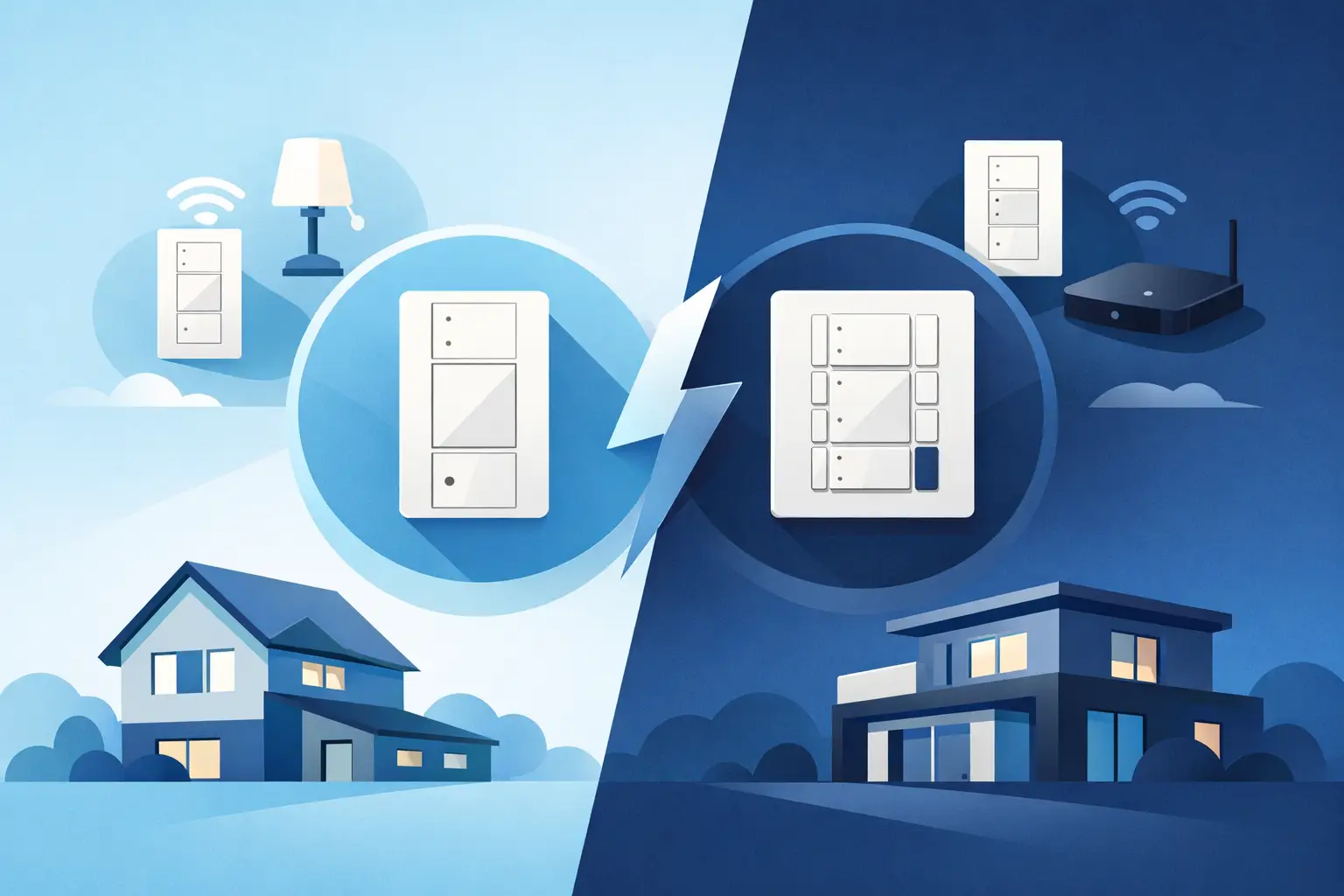
A lighting control decision is easiest when it starts with how a home will feel at 6:30 a.m., during a movie, or when everyone leaves for the weekend. The question of Lutron Caseta versus RA3 is not simply about choosing dimmers. It is about selecting a system that fits the home’s size, the family’s routines, the finish level of the project, and the possibility of future changes.
Both systems offer reliable Lutron lighting control, app access, scheduled events, and simple ways to create a more comfortable home. The difference is in how far each system can go. Caseta is an excellent fit for focused upgrades and many everyday homes. RadioRA 3, often called RA3, is designed for more detailed control across larger and more customized spaces.
Lutron Caseta versus RA3: The Core Difference
Caseta is a flexible, approachable system built around smart dimmers, switches, plug-in controls, Pico remotes, and a Smart Hub. It is especially well suited to retrofit projects, where homeowners want better control without opening walls or making major changes to the home’s electrical infrastructure.
RA3 is a professionally designed lighting control platform intended for homes that need more devices, more rooms, more scene control, and a more tailored user experience. It uses a dedicated processor and supports a broader family of Lutron controls, including elegant keypads that can manage multiple lights, shades, and scenes from one location.
Put simply, Caseta is often the right answer when the goal is to improve specific rooms or solve common frustrations. RA3 is the stronger choice when lighting is being planned as part of the home’s overall design.
When Caseta Makes the Most Sense
Caseta works well when a homeowner wants meaningful convenience without turning a renovation into a full lighting-control project. A kitchen, family room, primary bedroom, or basement remodel can gain scheduled lights, app control, voice control, and convenient scene settings with relatively little disruption.
Its Pico remotes are one of Caseta’s most practical advantages. A Pico can be mounted on a wall, placed by the bed, kept on a coffee table, or used as a handheld remote. That flexibility is valuable in older homes where adding another wall switch may be expensive or impractical.
Caseta is also a smart fit for homeowners who prefer to expand gradually. Start with the main living areas, then add controls to bedrooms, exterior lighting, or a finished lower level later. The experience remains straightforward: familiar wall controls for daily use, with app access available when it is helpful.
That said, Caseta is not always the best fit for a large custom home. As the number of rooms, devices, and control locations grows, a collection of individual dimmers and remotes can begin to feel less intentional than a system designed around room-by-room scenes and keypad control.
Where RA3 Brings More Value
RA3 is built for homes where lighting should feel coordinated rather than pieced together over time. It is particularly well suited to new construction, major renovations, larger residences, and projects with motorized window treatments or many lighting zones.
The most noticeable difference is often the keypad experience. Instead of placing several switches in a prominent location, an RA3 keypad can replace that cluster with labeled buttons for activities such as Entertain, Evening, Goodnight, or Away. One button can set the lighting across several areas to the right levels for that moment.
This is about more than appearance. A well-designed keypad reduces daily friction. Guests do not need instructions for which switch controls which fixture. Homeowners do not need to walk through several rooms at night to adjust the house. The control is clear, consistent, and placed where it makes sense.
RA3 also gives a professional integrator more room to design for the long term. A home may begin with lighting and shades in the main floor, then later add more rooms, outdoor living spaces, or coordinated controls in a theater area. Planning the system correctly from the beginning helps those future additions feel like part of the original home.
Scenes Matter More Than Individual Switches
The best lighting systems do not ask you to think about individual fixtures all day. They support the way a room is used.
For example, a kitchen may need bright, clear lighting for breakfast and meal preparation, softer light for dinner, and a low-level pathway late at night. A media room may need one setting for watching a film, another for cleaning, and another for entertaining. Both Caseta and RA3 can create scenes, but RA3 is generally better suited to homes where these scenes need to work across many rooms and control points.
This is also where motorized shades can make the choice more meaningful. With RA3, lighting and window treatments can be planned as one experience: lower shades and set the room for viewing, or open shades and bring up the appropriate lights in the morning. Caseta can support useful shade control in the right setup, but RA3 offers more design flexibility when treatments are central to the project.
How to Choose Between Caseta and RA3
The right system depends less on the product label and more on the project itself. Caseta is often the practical choice for a finished home with a few problem areas to improve. RA3 is often the better investment when the project involves a substantial renovation, a new build, or a homeowner who wants the controls to look and operate as a unified system.
Consider Caseta if your priorities are straightforward room upgrades, budget-conscious improvements, flexible remote placement, and the ability to build gradually. It is capable, dependable, and a major improvement over ordinary switches in the rooms where it is installed.
Consider RA3 if you want consistent keypad control, coordinated scenes across the home, a cleaner wall appearance, deeper integration with shades, or a platform designed for more extensive customization. It is especially appropriate when lighting plans are being finalized before drywall, cabinetry, and trim decisions are locked in.
There is also an in-between scenario. A homeowner may begin with Caseta because the immediate need is limited, then decide later that the home calls for a more comprehensive solution. That can be a reasonable path, but it is worth discussing the long-term vision early. Choosing RA3 from the start can prevent duplicated labor and mismatched controls in a home that is clearly headed toward a higher level of automation.
Cost Is More Than the Price of a Dimmer
Caseta usually has a lower entry cost because it requires less system infrastructure and can address individual rooms efficiently. For a targeted upgrade, that can make it an excellent value.
RA3 typically requires a larger upfront investment. The added cost reflects system design, programming, a processor, premium keypad options, and the time needed to create a thoughtful control experience. In a custom home or extensive remodel, that investment can be worthwhile because it replaces switch clutter with simple, consistent control and gives the system room to grow.
The more useful question is not which product costs less today. It is whether the system will still fit the home after the renovation is complete, the furniture is in place, and the family has lived with it for several years.
Professional Design Makes Either System Better
Even a well-made lighting platform can be disappointing if controls are placed without considering how people move through the home. The right design considers switch locations, room function, fixture types, dimming compatibility, wall finishes, shade placement, and the moments when simple control matters most.
For builders, this planning can also protect the finish quality of the project. Coordinating lighting controls early helps avoid crowded switch banks, late-stage changes, and visible compromises on carefully designed walls. For homeowners, it means the system feels natural from the first day rather than becoming another technology project to manage.
A lighting system earns its value when it fades into the background and makes everyday routines easier. Whether that points to Caseta or RA3, the best choice is the one that gives your home the right level of comfort now while leaving room for the life you plan to live there.

Comments are closed