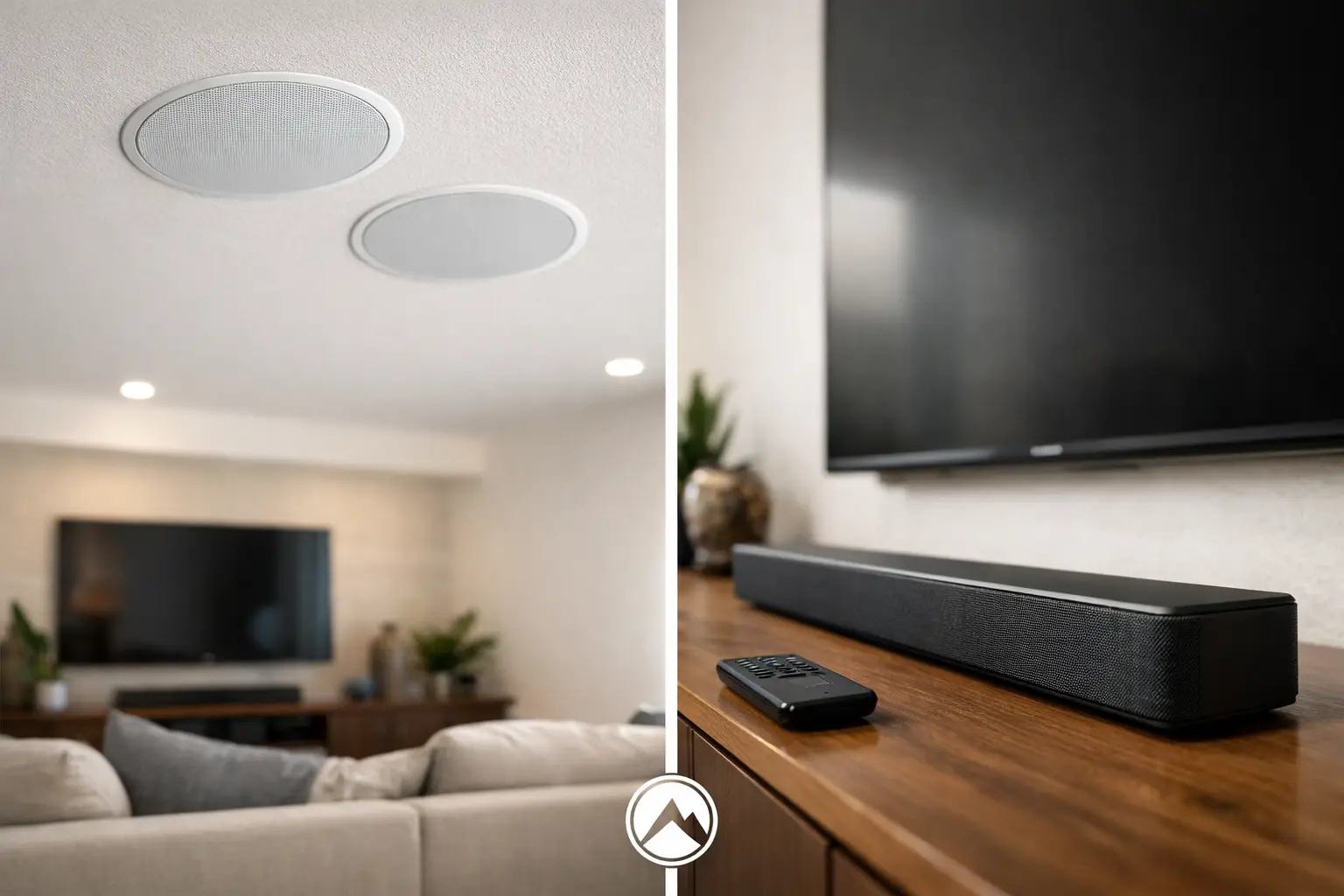
A living room can look finished and still feel slightly off the first time you turn on a movie. The picture is sharp, the furniture is right, but the sound feels thin, boxed in, or disconnected from the room. That is usually when the ceiling speakers vs soundbar question becomes real. It is not just about audio quality. It is about how you want technology to live in your home every day.
For some homeowners, a soundbar is the right answer because it is simple, fast, and effective. For others, ceiling speakers make more sense because they keep the room cleaner and can become part of a larger whole-home audio plan. The better choice depends on what you watch, how the room is used, and how much you care about visible equipment.
Ceiling speakers vs soundbar: the core difference
A soundbar is designed to improve TV audio with minimal effort. It usually sits below the television, plugs in quickly, and gives you a noticeable step up from built-in TV speakers. Many models also pair with a wireless subwoofer or rear speakers for a more immersive effect.
Ceiling speakers take a different approach. They are installed into the ceiling, wired back to an amplifier or audio system, and intended to blend into the space. They can sound excellent, but they are less about quick setup and more about long-term integration. In many homes, they are chosen because they reduce clutter and support a cleaner, more intentional design.
That difference matters. A soundbar is often a product decision. Ceiling speakers are usually a system decision.
When a soundbar makes the most sense
If your main goal is better TV sound without opening walls or planning a larger project, a soundbar is hard to argue against. It gives you clearer dialogue, stronger volume, and more presence than most TVs can manage on their own.
This works especially well in family rooms, bedrooms, apartments, and secondary spaces where convenience matters most. If you stream shows at night, watch sports on weekends, and want a simple remote-friendly setup, a soundbar fits naturally into that routine. It is also a practical option when the room layout may change over time.
There are trade-offs. Even very good soundbars are still limited by placement and cabinet size. They create a wider soundstage than a TV, but they do not disappear visually, and they rarely match the openness of a well-designed speaker system. Some also promise virtual surround effects that can be underwhelming in real rooms with high ceilings, open floor plans, or lots of reflective surfaces.
For many households, though, the value is in the balance. A soundbar can deliver a satisfying result with less complexity, lower upfront cost, and very little disruption.
Where ceiling speakers stand out
Ceiling speakers appeal to homeowners who want the room to stay visually calm. You do not have a bar under the TV, extra cords, or equipment competing with the design of the space. Once installed, the system sits quietly in the background, which is exactly what many people want from home technology.
They also make sense when audio is part of a bigger plan. If you are already considering whole-home audio, a media room refresh, or wiring during a renovation or new build, ceiling speakers can be a very smart move. They fit cleanly into kitchens, great rooms, patios, offices, and other areas where you want music or TV audio without filling shelves or countertops with gear.
The catch is that ceiling speakers are not automatically the best choice for every TV setup. For background music, they are excellent. For television and movies, the result depends heavily on speaker placement, room geometry, equipment selection, and system tuning. Sound coming from overhead can feel less natural if the goal is a cinematic experience with dialogue anchored to the screen.
That is why professional design matters here. In some rooms, ceiling speakers are a clean and effective answer. In others, they are better used as part of distributed audio while the TV gets a different speaker solution.
Sound quality is not just about the speaker
It is tempting to ask which sounds better in a general sense, but that usually leads to the wrong answer. Room shape, ceiling height, flooring, furniture, and even where you sit all affect what you hear.
A quality soundbar in a smaller, enclosed room can outperform a poorly planned ceiling speaker setup. On the other hand, a properly designed in-ceiling system with the right amplification and placement can sound balanced, spacious, and very refined for everyday listening. The point is not that one option always wins. The point is that performance depends on context.
For TV-first spaces, dialogue is often the deciding factor. People want voices to sound clear without turning the volume way up. Soundbars are generally strong here because they are positioned near the screen. Ceiling speakers can still work, but if the sound feels too elevated, the viewing experience may feel less grounded.
For music throughout the home, ceiling speakers often have the edge. They distribute sound more evenly, stay out of sight, and support a more polished whole-home setup.
Design, clutter, and how the room feels
Homeowners often focus on sound, then make the final decision based on appearance. That is reasonable. Audio equipment affects how a room feels, not just how it sounds.
A soundbar is visible by design. In some spaces, that is perfectly fine. It can look clean and minimal, especially under a wall-mounted TV. But in rooms where every detail is carefully considered, even a slim soundbar may feel like another object to manage.
Ceiling speakers are the opposite. They preserve shelf space, keep sightlines open, and support a more architectural look. If your goal is to enjoy entertainment without making technology the center of attention, that can be a major advantage.
This is especially relevant in open-concept homes, renovated living areas, and new construction projects where clients want strong performance without visual noise.
Installation and long-term flexibility
This is where the difference between quick convenience and lasting integration becomes clear.
A soundbar is easier to install and replace. If you change TVs, move furniture, or want to upgrade later, the process is straightforward. That flexibility is part of its appeal.
Ceiling speakers require planning. In a retrofit, that may involve fishing wire, locating joists, patching drywall, and making sure all components work together properly. In new construction or remodeling, the process is much cleaner and more cost-effective because wiring can be built in from the start.
Long term, ceiling speakers can support a more complete system. You may start with one room and later expand into additional zones for music, outdoor listening, or shared control. That is where an integrator can help avoid the common problem of piecing together products that do not communicate well.
If you value simplicity over time, not just on day one, that bigger picture matters.
Ceiling speakers vs soundbar for different rooms
The best answer often changes from room to room.
In a primary living room where the TV is the focus, a soundbar may be the more natural fit if you want strong dialogue and minimal installation. In a kitchen or dining area, ceiling speakers usually make more sense because they provide even sound without using counter or wall space.
In a bedroom, a soundbar is often the easiest option. In a whole-home audio plan, ceiling speakers are usually the cleaner and more scalable choice. In a multi-use great room, the decision may depend on whether the space is used more for casual television or for music and entertaining.
This is why the best systems are designed around lifestyle instead of product trends. What looks good in a box or online does not always translate well into daily use.
So which one should you choose?
Choose a soundbar if you want a simple upgrade, your room is centered around the television, and you prefer lower installation complexity. It is a practical solution that can sound very good when expectations are clear.
Choose ceiling speakers if clean aesthetics matter most, you are planning a broader audio system, or you want technology integrated into the home rather than placed on top of it. Just make sure the design matches the room and the way you actually use it.
For many homes, the smartest answer is not choosing one category for the entire house. It is using each where it performs best. A TV room may benefit from a soundbar, while nearby spaces use ceiling speakers for music and everyday listening. That kind of mix often creates the best balance of performance, appearance, and ease.
If you are weighing the options during a remodel, a new build, or an upgrade to an underperforming setup, it helps to think past the first install. The right audio choice should feel natural six months from now, not just impressive on installation day. When technology fits the room and the routine, you stop thinking about the equipment and simply enjoy being there.


Comments are closed