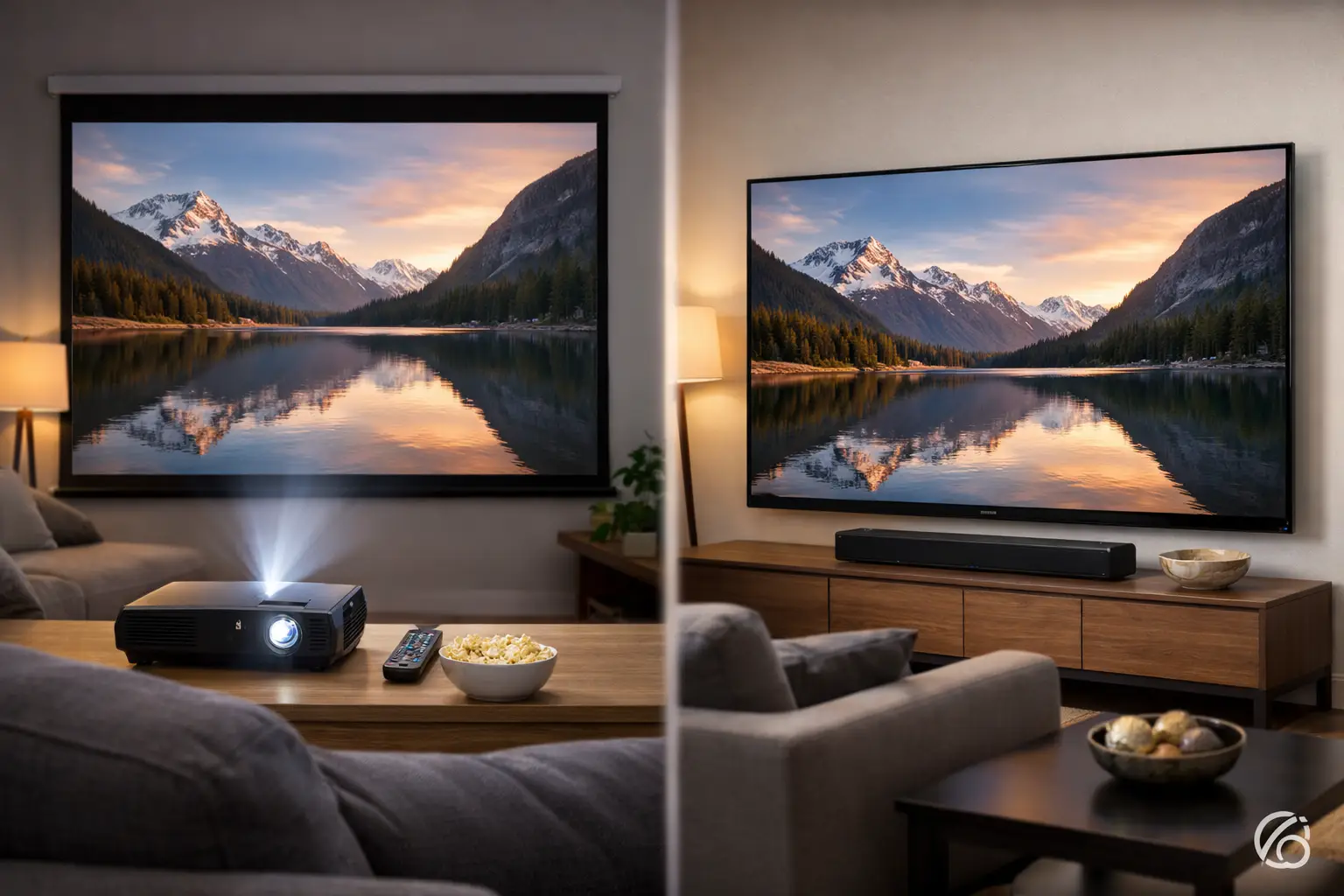
A 100-inch screen sounds exciting until you have to live with it every day. That is where the real projector vs large tv decision starts – not with specs alone, but with how your room works, how you watch, and how much simplicity matters.
For some homes, a projector creates the kind of movie-night experience a television cannot match. For others, a large TV is the better long-term choice because it is brighter, easier to use, and more forgiving in everyday spaces. The right answer depends less on which one is more impressive on paper and more on which one fits your habits without adding frustration.
Projector vs Large TV: The Biggest Difference
The clearest difference is scale versus convenience. A projector gives you access to a much larger image, often at a lower cost per inch. If your goal is a true theater feel, that matters. A 120-inch picture changes how sports, movies, and gaming feel in a room.
A large TV, on the other hand, wins on simplicity. It is bright, sharp, reliable, and ready to perform well in most lighting conditions. You turn it on, and it works. There is no need to think about lamp life, screen material, projector placement, or how much ambient light is creeping in from the windows.
That does not make one automatically better. It means each one solves a different problem.
When a Projector Makes More Sense
A projector is usually the better fit when screen size is the priority and the room can support it. If you have a dedicated media room, basement theater, or a space where lighting can be controlled, a projector can create a more immersive experience than even a very large TV.
That experience is not just about size. A projected image feels different because it is designed to fill your field of view. For movie lovers, that can feel more natural and cinematic. In the right room, it is the closest thing to bringing a theater home.
There is also a design benefit. When the projector and screen are planned well, the system can feel less visually dominant than an oversized TV. Some homeowners prefer a retractable screen or a clean wall instead of a giant black panel that is always visible.
Still, a projector asks more from the room and the system around it. Mounting position matters. Throw distance matters. Screen choice matters. If the installation is not well planned, the result can feel less polished than expected.
Light control changes everything
This is where many projector decisions are won or lost. Projectors look best in darker spaces. Even high-performance models struggle when sunlight or bright ambient light washes out the image.
If your family room has large windows and you watch during the day, a projector may disappoint unless the room includes thoughtful shading and screen selection. That does not mean it cannot work, but it does mean the room itself becomes part of the system.
Projectors are ideal for purpose-built spaces
In a dedicated theater or media room, a projector often delivers the best value for a large-screen experience. It is especially attractive when the room is built around entertainment rather than mixed daily use. In those spaces, you can optimize speaker placement, viewing distance, lighting, and control for a cleaner result.
When a Large TV Is the Better Choice
A large TV is often the better answer for the rooms people use the most. Living rooms, great rooms, family rooms, and multipurpose spaces usually benefit from a display that looks strong in daylight, starts instantly, and needs very little maintenance.
Modern large TVs are excellent. Picture quality is impressive, brightness is strong, and performance is consistent across a wide range of content. For everyday streaming, casual sports watching, news, and gaming, they are hard to beat.
There is also less guesswork. You do not need to fine-tune projection distance or worry about replacing a lamp. Even with premium TVs at larger sizes, the ownership experience is generally more straightforward.
That simplicity matters more than many buyers expect. Technology should support the room, not make the room harder to use.
TVs handle bright spaces better
This is one of the biggest practical advantages. If your room has open windows, overhead lighting, or regular daytime use, a large TV will usually perform better with less effort. You will get more contrast, more brightness, and a more dependable picture across changing conditions.
For households that want one entertainment space to do everything, that consistency can be more valuable than extreme screen size.
TVs are often easier for mixed use
Many homeowners are not building a home theater. They are creating a comfortable room where people watch movies, play games, scroll through streaming apps, and occasionally leave the TV on in the background while cooking or cleaning. In that kind of environment, a large TV usually fits more naturally.
It also tends to integrate well with soundbars, whole-home audio, and clean wall-mounted designs. The result can feel refined without requiring the room to revolve around the display.
Picture Quality, Audio, and Daily Use
If you compare a projector and a large TV side by side in an average room, the TV usually looks brighter and punchier. Blacks often appear deeper, highlights stand out more, and detail holds up better with ambient light.
A projector can still look excellent, especially in a properly designed room. But it needs the right environment to reach that level. This is why spec sheets can be misleading. What looks ideal in a showroom or online review may not translate the same way in a real home.
Audio is another factor that should not be treated as an afterthought. Neither a projector nor a large TV reaches its full potential with weak sound. A good display deserves a sound system that matches it. In a projector-based room, that usually means more intentional speaker planning. With a TV, integration can be simpler, but professional setup still makes a major difference in performance and appearance.
Installation Matters More Than Most People Think
A projector system is rarely just a projector. It may include a screen, ceiling mount, cabling, power relocation, source equipment, control integration, and coordinated lighting or shading. That is one reason professional design matters. A projector can be outstanding, but only when the details are handled well.
A large TV installation can also benefit from planning, especially at bigger sizes. Mounting height, viewing angle, recessed power, hidden wiring, and speaker placement all affect how finished the room feels. A large display should look intentional, not oversized and awkward.
This is especially true in new construction and renovation projects. If you are already opening walls or planning a room layout, it is smart to think beyond the display itself. The right low-voltage planning can make the entire system easier to use and easier to live with.
Budget Is About More Than the Display
People often compare the price of a projector to the price of a large TV and stop there. That can be misleading.
A projector may seem like the better deal because it delivers more inches for the money. But the full system cost can rise once you add the screen, mounting hardware, wiring, audio, and room treatment. If the room needs motorized shades to control glare, that should be part of the conversation too.
A large TV may have a higher display cost at bigger sizes, but the installation path is often simpler. In many cases, the total investment is easier to predict.
That does not mean a projector is the expensive choice or a TV is the bargain choice. It means the value depends on the room, the performance you expect, and how complete you want the final setup to be.
So, Which One Should You Choose?
If you want the biggest, most cinematic image possible and you have a room that can support it, a projector is often the right move. It shines in dedicated entertainment spaces where lighting, seating, and sound can be designed around the experience.
If you want outstanding picture quality with less effort, stronger daytime performance, and easier everyday use, a large TV is usually the smarter fit. It is especially well suited for common living spaces where convenience matters as much as image size.
For many homes, the answer is not projector or TV everywhere. It is choosing the right display for the right room. A large TV may be perfect for the main family space, while a projector makes sense in a basement theater or bonus room. That kind of planning tends to produce better results than forcing one solution into every situation.
A good entertainment system should feel natural the first week and still feel right years later. If you start with how the room is used, not just how the screen looks, the best choice usually becomes much clearer.


Comments are closed