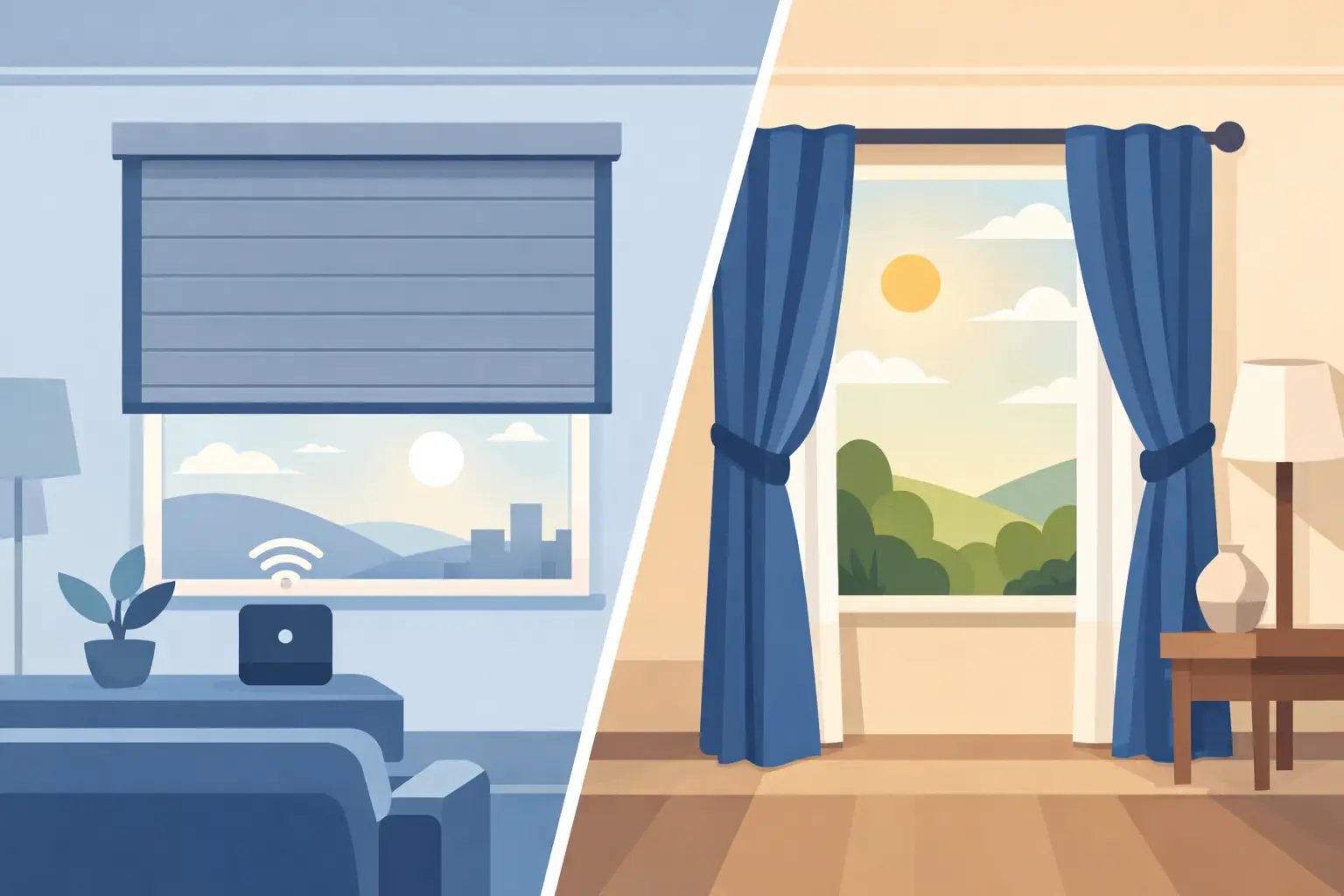
The decision between motorized shades vs curtains often starts with appearance, then quickly becomes a question of how you want your home to feel every morning, afternoon, and evening. A beautiful window treatment should do more than frame a view. It should help manage glare, protect privacy, support comfortable room temperatures, and fit naturally into the way your household lives.
For a new build, renovation, or focused room update, both options can be the right choice. The better fit depends on the room, the windows, your design goals, and how much convenience you want built into the space.
What This Choice Changes Every Day
Curtains bring softness, texture, and visual warmth. They can make a bedroom feel finished, give a living room more presence, and add color or pattern where the room needs it. With the right lining and fabric, they can also reduce light and provide useful privacy.
Motorized shades take a more functional role while still offering a refined look. At the touch of a button, on a wall keypad, or through a scheduled routine, they can raise and lower precisely when needed. That matters on a wall of east-facing windows, in a media room where afternoon glare hits the screen, or in a primary bedroom where early sunlight does not follow a weekend schedule.
The difference is not simply technology versus tradition. It is a choice between a treatment you adjust manually when you remember and one that can respond consistently to the rhythm of your home.
Motorized Shades vs Curtains: Light and Privacy
Precise light control favors shades
Shades are typically the stronger choice when controlling light is the main priority. Roller shades, cellular shades, Roman shades, and sheer shade systems can be selected for the specific amount of light filtering a room needs. Options range from light-filtering fabrics that soften harsh daylight to room-darkening materials that support sleep and movie watching.
Motorization makes that control easier to use. Instead of walking from window to window, you can lower every shade in a room together. If a room has hard-to-reach windows over a stairwell, behind furniture, or above a soaking tub, automation turns an impractical manual task into an everyday convenience.
Curtains can block light very effectively, particularly with blackout lining. Still, small gaps around the sides and top of the panel are common. For bedrooms and other rooms where darkness matters, a room-darkening shade behind decorative drapery often provides a more complete solution.
Both can provide privacy, but timing matters
Curtains offer excellent privacy when closed, but they are usually either open or shut. Motorized shades give homeowners more flexibility. A privacy shade can lower in the evening while still allowing daylight through during the day. In rooms facing neighboring homes or a busy street, scheduled closing times can remove one more small task from the evening routine.
For homes in Northeast Ohio, privacy and light control can change noticeably with the seasons. Bare trees in winter may expose rooms that feel private in summer. A programmed shade schedule can adapt without requiring anyone to make a daily adjustment.
Comfort and Energy Use Depend on Fabric and Fit
Window treatments can support comfort, but the material and installation matter more than the word “motorized.” A quality cellular shade can create an insulating air pocket at the window. Solar shade fabrics can reduce glare and help limit heat from direct sun. Properly fitted blackout shades can also make a room feel more settled at night.
Curtains can contribute as well, especially when they are lined, full enough to cover the window generously, and installed to reduce gaps. Their insulating value varies widely by fabric weight, lining, and how closely the panels sit to the wall.
Motorization adds consistency. Shades that lower during the hottest part of a sunny afternoon or rise to welcome winter daylight are more likely to be used as intended. This is not a promise that window treatments will replace efficient windows or solve every heating and cooling concern. It is a practical way to better manage the conditions at the glass, where much of a room’s discomfort begins.
Design Flexibility Is Not One-Sided
Curtains are hard to beat for decorative impact. They add depth and softness that shades alone may not provide, particularly in formal dining rooms, bedrooms, and living spaces with taller ceilings. Fabric panels also help balance large windows and can make a room feel more layered and intentional.
Motorized shades offer a cleaner architectural look. When raised, many disappear into a fascia, recessed pocket, or compact headrail. This can be especially appealing in contemporary homes, kitchens, offices, and spaces where window trim, views, or clean lines should remain the focus.
The strongest designs often use both. A motorized roller or cellular shade handles glare, privacy, and daily light control. Stationary drapery panels or operable curtains add texture and visual warmth. This approach lets each treatment do the job it does best without asking one product to solve every need.
Cost Includes More Than the Product
Manual curtains generally have a lower entry cost, especially for standard-size windows with ready-made panels and basic rods. Custom drapery can become a significant investment once fabric, lining, hardware, fabrication, and professional installation are included. Large or unusually shaped windows can increase the cost further.
Motorized shades cost more upfront because the system includes the shade, motor, controls, power planning, and installation. Battery-powered options can work well for many retrofit projects. Wired power is often the best fit for new construction, major renovations, or large groups of shades that will operate frequently.
It is helpful to compare total value, not just the initial price. A treatment on a rarely used guest-room window may not need automation. A shade on a high window, in a sun-heavy great room, or across a wide bank of glass may deliver far more value when it is easy to control every day.
For builders, planning motorized shades early can also protect the finished look. Power locations, shade pockets, trim details, and control placement are much easier to coordinate before drywall and finish work are complete. For homeowners updating an existing space, a professional assessment can identify battery, wired, and hybrid approaches that avoid unnecessary disruption.
Installation and Daily Reliability
Curtains are mechanically simple, but the installation still affects how they look and perform. Rod height, panel width, bracket placement, and fabric fullness all influence the result. A curtain that drags, hangs unevenly, or does not cover the window properly can make an otherwise polished room feel unfinished.
Motorized shades require more planning, but a well-designed system should feel uncomplicated after installation. Controls should be intuitive. Motors should move quietly. Shade positions should be set for the way each room is actually used, rather than left as a collection of features nobody remembers to use.
Professional installation is particularly valuable when shades are integrated with lighting routines, whole-home control, or hardwired power. Clean wiring, correct measurements, dependable programming, and support after installation make the difference between a helpful home feature and another device to manage.
When Curtains May Be the Better Choice
Choose curtains when decorative fabric is the main goal, when you enjoy the hands-on ritual of opening and closing panels, or when the window is simple and easy to reach. They are also a sensible choice when the budget is focused on furnishing several rooms at once.
Curtains can be ideal for a formal space that is used occasionally, a bedroom where a heavy blackout drapery is part of the design vision, or a room that needs softness more than automation. There is no need to add motors where they do not make daily life easier.
When Motorized Shades Make More Sense
Motorized shades are especially worthwhile for tall windows, large window walls, media spaces, primary bedrooms, nurseries, and rooms with strong sun exposure. They are also a natural fit for homeowners who want consistent privacy and light control without adding more steps to the day.
They work best when selected around real habits. Think about when the sun becomes uncomfortable, which windows are difficult to reach, and where you would appreciate a room adjusting itself before you walk in. Those answers usually point to the right fabric, control method, and level of automation.
The most satisfying window treatment is the one you will actually use. Whether that means the quiet convenience of motorized shades, the warmth of tailored curtains, or a thoughtful combination of both, start with how you want each room to feel and let the technology stay in the background.


Comments are closed