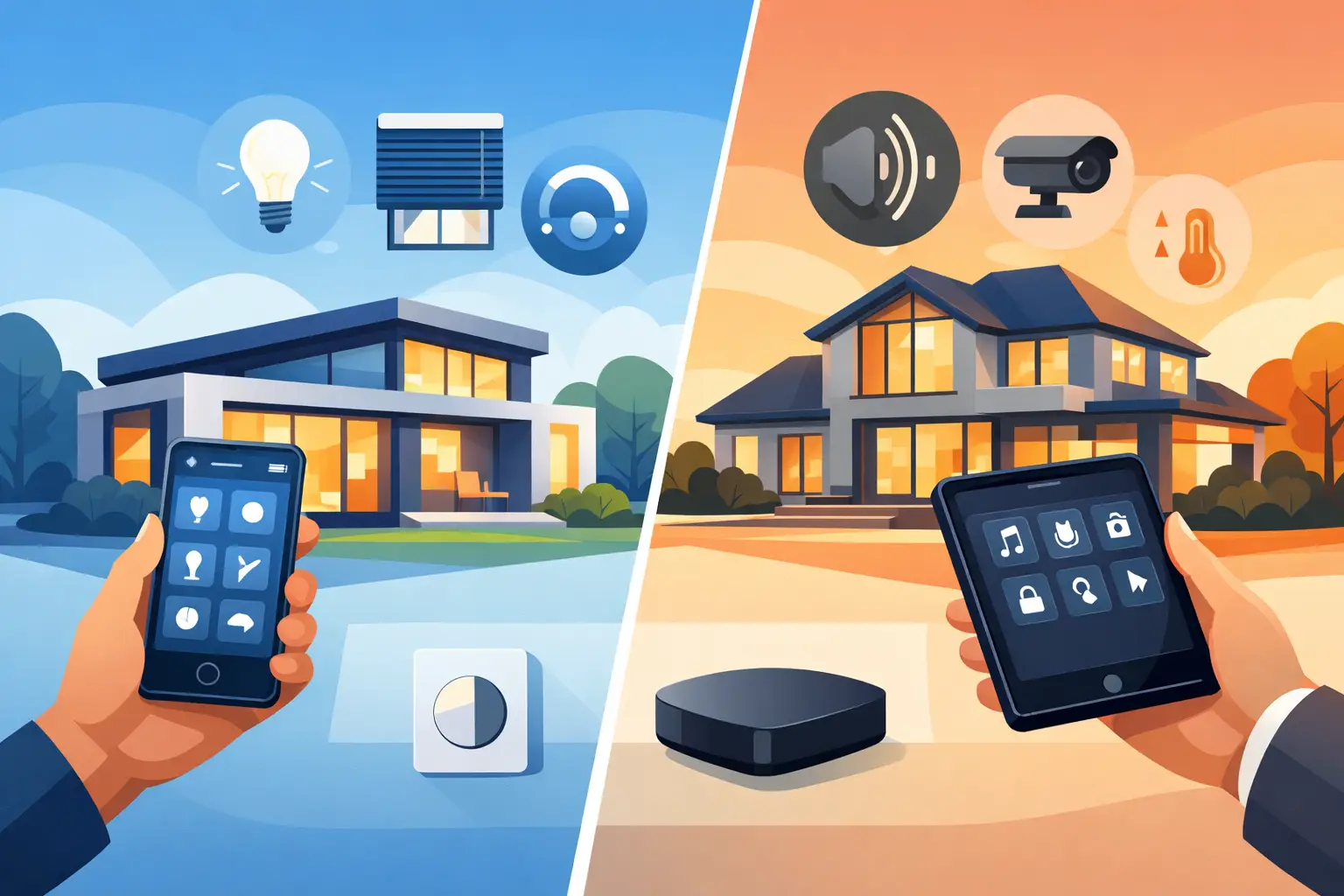
A Lutron vs Savant decision is rarely about choosing the more impressive brand. It is about deciding what should feel easiest in your home every day. Do you want lighting and motorized shades that respond reliably without much thought? Or do you want one polished control experience for entertainment, climate, lighting, and more? Both brands can create a refined home experience, but they are built to lead in different areas.
For a new home, major renovation, or a carefully planned upgrade, the best answer starts with how you live in the space. A professional design can also make the choice less either-or than it first appears.
Lutron vs Savant: Different Jobs, Different Strengths
Lutron is best known for lighting control and motorized window treatments. Its systems are designed around a simple but meaningful idea: the right light at the right time makes a home more comfortable, more useful, and easier to enjoy. From a bedside keypad to an evening scene that adjusts several rooms at once, Lutron makes everyday lighting feel intentional.
Savant is a broader smart home control platform. It brings multiple systems into one interface, including entertainment, climate, lighting, shades, and whole-home audio. Savant is especially appealing to homeowners who want an elegant app, a dedicated remote, or a wall-mounted control point that can manage several technologies without moving between separate apps.
That distinction matters. Lutron can be the foundation for a beautifully lit home, while Savant can serve as the coordinator for a larger connected-home experience. Comparing them only feature by feature can miss the real question: which system needs to be dependable with the least effort from the people living there?
Where Lutron Excels
Lutron has earned its reputation by focusing deeply on the lighting experience. Its controls are intuitive, whether you prefer familiar wall keypads, handheld remotes, scheduled scenes, or app-based adjustments. The physical controls are a major advantage for many households. A guest, child, or visiting family member can usually understand a clearly labeled button faster than a phone app.
Lighting that supports daily routines
Lighting scenes are where Lutron becomes more than a dimmer. One button can set the kitchen for cooking, soften the family room for a movie, or turn off selected areas before bed. Scheduled adjustments can help a house feel welcoming in the morning and settled in the evening without requiring constant manual changes.
The value is not in having more settings. It is in reducing small decisions. When common actions are easy and consistent, the system disappears into the routine.
Motorized shades with a refined feel
Lutron shades are a strong fit for rooms with large windows, hard-to-reach treatments, changing sun exposure, or a desire for more privacy at certain times of day. They can be grouped with lighting scenes so a room adjusts as one environment rather than as several unrelated devices.
This is particularly useful in open-concept homes, primary suites, and media spaces. The fabric, style, mounting approach, and wiring plan all matter, so shades should be considered early in a build or renovation whenever possible.
Reliability and design flexibility
Lutron offers options for both wired and wireless projects. That makes it practical for new construction as well as many finished homes where opening walls is undesirable. The right product family depends on the size of the project, the number of loads and shades, the desired keypad style, and future expansion plans.
Lutron is often the better starting point when lighting and shades are the priority. It can also stand on its own very well. A homeowner does not need a large entertainment system or a house full of connected devices to appreciate thoughtful lighting control.
Where Savant Excels
Savant is designed for homeowners who want one place to manage multiple parts of the home. Its strength is the experience of bringing systems together in a consistent, attractive interface. Instead of using a separate remote for the television, another app for music, and another for lighting, Savant can organize common actions around how a room is used.
Entertainment and whole-home audio
Savant is especially compelling in homes with several televisions, distributed music, dedicated theater spaces, or a mix of streaming and traditional sources. A tailored control screen or remote can make it simple to turn on a room, choose a source, adjust volume, and set the atmosphere without explaining a stack of remotes to every guest.
For families, the goal is not to add more menus. It is to make “watch TV,” “play music,” or “movie night” a clear, repeatable action. Good programming and clean equipment installation make a meaningful difference here.
One interface for a broader connected home
Savant can also coordinate lighting, shades, climate, and other compatible devices. That gives it an advantage when the homeowner wants broader control from a single app or touch interface. It is a strong choice for people who value personalization and want their most-used actions presented clearly.
The trade-off is that a broader platform needs thoughtful design. The quality of the final experience depends on the equipment selected, the network underneath it, and the way the controls are programmed. A crowded interface can make a capable system feel complicated, while a well-designed one makes advanced technology feel natural.
Lutron vs Savant in Everyday Use
The daily experience is often where the decision becomes clear. Lutron tends to feel immediate and direct. You walk into a room, press a keypad button, and the lighting changes. You can schedule shades or adjust them from an app, but the core experience remains simple and tactile.
Savant tends to feel more centralized. You may use a premium remote to start a show, select music in the kitchen, adjust the room lighting, and lower shades from one familiar control environment. It is a better fit when several technologies need to work together around a specific activity.
Neither approach is automatically better. A homeowner who mainly wants consistent lighting and shades may find a full smart home control platform unnecessary. A household with multiple media zones and a desire for unified control may find Lutron alone too narrow, even though it handles lighting exceptionally well.
The Best Answer May Be Lutron and Savant
Many premium homes use both systems. Lutron handles lighting and shades, where its dedicated hardware and controls shine. Savant becomes the larger control layer, presenting Lutron scenes alongside entertainment, audio, and climate functions.
This pairing can offer the best of both approaches, but only when it serves a real need. Adding a second platform simply because it is available can create unnecessary cost and complexity. The right design should preserve direct, dependable control for essential daily functions while offering broader coordination where it adds value.
For example, a “Good Night” command might turn off selected lights, lower bedroom shades, and adjust the home for the evening. Yet the kitchen lighting should still work immediately from the wall keypad if the app is unavailable or someone does not want to use it. That balance is what makes a connected home comfortable rather than fussy.
What to Consider Before Choosing
Start with the rooms and routines that matter most. If natural light, lighting scenes, and window treatments are central to the project, Lutron deserves close consideration from the beginning. If the priority is bringing television, music, lighting, and climate into one thoughtful control experience, Savant may be the better lead platform.
Budget also matters, but it should be evaluated over the life of the system rather than by comparing device prices alone. Professional installation, proper wiring, strong Wi-Fi coverage, organized equipment, programming, and future service all shape whether the system remains enjoyable years later. A less expensive collection of disconnected products can become frustrating if it is difficult to support or upgrade.
New construction offers the greatest flexibility because wiring paths, equipment locations, keypad placement, and shade power can be planned before walls are closed. Retrofit projects need a different strategy, often blending wireless controls with carefully selected wired infrastructure where it has the most impact.
At Tri-County Technology, the most useful first step is not choosing a logo. It is identifying the moments you want technology to simplify – arriving home, hosting friends, settling in for a movie, waking up, or managing a busy household. A well-planned system should make those moments feel calmer, clearer, and easier from the first day you use it.


Comments are closed