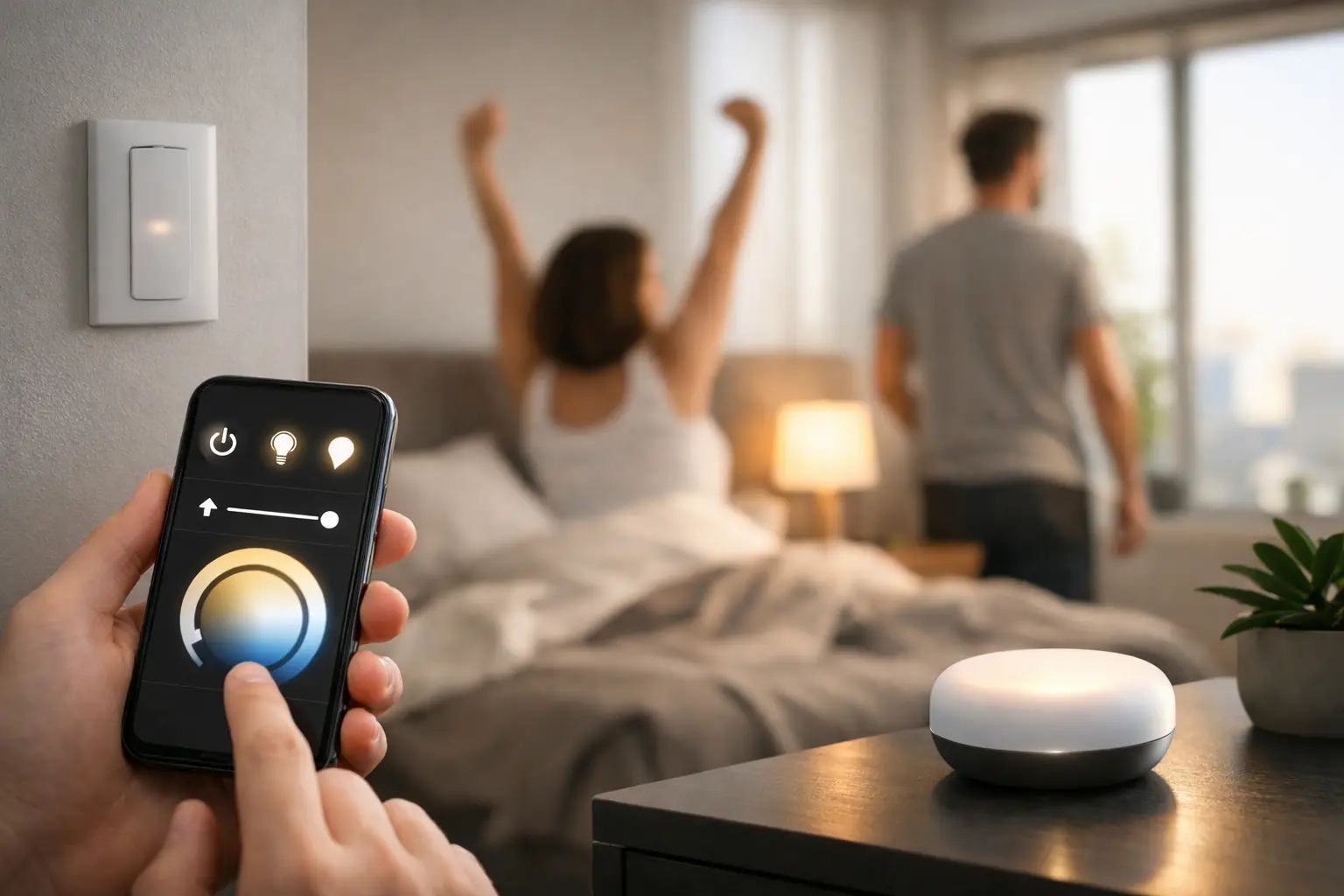
Your lights already follow your habits, just not very well. Someone turns on the kitchen lights before coffee, dims the family room after dinner, checks the hallway before bed, and leaves a few lamps on when the house is empty because it feels safer that way. Lighting automation for daily routines takes those small, repeated actions and makes them consistent, comfortable, and easier to live with.
This is where smart lighting becomes genuinely useful. Not as a novelty, and not as a pile of apps and settings, but as part of how your home supports your day. The best systems feel quiet in the background. You notice the comfort, the convenience, and the fact that you are not thinking about switches nearly as often.
What lighting automation for daily routines really means
At its core, lighting automation is simple. Your lights respond to time, occupancy, natural light levels, or a button press that activates a scene. Instead of controlling one fixture at a time, you shape an environment around what is happening in the moment.
A good morning routine is a clear example. Rather than walking room to room, a schedule can bring up soft kitchen and hallway lighting before the household is fully moving. In the evening, common areas can shift to warmer, lower light that feels calmer and more appropriate for winding down. At bedtime, one command can turn off the main living areas while keeping a path lit to bedrooms and bathrooms.
That sounds straightforward because it should be. The goal is not to add complexity. The goal is to reduce it.
Why daily routines are the best place to start
Many homeowners assume they need to automate the entire house at once for it to be worthwhile. In reality, the best starting point is often the set of routines you repeat every day. Those routines reveal where lighting matters most.
Morning, evening, entertaining, arriving home, leaving the house, and overnight safety are usually the highest-value moments. If those scenes are handled well, the whole system feels helpful immediately. You are not learning a new lifestyle. You are refining the one you already have.
This is also where professionally designed systems stand apart from one-off gadgets. A few smart bulbs can solve a very small problem. Daily routine lighting usually needs a broader plan, especially if you want keypads, reliable dimming, coordinated rooms, and controls that everyone in the home can understand without explanation.
The routines that make the biggest difference
Morning starts without harsh light
One of the most common mistakes in smart lighting is making everything too bright, too early. A better morning scene layers light gradually. Kitchen pendants might come on at a lower level first, with under-cabinet or breakfast-area lighting supporting the space instead of overwhelming it. Hallways and bathrooms can brighten appropriately as people move through the house.
If your schedule changes from weekday to weekend, that can be built in. A household with school-age kids may want a more structured weekday routine, while a retired couple may prefer occupancy-based lighting that responds more flexibly. There is no single right setup. It depends on the home and the pace of life inside it.
Evenings feel calmer and more comfortable
At the end of the day, bright overhead lighting often works against the mood most people want. Evening scenes can lower intensity, warm the feel of a room, and emphasize the spaces where people actually gather. Living rooms, kitchens, and dining areas benefit from a softer balance that supports conversation, reading, or watching a movie without feeling gloomy.
This is also where window treatments and lighting can complement each other. As daylight fades, lights can come on gradually rather than all at once. The transition feels more natural, and the house remains comfortable without anyone having to chase darkness from room to room.
Leaving home is simpler
A leave-home scene is one of the most practical uses of automation. With a single button press or scheduled event, indoor lights turn off, selected exterior lights adjust, and the house shifts into an energy-conscious mode.
For some families, this is mostly about convenience. For others, it is about peace of mind. If you have ever left the driveway wondering whether lights were left on upstairs, you already understand the value. Remote access can also help when plans change and you want to check or adjust lighting from your phone.
Arriving home feels safer
Exterior entry lighting, garage-adjacent pathways, and key interior areas can respond to expected arrival times, sunset, or motion. That means no dark approach to the front door and no fumbling for switches with groceries in hand.
The same principle works well for small businesses, too. Opening and closing routines are often repetitive and easy to automate. The important part is designing those routines around actual use instead of adding features for their own sake.
Nighttime movement becomes easier
Overnight lighting is often overlooked until someone stumbles through a dark hallway. Soft pathway lighting in hallways, bathrooms, or stair areas can activate at a low level, enough for visibility without fully waking the household.
This is especially useful in homes with children, aging family members, or guests unfamiliar with the layout. It is a small change, but one that improves comfort and confidence every night.
Good automation depends on good design
The promise of smart lighting is appealing, but performance depends on how the system is planned and installed. This is where many homeowners get frustrated with DIY setups. Devices may work individually yet feel inconsistent as a system. Dimming may be uneven. Controls may become confusing. Family members may avoid using the system because it does not behave the same way every time.
A well-designed lighting control setup starts with how people live in the space. Which lights should work together? Where do scenes make more sense than individual switches? Which schedules should be fixed, and which should respond to occupancy or daylight? These questions matter more than the app interface or the latest feature.
There are also practical trade-offs. Motion-based automation is useful, but in some rooms it can become annoying if lights turn off too quickly. Schedules are dependable, but they need to reflect real life rather than an idealized routine. Voice control can be convenient, but wall controls still matter because they are fast, visible, and easy for everyone to use.
Where homeowners often overdo it
More automation is not always better automation. One common mistake is trying to automate every room in the same way. Bathrooms, kitchens, bedrooms, hallways, and outdoor spaces all serve different purposes. A thoughtful system respects those differences.
Another issue is overcomplicating scenes. If a keypad has too many options, most people stop using it. If an app requires too much attention, the technology starts asking for more than it gives back. The best results usually come from a short set of scenes that match daily life clearly: morning, evening, entertain, away, and bedtime are often enough.
This is one reason homeowners in Northeast Ohio often benefit from a guided design process. Seasonal daylight changes are significant, and what feels right in January may need a different schedule in July. Systems should be easy to refine over time, not locked into one static idea of how the home operates.
What to expect from a professionally installed system
A professionally installed lighting automation system should feel intuitive on day one and dependable over the long term. That means clean controls, predictable performance, and a setup that works for the whole household rather than just the most tech-comfortable person in it.
It should also account for the home itself. New construction offers more flexibility, but retrofit projects can still deliver excellent results when the design is realistic about existing wiring, room use, and budget priorities. The right approach is not always the biggest one. Sometimes the smartest move is to automate the rooms and routines that create the most daily benefit first, then expand later if it makes sense.
At Tri-County Technology, that kind of planning is what keeps lighting control practical instead of frustrating. The technology should support the rhythm of the home quietly, with controls that make sense and performance you do not have to second-guess.
If you are considering lighting automation for daily routines, start by paying attention to the moments that repeat. The first lights on in the morning, the path you take at night, the rooms that always seem too bright or too dark, the switches everyone uses over and over. Those patterns tell you where better lighting will matter most, and they usually point to a home that feels easier from the very first day.


Comments are closed