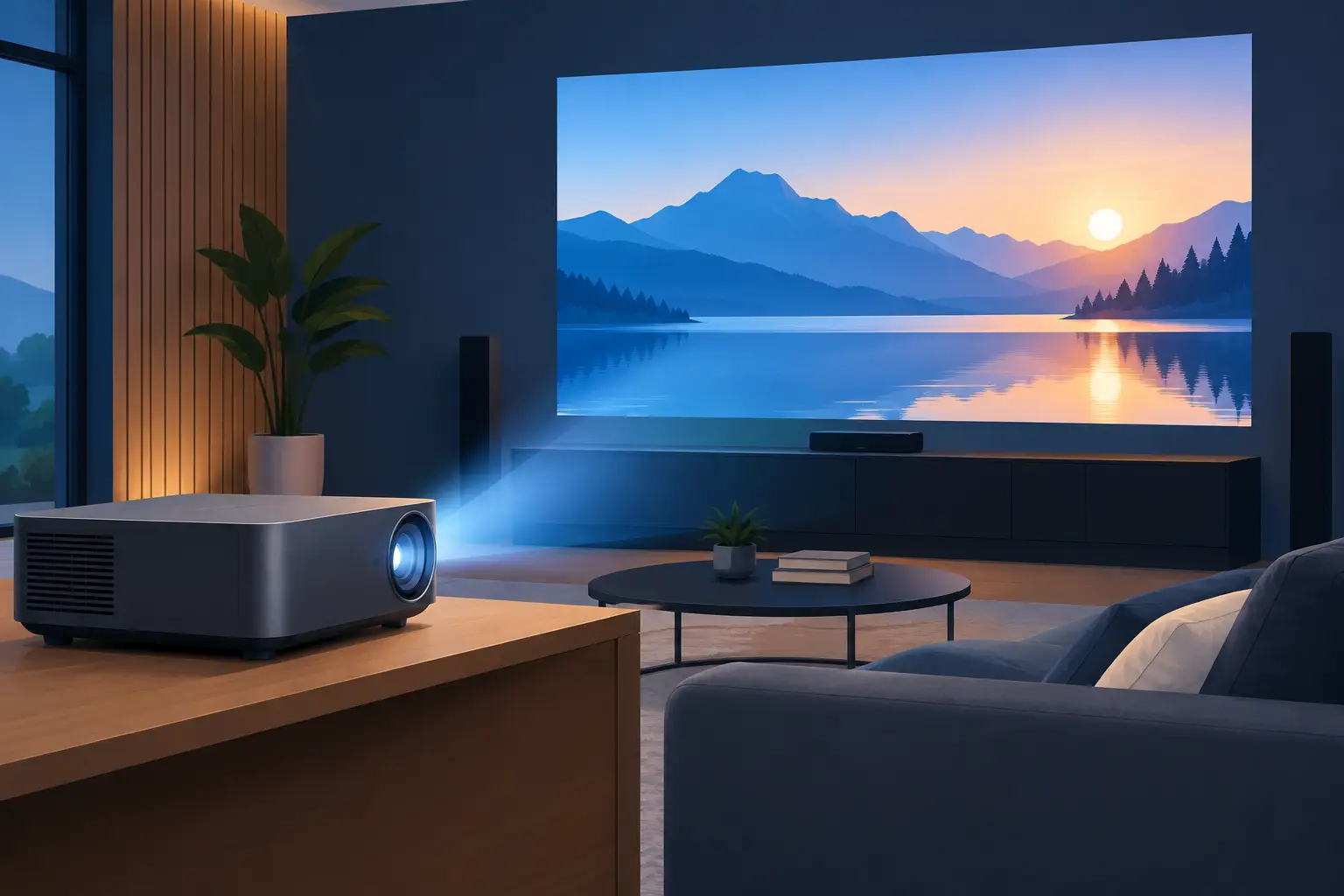
A laser projector review should answer more than whether a picture looks impressive in a dark showroom. The better question is whether that projector will look consistently good in your room, work naturally with the equipment you use, and remain easy to enjoy long after installation day. For a dedicated theater, a media room, or a multipurpose family space, laser projection can deliver a remarkably large, cinematic image. The right result depends on matching the projector to the room rather than choosing from a specification sheet alone.
Why laser projection has become the preferred option
Traditional lamp-based projectors can produce a beautiful image, but their lamps gradually dim and eventually need replacement. Laser light sources are designed for much longer operating life, with steadier brightness over time and no lamp-change routine to manage. That makes them an appealing fit for homeowners who want theater-quality viewing without adding another maintenance task to the household list.
Laser projectors also start quickly, run more quietly than many older designs, and are available in a broad range of brightness levels. They can work beautifully for movies, sports, streaming, and gaming. Still, the word “laser” is not a guarantee of a better image in every setting. Contrast performance, lens quality, processing, screen material, and room light control have as much influence on the final experience as the light source itself.
Laser projector review: the details worth comparing
The most useful comparisons begin with the viewing environment. A projector that looks outstanding in a fully darkened theater may appear washed out in an open living room with large windows. Likewise, an ultra-short-throw projector placed inches from the wall solves a placement challenge, but it brings different screen and furniture requirements than a traditional ceiling-mounted model.
Brightness is about the room, not just the number
Brightness is usually listed in ANSI lumens. Higher output helps a projector compete with ambient light, but more lumens are not automatically better. Excessive brightness in a dark, smaller room can make dark scenes look gray and fatiguing. A more balanced model may create a richer, more natural image when the lights are down.
For a dedicated theater with controlled lighting, the priority is often contrast and black-level performance rather than maximum output. In a family room used throughout the day, additional brightness becomes more valuable. Window treatments, lighting zones, wall color, and the size of the projected image should all be considered before choosing a brightness range.
The screen size matters more than many buyers expect. Spreading the same light across a 150-inch image produces a dimmer result than using it on a 100-inch screen. Bigger is exciting, but a screen that is too large for the room or the projector can make movies less satisfying rather than more immersive.
Resolution and processing affect everyday viewing
Native 4K projectors display the full 4K image without shifting pixels. Pixel-shifting 4K models use fast optical processing to create a highly detailed picture at a lower price point. Both can look excellent from normal seating distances. For many homes, the differences are less noticeable than good calibration, an appropriate screen, and proper viewing distance.
Look beyond the resolution label to how the projector handles motion, upscaling, and high dynamic range content. Sports viewers may value clean motion and brightness. Movie enthusiasts tend to notice shadow detail, accurate color, and the way a projector handles darker scenes. Gamers should also check input lag, which measures how quickly a controller action appears on screen.
A projector’s settings should be accessible without turning movie night into a technical project. A well-designed system can use a single control interface to lower the lights, start the source, and select the right viewing mode. Technology should support the experience quietly, not ask for attention every time someone wants to watch a film.
Color accuracy is more useful than exaggerated color
Some projectors promote exceptionally wide color capability, and that can be meaningful with well-mastered 4K content. But oversaturated color is not the same as accurate color. Skin tones, natural landscapes, and subtle detail in a film benefit from careful calibration.
This is one area where professional setup makes a visible difference. Out-of-the-box modes are often built to look striking under retail lighting, not to reproduce a movie as intended in a finished home. Calibration adjusts the image for the actual screen, room surfaces, and light conditions. The goal is not a picture that calls attention to itself. It is a picture that feels convincing and comfortable for a full-length movie.
The screen is part of the projector system
A wall is rarely an ideal projection surface. Even a smooth, light-colored wall can introduce texture, uneven color, and reflected light that weakens contrast. A dedicated screen provides a more controlled image and gives the installation a finished appearance.
Screen material should be selected with the projector and room in mind. A standard white screen is often an excellent choice in a darkened theater. A gray or ambient-light-rejecting material may help in brighter rooms, though it can have narrower viewing angles and costs more. These screens are especially common with ultra-short-throw projectors, which need materials designed to accept light arriving from below while rejecting light from overhead fixtures and windows.
Motorized screens are useful when the projector shares a room with everyday living. The screen can disappear when it is not needed, preserving the room’s design without asking the homeowner to set up equipment each time. In a new build or renovation, planning the screen housing, power, and low-voltage wiring early creates a much cleaner result.
Placement changes the experience
Traditional projectors are commonly mounted at the rear of the room or in a ceiling location. This approach keeps equipment out of sight and allows broad screen-size flexibility, but it requires thoughtful planning for mounting, power, cabling, ventilation, and service access. Lens shift is particularly valuable because it lets the installer position the image precisely without relying heavily on digital correction.
Ultra-short-throw projectors sit near the screen, usually on a console. They are a strong option where ceiling mounting is not practical or where a homeowner prefers a simpler physical installation. The trade-off is that alignment is more sensitive, the furniture must be stable, and the projector remains visible in the room. It may also be harder to integrate speakers cleanly without planning the cabinet or screen arrangement around them.
Throw distance, projector height, and seating location should be confirmed before drywall is closed when possible. Retrofitting is certainly possible, but early planning reduces visible wires, last-minute compromises, and unnecessary construction work.
Do not separate picture quality from sound
A large projected image with weak or poorly placed sound never feels complete. Built-in projector speakers can be useful for casual use, especially with portable models, but they are not a substitute for a properly designed audio system in a theater setting.
Speaker placement, room acoustics, and source components should be considered alongside the projector. A thoughtful system makes dialogue easy to understand, gives music and effects appropriate scale, and keeps the room from feeling cluttered with equipment. The controls should remain simple whether the household is watching a game, streaming a show, or hosting a movie night.
Who benefits most from a laser projector?
Laser projection makes the most sense for people who value a screen size a television cannot practically provide. It is particularly effective in dedicated theaters, finished basements, bonus rooms, and larger media spaces where the viewing environment can be controlled. It can also be a good fit for an open living area, provided the system is designed around daylight, screen material, and furniture layout.
A premium television may be the stronger choice for a bright room where watching happens mostly during the day and the desired screen size is under about 100 inches. A projector earns its place when scale, shared viewing, and a more cinematic feel are the priorities.
For homeowners in Northeast Ohio planning a new home, renovation, or media-room upgrade, Tri-County Technology can help translate those priorities into a system that looks clean, performs reliably, and stays easy to use. The best projector is not simply the brightest or most expensive model. It is the one that fits the room, the way you watch, and the comfort you want when the lights go down.


No responses yet