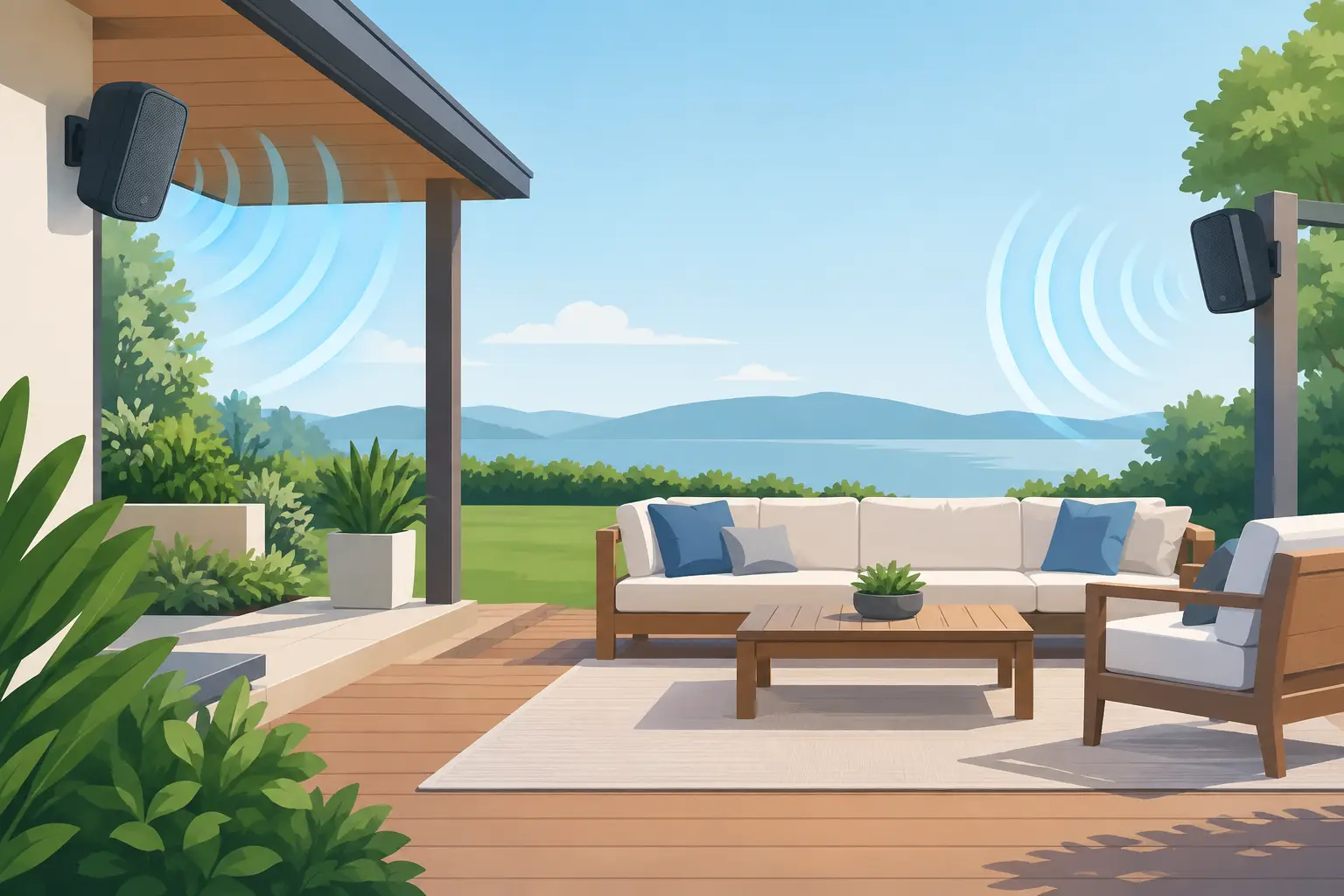
A patio can have beautiful furniture, thoughtful lighting, and a great view, yet still feel unfinished if music only sounds good in one chair. Knowing how to position outdoor speakers changes that experience. The goal is not to make the yard louder. It is to create comfortable, even sound where people actually gather, without forcing the volume up or sending every song toward the neighbors.
Outdoor audio works differently than audio inside a room. Walls, ceilings, and furnishings help contain and reflect sound indoors. Outside, sound disperses quickly, wind affects what you hear, and open areas can create dramatic shifts between quiet and overly loud spots. A well-designed speaker layout accounts for those realities before a single speaker is mounted.
Start With the Listening Areas, Not the House
The most common mistake is placing outdoor speakers wherever mounting is easiest, usually high on the back wall of the home. That approach may cover a small deck, but it often leaves the far side of the patio weak and encourages people to turn up the volume. The result is uneven sound and more audio reaching beyond the property.
Instead, identify the places where people spend time. This may include a covered porch, dining table, outdoor kitchen, fire pit, pool seating, or garden path. Treat each space as a listening zone with its own purpose. A dining area benefits from low, even background music that supports conversation. A pool area may need broader coverage, while a fire pit often calls for a more intimate sound field.
Once the activity areas are clear, speaker locations can be planned around the audience rather than the building. This is especially valuable in larger yards, where one pair of speakers mounted at the house is rarely the best answer.
How to Position Outdoor Speakers for Even Coverage
Outdoor speakers should generally face into the entertaining area, not straight out toward the property line. Aim them toward the center of the seating or activity zone, with a slight downward angle when they are wall-mounted. This directs more of the sound toward listeners and less toward open air.
For a typical covered patio, a pair of speakers placed at opposite sides of the space can work well. Positioning them too far apart, however, creates a hole in the middle. Positioning them too close together concentrates the sound in one location. The right spacing depends on speaker dispersion, mounting height, patio dimensions, and how close guests sit to the speakers.
A useful design principle is to use more speakers at a lower volume rather than fewer speakers pushed harder. Distributed audio produces a gentler, more consistent listening experience. Guests can move from the grill to the table without leaving the music behind, and the system does not need to work as hard to reach the far corners of the yard.
Avoid pointing two speakers directly at one another across a narrow space. Their coverage can overlap in ways that make certain frequencies sound uneven. Instead, angle each speaker across the listening area so coverage overlaps modestly, not aggressively. This is one reason a professional on-site assessment matters. The speaker’s actual coverage pattern is just as important as its physical location.
Mounting Height Changes the Experience
Mounting speakers too high is a common compromise that reduces sound quality. When speakers are placed near a second-story roofline to cover a ground-level patio, the music may feel distant and lack detail. Raising the volume usually does not solve the problem. It simply makes the system louder in every direction.
For wall-mounted speakers, a height roughly 7 to 10 feet above the finished floor is often a practical range for patios and porches. This gives people clearance while keeping the speakers close enough to the listening area. Aim them down toward the space rather than parallel to the ground.
Landscape speakers offer a different approach. They are installed lower in the yard, often tucked into planting beds or near hardscape edges, and aimed across the lawn or gathering space. Because the sound starts closer to the listener, landscape systems can provide excellent coverage at lower volume. They are particularly effective for gardens, pool decks, and larger outdoor living areas where wall-mounted speakers would feel too distant.
The exact placement still depends on sight lines, landscaping plans, irrigation, foot traffic, and future maintenance. Speakers should blend into the environment without being hidden behind dense shrubs that can block or muffle the sound.
Plan for Conversations and Quiet Property Lines
The best outdoor audio is present without taking over the evening. That requires careful attention to volume and direction, especially in neighborhoods where homes sit close together.
Aim speakers inward toward the home or toward the center of the yard whenever possible. If the patio sits near a property edge, avoid mounting speakers on that side facing outward. A speaker located closer to listeners can run at a lower level than one trying to project across the entire yard, which helps keep sound contained.
Hard surfaces also matter. Brick walls, stone fireplaces, glass doors, concrete, and pool decking can reflect sound. These surfaces can make an area feel louder than expected, particularly when speakers are mounted nearby. Soft furnishings, outdoor rugs, and landscaping can soften the environment slightly, but placement and calibration do the real work.
Before finalizing a layout, consider these four questions:
- Where will people sit, stand, and move during normal use?
- Which direction offers the best inward-facing speaker angle?
- Are there nearby bedrooms, adjacent homes, or quiet spaces to respect?
- Will the system sound balanced at a relaxed conversation level?
Those answers often reveal that one powerful pair of speakers is not the right solution. Smaller, strategically placed speakers usually produce a more polished result.
Match the Speaker Type to the Outdoor Space
A covered porch, open patio, pool area, and large garden do not need the same kind of speaker. Surface-mounted models are often a strong fit for a roofed patio or pergola where clean mounting points already exist. They can be aimed precisely and remain visually discreet when selected in a finish that complements the architecture.
Landscape speaker systems are better suited to broad, open spaces. Satellite speakers can be distributed throughout planting areas, while an outdoor-rated subwoofer can add depth without overwhelming the space. The benefit is not simply more bass. It is fuller sound at moderate volume, so music remains enjoyable across the yard.
Rock-style speakers can be useful in select landscapes, but placement should still support the listening plan. Hiding speakers does not help if they are all clustered at the edge of the property or buried behind plants. Appearance and performance need to work together.
For new construction and major renovations, speaker wiring should be considered early. Running low-voltage cable before hardscaping, finished ceilings, or mature landscaping is in place creates cleaner options and reduces future disruption. Retrofit projects can also achieve excellent results, but they require more careful planning around existing finishes and utilities.
Do Not Forget the Source, Controls, and Weather
Speaker location is only part of a dependable outdoor audio system. The amplifier needs enough power for the number and type of speakers installed, with room for clean performance at normal listening levels. Underpowered systems are often turned up too far, which can make music sound strained.
Control should feel simple. Homeowners should be able to select music, adjust the patio volume, or turn the system off without hunting through complicated menus. If indoor and outdoor audio are part of the same system, independent volume control keeps one area from dictating the experience everywhere else.
Ohio weather also deserves attention. Outdoor-rated equipment, proper mounting hardware, protected connections, and thoughtful cable routing all support long-term reliability through heat, rain, snow, and seasonal changes. Weather resistance is not a substitute for proper installation. Water should have a path away from connectors, and speakers should not be placed where sprinklers spray them directly day after day.
Test the Layout Before Calling It Finished
Even a well-planned design benefits from real-world listening. Walk the patio, sit at the dining table, stand by the grill, and move toward the edges of the yard. Listen at the volume you would use for a typical afternoon or evening, not at a level chosen to impress for thirty seconds.
Pay attention to whether vocals remain clear, whether one seat feels noticeably louder than another, and whether music is still audible without becoming intrusive at the edge of the property. Small adjustments to aim, level, and zone settings can make a meaningful difference.
A thoughtful outdoor audio system should disappear into the rhythm of the space. When the speakers are positioned well, guests notice the atmosphere first, and the technology simply makes the time outside more enjoyable.


No responses yet