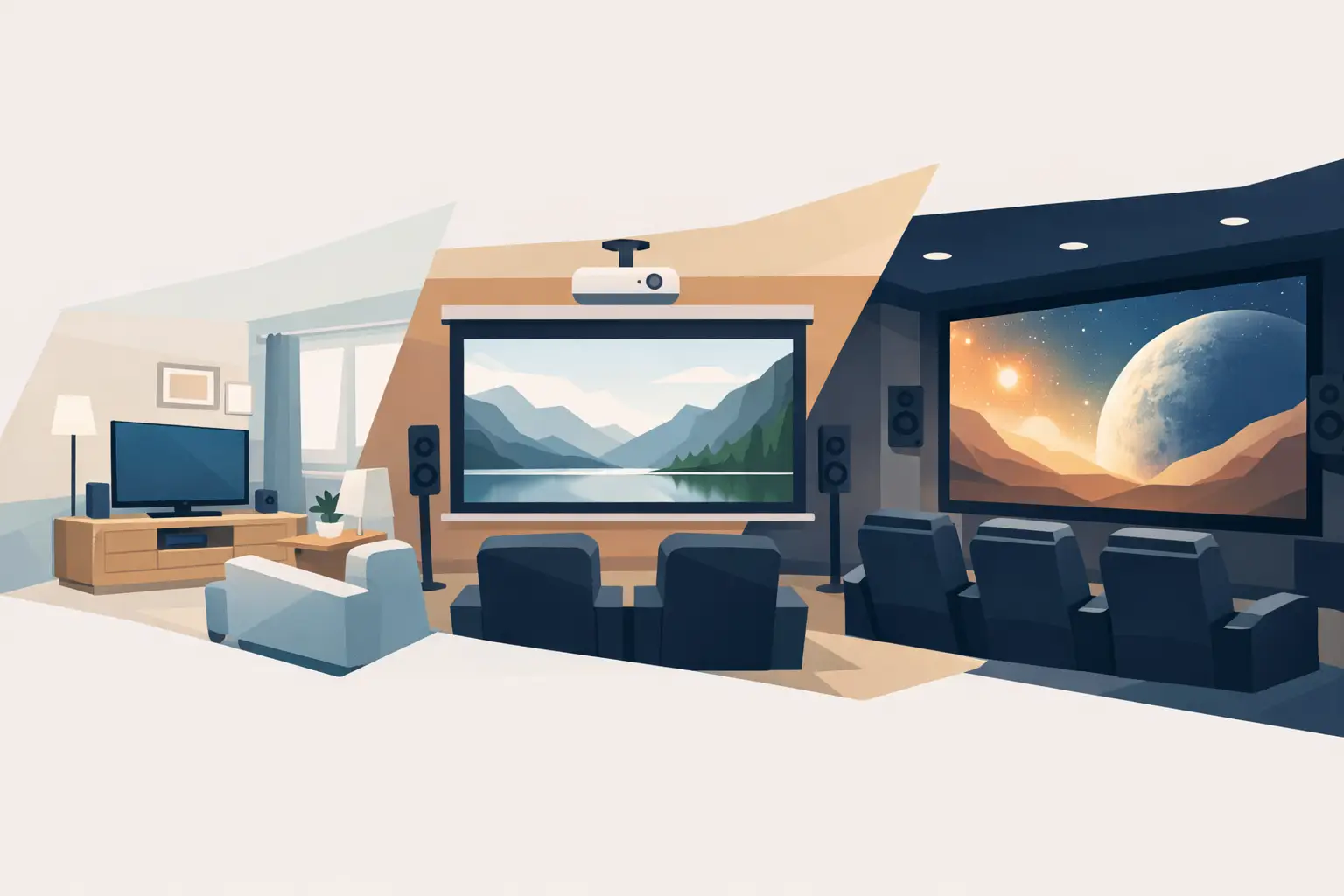
A projector can produce a remarkable picture, but the screen is what determines whether that picture feels cinematic or merely large. The right home theater screen options account for more than image size. They need to suit the room’s ambient light, seating layout, projector placement, décor, and the way your family actually watches movies, sports, and streaming content.
For a dedicated theater, the answer may be a fixed screen built around a carefully planned projector system. In a living room or multipurpose space, a retractable or ambient-light-rejecting screen may make more sense. A thoughtful design keeps the technology discreet, the room comfortable, and the viewing experience consistently enjoyable.
Start With the Room, Not the Screen Size
It is tempting to choose the biggest screen that will fit on a wall. Bigger is not always better. A screen that dominates the field of view can make subtitles tiring to read and fast action difficult to follow, especially from close seating. One that is too small can leave a capable projector underused.
Viewing distance is the starting point. For a 120-inch diagonal 16:9 screen, many homeowners find a primary seating distance of roughly 10 to 15 feet comfortable. Personal preference matters here. Movie enthusiasts often prefer a more immersive image, while families using the room for casual television may want a slightly more relaxed view.
The screen’s aspect ratio also affects the decision. A 16:9 screen is the natural fit for streaming, television, sports, and gaming. A wider 2.35:1 or 2.40:1 screen creates the classic widescreen presentation many homeowners want for film-focused theaters, but it requires a projector and setup designed to handle changing content formats gracefully.
Before selecting a screen, look at ceiling height, wall width, furniture placement, speaker locations, windows, and walking paths. In a new build, planning these elements together prevents compromises later. In a retrofit, a professional site review can reveal practical ways to achieve a clean installation without making the room feel crowded.
Fixed-Frame Home Theater Screen Options
A fixed-frame screen is permanently mounted to the wall, with the screen material stretched flat inside a rigid frame. It is often the best choice for a dedicated home theater because it offers a consistently smooth surface and a crisp, finished appearance.
The visual benefits are straightforward. There are no wrinkles, waves, or deployment mechanisms to manage. The screen is always ready, and a black velvet-style border can improve perceived contrast by giving the image a clean edge. Fixed-frame models are available in a wide range of materials, including acoustically transparent options that allow speakers to be placed behind the screen.
This option works best when the room is dedicated to entertainment or when the screen can remain visible without disrupting the room’s design. It is less practical in a formal living room, a shared family room, or any space where a large white rectangle would compete with artwork, windows, or other focal points.
When an Acoustically Transparent Screen Makes Sense
An acoustically transparent screen uses a woven or perforated surface that lets sound pass through it. This makes it possible to place the front speakers behind the image, much like a commercial cinema. Dialogue appears to come directly from the actors rather than from beneath the screen.
It is an elegant solution for serious theater rooms, but it needs careful planning. Speaker selection, speaker spacing, screen material, and projector brightness all matter. Some materials can slightly reduce image brightness or introduce fine texture when viewed too closely. With the right design and calibration, however, the result is a highly natural and immersive experience.
Motorized Screens for Flexible Rooms
Motorized projection screens disappear when not in use, making them a strong fit for multipurpose spaces. At the press of a button, the screen lowers for movie night. When it retracts, the room returns to its everyday purpose.
A recessed motorized screen can be installed within the ceiling for a particularly clean look. Surface-mounted models are often a practical choice for renovations where ceiling access is limited. Both can be integrated with the projector and room controls so the screen, projector, and audio system respond together with a simple command.
The trade-off is mechanical complexity. A quality motorized screen should operate quietly, stop accurately, and remain aligned over years of regular use. Cheaper models may develop edge curl, uneven retraction, or noise. Professional installation also matters because the screen housing must be securely supported and precisely positioned relative to the projector.
For homeowners who want a screen in a family room without turning the room into a permanent theater, this is often the most balanced choice.
Ambient Light Rejecting Screens for Brighter Spaces
Windows, recessed lighting, lamps, and light-colored walls all affect projector performance. Even a bright projector can look washed out when light lands directly on a conventional matte white screen. An ambient light rejecting, or ALR, screen is designed to reflect projector light toward viewers while reducing light arriving from other directions.
These screens can make projection more viable in rooms that cannot be fully darkened. They are especially useful for daytime sports viewing, casual entertainment in open-concept spaces, and rooms with large windows. Some materials are designed specifically for standard long-throw projectors, while others are made for ultra-short-throw models. They are not interchangeable.
ALR screens have limits. They generally cost more than standard white materials and can have narrower viewing angles. If viewers sit far off to the side, the image may appear less bright or less uniform. Ceiling lights can also be challenging depending on the material’s directional properties. Window shades and lighting control still play an important role in achieving the best picture.
Screen Material Changes the Picture
The screen material, often called the screen surface, has a direct effect on brightness, contrast, color, and viewing angle. There is no single best material for every room.
A matte white screen is the versatile default for a light-controlled theater. It offers wide viewing angles and natural color reproduction, making it an excellent choice for families and larger seating arrangements. Gray or higher-contrast materials can deepen black levels in rooms with some reflected light, though they may require more projector brightness.
Screen gain describes how much light a material reflects back toward the seating area. A gain near 1.0 is typically balanced and forgiving. Higher-gain materials can produce a brighter image but may narrow the useful viewing angle and create visible hot spots if the projector or seating is poorly positioned. Lower-gain materials can improve black level perception but may look dim with an underpowered projector.
This is where component matching matters. The projector’s light output, throw distance, lens settings, and the room’s wall and ceiling colors all influence the final result. A screen should be chosen as part of the system, not as an isolated purchase.
Consider an Ultra-Short-Throw Setup Carefully
Ultra-short-throw projectors sit inches from the wall or screen, typically on a low cabinet. They can be appealing when ceiling mounting is undesirable or when the room’s layout makes a traditional projector difficult.
For the best result, pair an ultra-short-throw projector with a purpose-built ultra-short-throw ALR screen. These screens use a specialized surface geometry to direct light from below toward the viewers while rejecting much of the overhead light. Using a standard screen may still produce an image, but it usually gives up much of the performance that makes this setup attractive.
The furniture and wall need to be planned carefully. Small changes in the projector’s position can affect image alignment, and an uneven wall can become noticeable. This approach is often excellent for a polished media room, but a conventional ceiling-mounted projector may offer more flexibility for a true theater layout.
Details That Keep the System Easy to Live With
A beautiful image can be undermined by small installation details. The screen should be centered on the primary seating position, not simply the nearest available wall. The bottom edge needs enough clearance for furniture and speakers, while the top should remain comfortable to view from the back row.
Cable routing, projector power, ventilation, and control should be addressed before finishes are complete whenever possible. A clean low-voltage plan avoids visible cords, awkward extension solutions, and equipment that is difficult to service. It also makes it easier to add audio, shades, and lighting scenes that support the viewing experience without requiring a collection of remotes.
Tri-County Technology designs projection systems around the room and the people using it, whether the goal is a dedicated cinema or an everyday space that transforms for entertainment. The value is not just a larger image. It is a system that works reliably, looks intentional, and feels simple from the sofa.
The best screen choice is the one you stop noticing once the movie begins. Plan it around how the room is used, allow for the light you cannot control, and choose components that work together from the start. That is how a theater becomes a comfortable part of home life rather than another piece of technology to manage.


Comments are closed