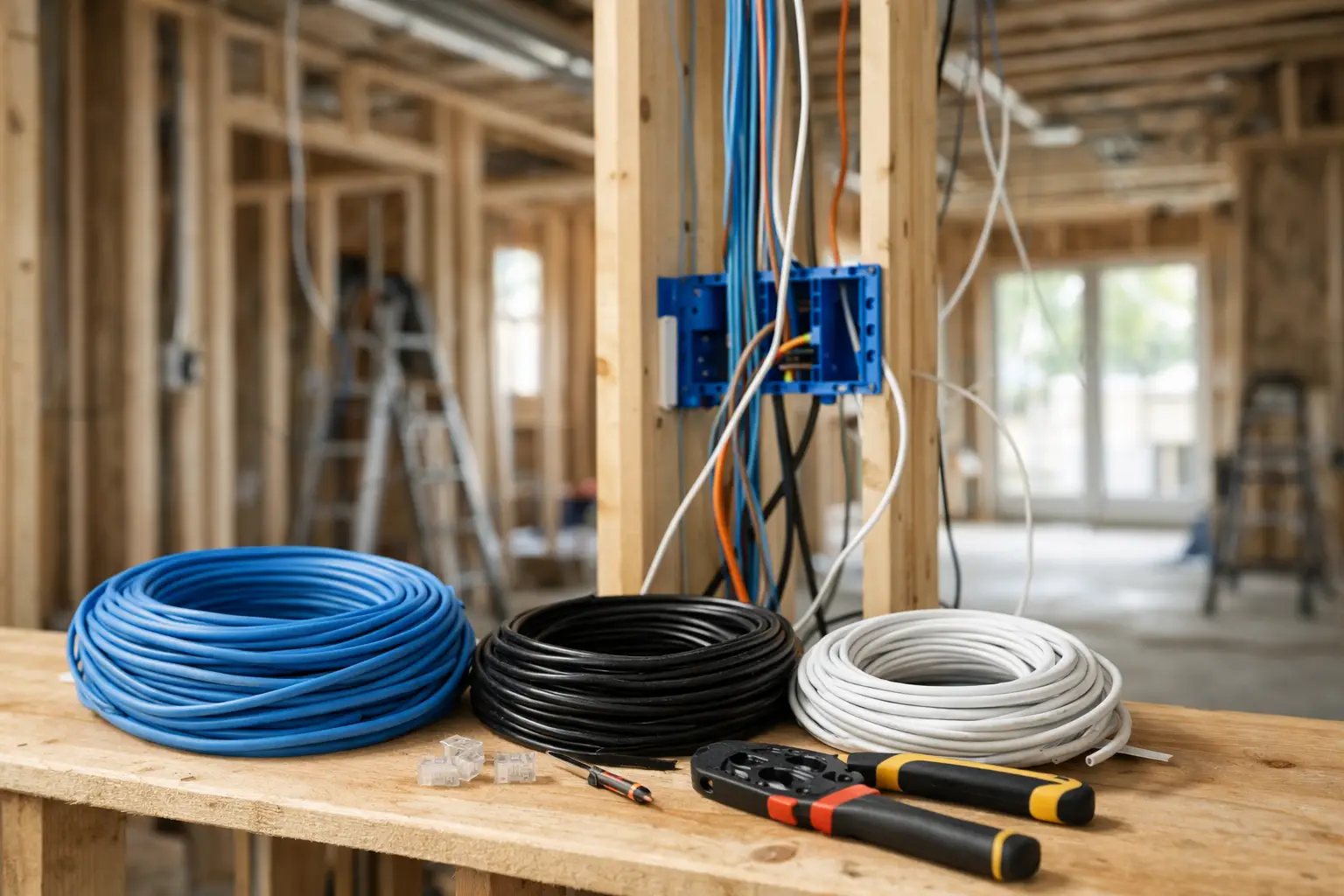
A new build gives you one rare advantage that never really comes back once the drywall is up – access. That is why low voltage wiring for new construction matters so much. It is the stage where you can plan for strong Wi-Fi, clean TV locations, security devices, audio, cameras, and smart home control without cutting into finished walls later.
Too often, low-voltage planning gets pushed behind roofing, flooring, cabinets, and paint. Those choices are visible, so they get attention. Wiring is quieter work, but it has a lasting effect on how a home feels every day. Good planning makes technology easier to use, less intrusive, and much more reliable.
What low-voltage wiring includes
Low-voltage wiring carries signal and communication rather than standard household electrical power. In a new construction setting, that usually means structured cabling for internet and networking, wiring for surveillance cameras, prewiring for distributed audio, doorbells, alarm devices, TV locations, motorized shades, and control keypads or touch panels.
This is also the right time to think about where the system will live. A clean, centralized wiring location helps keep equipment organized and easier to service. That can be a utility room, basement, closet, or another dedicated space with power, ventilation, and room for future expansion.
The goal is not to fill a house with gadgets. The goal is to create infrastructure that supports comfort, security, entertainment, and connectivity in a way that feels natural.
Why low voltage wiring for new construction pays off
The biggest benefit is freedom. Before insulation and drywall, cable routes are simpler, device locations are more flexible, and the finished result is cleaner. You are not forced into compromises because a wall is closed or a ceiling is hard to reach.
There is also a cost advantage. Prewiring during construction is usually more efficient than retrofitting later. Labor is lower, patching is avoided, and you can prepare for future upgrades even if you do not install every device on day one.
That flexibility matters. Maybe you are not ready for whole-home audio today, but you know you may want it later. Maybe outdoor cameras are part of phase two. Running cable now gives you options without turning a finished home into a jobsite again.
Just as important, good prewiring improves performance. Wireless technology is useful, but it is not a complete replacement for cable. Hardwired connections still provide the best foundation for access points, streaming devices, TVs, cameras, and other systems that need consistent speed and stability.
Start with lifestyle, not just device counts
The best wiring plans start with how you expect to live in the house. A family that works from home and streams in multiple rooms has different needs than someone building a second home for occasional use. A household focused on outdoor entertaining will prioritize different spaces than one centered on a media room.
That is why room-by-room planning matters. You are not simply asking, How many wires go here? You are asking, What should this space do well every day?
A kitchen may need strong wireless coverage, under-cabinet audio, and a clean place for a screen. A great room might need TV power and data in the right spot, speaker prewire, and shades that reduce glare. A home office may need hardwired network connections rather than relying only on Wi-Fi. Outdoor living areas often benefit from speaker wiring, camera coverage, and carefully placed wireless access points.
When the wiring plan follows the way the home will actually be used, the technology feels less like an add-on and more like part of the design.
The systems worth planning early
Networking and Wi-Fi
If there is one system that affects almost everything else, it is the network. Smart devices, streaming platforms, video doorbells, cameras, and remote access all depend on stable connectivity. In many new homes, strong Wi-Fi does not happen by accident. It needs intentional access point placement, cable runs, and a proper equipment location.
Relying on a router from the internet provider in one corner of the house often leads to dead spots and frustration. Prewiring for a professionally designed network gives you a better path from the beginning.
TVs and entertainment
TV placement seems straightforward until the room is finished and cords are visible, outlets are misplaced, or the wall backing is missing. New construction is the right time to plan screen locations, speaker wiring, conduit where appropriate, and the infrastructure needed for a clean installation.
Even if some rooms will not get a TV right away, prewiring keeps your options open.
Security and surveillance
Cameras, video doorbells, motion devices, and related security features work best when their wiring is planned before the home is complete. This gives you better placement, fewer exposed wires, and a cleaner result overall.
Exterior camera positions deserve special attention. You want useful viewing angles, not just a device mounted wherever it was easiest at the end of the job.
Audio and control
Whole-home audio and simple system control are much easier to prepare for during framing. Speaker wire, keypad locations, and supporting cabling can be hidden inside the structure instead of added later. Even if you only finish part of the system now, the home is ready to grow with you.
Window treatments and specialty systems
Motorized shades and similar features are another area where early coordination helps. Power and control requirements should be considered before trim and finishes are complete. This is one of those details that is easy to miss early and expensive to revisit later.
What homeowners and builders often overlook
A common mistake is assuming the electrician is handling all technology wiring. Electrical and low-voltage scopes are not the same, and the details matter. Device heights, cable type, pathway planning, rack location, and equipment ventilation all affect the final experience.
Another issue is underbuilding. Many people wire only for what they need today, not what they may want in three to five years. That can be shortsighted in a custom home. Running extra cable during construction is often a modest step that protects your investment.
There is also the problem of overbuilding. Not every home needs every possible system. A good plan balances current priorities, future flexibility, and budget. That is where experience matters. The right design is not the one with the most parts. It is the one that supports the home without adding unnecessary complexity.
Coordination matters as much as cable
Low-voltage work tends to go best when it is coordinated early with the builder, electrician, designer, and homeowner. That helps avoid conflicts with HVAC runs, framing changes, cabinetry, and finish details.
For example, the ideal TV wall may change once millwork is finalized. Speaker locations may shift based on ceiling design. Wireless access point placement may need to account for materials like tile, metal, or concrete that affect signal. These are manageable issues when the conversation happens early.
This is where a professional integrator brings real value. The work is not just pulling wire. It is translating everyday goals into a system layout that performs well and stays visually clean.
Low voltage wiring for new construction in real-world terms
For homeowners, this usually comes down to a few simple questions. Will the Wi-Fi be strong where people actually use it? Will TVs, speakers, and cameras be installed cleanly? Will the system be easy to upgrade later? Will the technology feel reliable instead of fussy?
For builders and trade partners, the focus is often different but just as practical. Is the scope clear, coordinated, and ready on schedule? Are device locations aligned with the plan? Will the finished home present well without visible shortcuts or callback issues?
Those outcomes are exactly why prewiring deserves a place in the construction conversation early, not late.
In Northeast Ohio, where new homes often include dedicated offices, finished basements, and expanding outdoor living spaces, that planning can make an even bigger difference. The layout of the home and the way people use it have changed. The wiring plan should reflect that.
A well-wired house does not call attention to itself. It simply works the way it should, room after room, day after day. If you are building now, that is the moment to make future technology feel easy, not forced.


Comments are closed