A kitchen playlist should not disappear when someone walks into the dining room. A favorite station should be easy to start before guests arrive, and it should not require opening three apps, finding the right input, or turning up a television just to hear music. That is the everyday value behind a well-planned whole-home audio system. This home audio distribution guide explains the decisions that make music feel natural in every room rather than added on afterward.
What Home Audio Distribution Actually Does
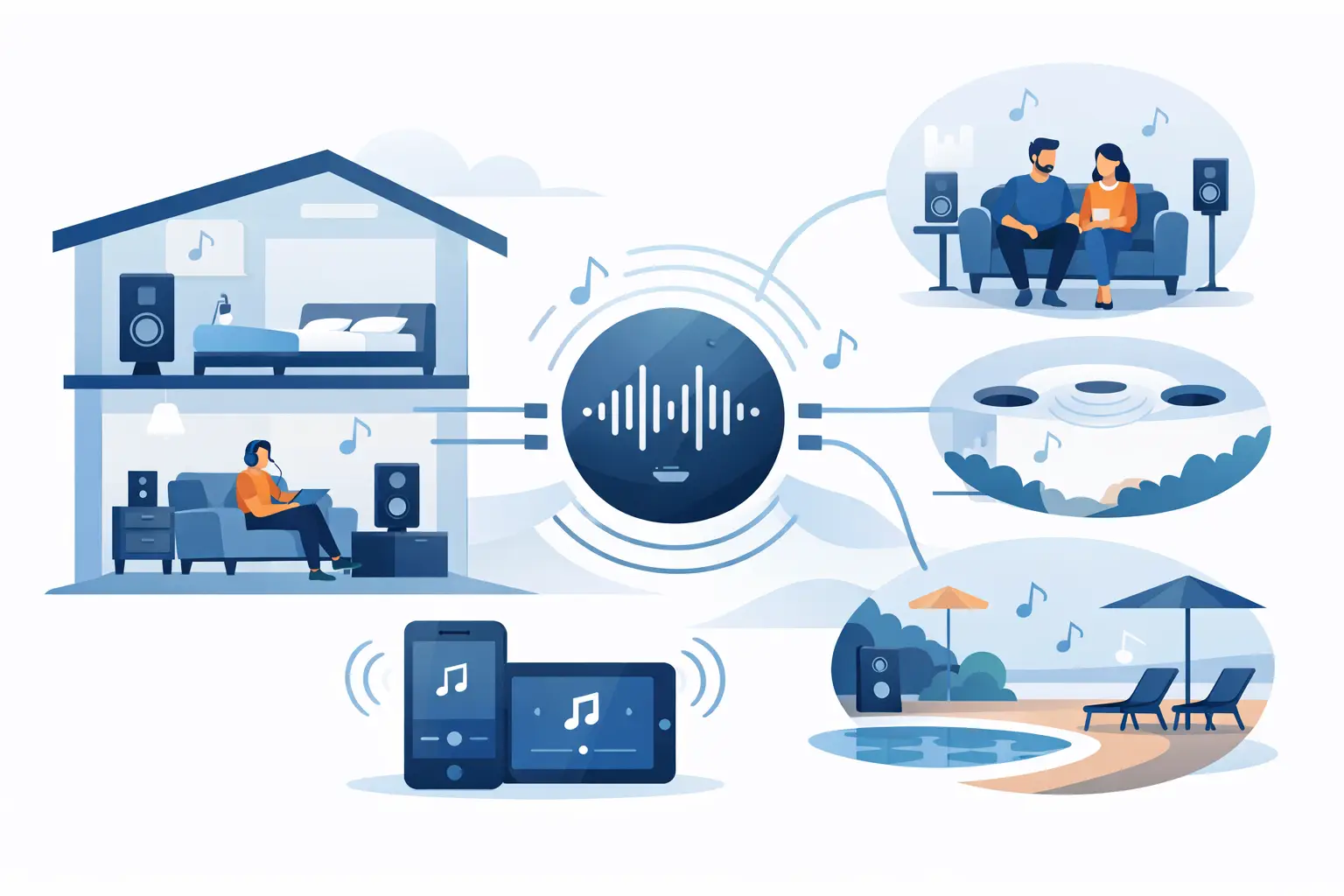
Home audio distribution sends music from one or more sources to speakers located throughout the home. Those speakers can play the same audio everywhere, such as during a gathering, or different audio in different rooms. The goal is not simply to add more speakers. It is to create a system that is easy to use, sounds appropriate for each space, and remains dependable as technology changes.
A complete system usually includes audio sources, amplification, speakers, wiring or network connections, and a method of control. Some homes use streaming services as their primary source. Others also want television audio, a turntable, a local music library, or outdoor entertainment included in the design.
The right approach depends on the home and the people using it. A compact ranch with a few key listening areas needs a different plan than a new custom build with multiple floors, a patio, and a finished lower level. Good design starts with how the household lives, not with a speaker count.
Start With Listening Zones, Not Equipment
A zone is an area that can play audio independently. In many homes, the kitchen and great room work best as one zone because they are used together. A primary bedroom may need its own zone for quieter listening. The patio often deserves separate control so indoor music does not have to follow guests outside.
Think through the rooms where music would genuinely improve the routine. Kitchens, living rooms, primary suites, bathrooms, home offices, basements, and outdoor living spaces are common choices. Hallways and guest rooms may be lower priorities. Including every possible room can raise cost without adding much value, especially if some areas are rarely occupied.
It also helps to consider how many independent streams the home needs at one time. If one person wants a podcast in the office while another plays music outside, those areas need separate zones. If the household usually enjoys the same background music across the main level, grouping connected spaces can simplify the system and reduce equipment needs.
Plan for Daily Use and Entertaining
The best zone layout supports ordinary moments first. Background music while cooking, a relaxing playlist in the morning, and easy outdoor audio on a weekend tend to matter more than elaborate features that are rarely used.
Entertaining is still an important test. Consider whether the main living areas can be grouped with one command, whether volume can be adjusted by area, and whether outdoor speakers can be turned off independently when the gathering moves indoors. These details make a system feel thoughtful rather than complicated.
Choose Speakers for the Room, Not Just the Look
In-ceiling speakers are popular because they keep rooms visually clean while delivering even background sound. They work particularly well in kitchens, hallways, bathrooms, and open living areas. For rooms where focused listening or television sound matters more, in-wall speakers, bookshelf speakers, or a soundbar may be a better fit.
Speaker placement matters as much as speaker quality. One speaker near a doorway will not provide the same experience as properly spaced speakers across a large kitchen or great room. In open-concept homes, sound can drift into adjacent areas, so placement and volume control should be considered together.
Bathrooms and patios require speakers built for moisture, temperature changes, and other environmental conditions. Outdoors, it is tempting to aim for maximum volume. A better result usually comes from several properly placed landscape or surface-mount speakers playing at a comfortable level. This creates fuller coverage while reducing the chance of sending all the sound toward neighbors.
Stereo Sound Versus Background Coverage
Some spaces benefit from true left-right stereo imaging, especially a dedicated listening room, office, or media space. In many everyday rooms, balanced coverage is more valuable than a precise stereo sweet spot. A professional designer can recommend whether stereo pairs, single-stereo speakers, or distributed coverage best match the room’s purpose and layout.
Wiring Creates Flexibility That Wireless Alone Cannot
Wireless audio has made music easier to add to existing homes, and it can be a good fit for a single room or a modest upgrade. However, a wired infrastructure remains the strongest foundation for larger whole-home systems, particularly in new construction or major renovations.
Speaker wire installed before drywall gives homeowners more choices later. It supports centralized amplifiers, avoids the need for visible power cords near every speaker, and makes future equipment upgrades easier. Structured wiring can also support dependable network connections for streaming components and control devices.
For a retrofit, the decision is more nuanced. Running new wire may be simple in an unfinished basement, attic, or accessible crawlspace, but much harder in a completed home with limited pathways. In those cases, a hybrid design can make sense: hardwired speakers in the most-used areas and carefully selected wireless components where construction access is limited.
Do not overlook the equipment location. Amplifiers and audio components need a clean, ventilated, serviceable place to live. A closet, utility room, or dedicated equipment cabinet often works well. Planning this location early keeps the living spaces free of stacked devices, exposed cables, and improvised connections.
Select Controls Everyone Will Actually Use
The most advanced system is not the best system if guests and family members hesitate to touch it. Control should feel familiar and take only a few steps. For many homes, a phone or tablet app is a convenient primary control method. Voice control can be useful for simple requests, such as starting music in a room, but it should not be the only way to operate the system.
Wall keypads can be especially helpful in kitchens, bedrooms, and outdoor spaces. They provide quick access to favorites, volume, and basic room control without requiring a phone. This is useful when someone is cooking, when children are home, or when visitors need an obvious way to adjust the music.
A well-designed control experience also makes grouping simple. You should be able to select the rooms you want, choose a source, and adjust the volume without managing the technical details underneath. That is where thoughtful programming has real value.
Think About Network Performance Early
Streaming audio depends on the home network. When Wi-Fi coverage is inconsistent, music can pause, rooms can fall out of sync, and control apps can become frustrating. Audio distribution planning should include an honest look at network coverage, equipment placement, and the number of connected devices in the home.
This does not mean every audio component must rely on Wi-Fi. Where possible, wired network connections can improve stability for centralized equipment and fixed streaming players. Strong wireless coverage still matters for phones, tablets, and portable devices used to control the system.
For larger homes, network design and audio design should be coordinated instead of handled as separate projects. A system can only be as pleasant to use as the connection supporting it.
Build for Change Without Overbuilding
Audio technology evolves quickly, but quality speakers and properly installed wire can serve a home for many years. That is why it often makes sense to invest in the infrastructure while keeping source equipment and control hardware easy to update later.
Avoid buying more zones than the household will use just because future expansion is possible. At the same time, if walls are open during construction, adding wire pathways to likely future spaces can be a practical, low-cost decision. A screened porch, basement finish, or future outdoor area may not need speakers now, but preparing for them can prevent disruption later.
The same principle applies to equipment capacity. Leave reasonable room for growth, but do not pay for a system designed around unlikely scenarios. The right design balances current priorities, budget, and realistic plans for the home.
When Professional Design Makes the Difference
A whole-home audio system brings together acoustics, construction details, networking, equipment selection, and everyday usability. Each element affects the others. An attractive ceiling speaker installation can still disappoint if the zones are poorly planned, the amplifier is undersized, or the controls are confusing.
For builders, early coordination helps protect ceilings and wall finishes, identify equipment locations, and keep low-voltage work aligned with the construction schedule. For homeowners renovating an existing property, a site review can identify what is practical before decisions are made around furniture, finishes, and access points.
Tri-County Technology designs home audio systems around the spaces people actually use, with clean installation and controls that fit naturally into daily life. The objective is simple: music should be there when you want it and quietly out of the way when you do not.
The most satisfying audio systems are rarely the ones with the longest feature list. They are the ones that make a quiet morning, a family dinner, or an evening on the patio sound a little better without asking anyone to become the household technology expert.


Comments are closed