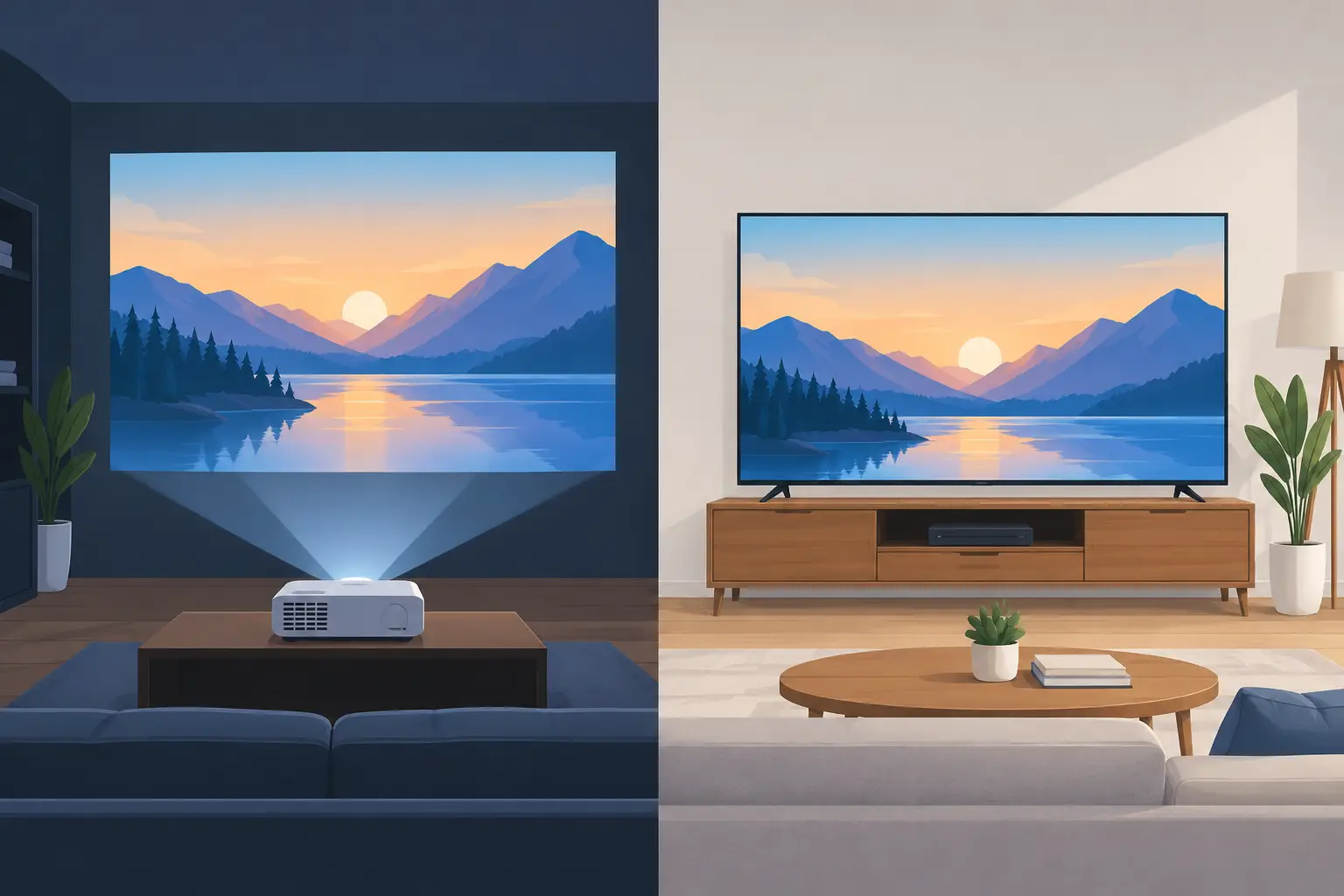
A 100-inch image changes the feel of a room. Movie nights become more immersive, game days are easier to share, and a finished basement can feel like a true retreat. But when homeowners compare a projector versus large TV, screen size is only the first consideration. The better choice depends on how you use the room, how much daylight it receives, and how polished you want the finished space to feel.
A large TV delivers an excellent picture with minimal planning. A projector can create a more cinematic experience, often at a larger size, but it asks more of the room and the installation. Understanding those trade-offs before walls are finished or furniture is selected can prevent a costly compromise later.
Projector Versus Large TV: Start With the Room
The room usually makes the decision clearer than a specification sheet does. A television performs reliably in almost any environment. Bright living rooms, open-concept spaces, rooms with windows, and areas used throughout the day all favor a large TV. Modern 85-, 98-, and even larger televisions can deliver vivid color, strong contrast, and clear detail without requiring the room to be dark.
A projector works best when the viewing area can be designed around it. A dedicated media room, lower-level theater, or enclosed bonus room is often an ideal setting. Light can be controlled, the seating can face one direction, and the screen can become the visual center of the space when it is in use.
That does not mean a projector is limited to a fully dark room. Many current models offer high brightness, and carefully selected screens can improve performance in rooms with some ambient light. Still, physics matters. Daylight, overhead fixtures, and reflections will affect a projected image more noticeably than they affect a TV.
Daytime viewing and light control
If you expect to watch a morning news program, an afternoon game, or television while children play nearby, a large TV is typically the easier fit. It turns on quickly, remains easy to see in a bright room, and does not require shades to be lowered every time someone wants to watch.
For a projector, motorized window treatments and thoughtful lighting design can make a meaningful difference. The goal is not to make a room feel closed off. It is to give the homeowner simple control over glare and brightness when it is time to watch. With the right setup, one button can lower shades, adjust lighting, and prepare the room for viewing without interrupting the evening.
Picture Quality Is More Than Screen Size
A projector’s greatest advantage is scale. A 120-inch or 150-inch image has a sense of presence that even a very large television may not match. For films, concerts, and sports, that extra size can be genuinely compelling, especially when viewers sit far enough back to take in the full image comfortably.
Televisions hold the advantage in contrast, black levels, and everyday brightness. Premium TVs can show dark scenes with impressive depth while maintaining fine detail in highlights. They also tend to perform more consistently across different content, whether you are streaming a show, watching a game in the afternoon, or playing a fast-paced video game.
Projector image quality varies more widely by model, screen material, and room conditions. A well-designed projection system can look exceptional. A projector placed in a bright room with a basic wall as the screen may look washed out, even if the projector itself is capable. The screen is not an afterthought. It is a major part of the viewing system.
Screen texture, gain, color, size, and placement all influence the finished picture. A professionally installed fixed-frame screen creates a clean, theater-like result. A recessed motorized screen can disappear into the ceiling when the room serves other purposes. Both options can look far more intentional than a blank wall with exposed wiring and an improvised projector shelf.
Consider How the Equipment Lives in the Space
A large TV is straightforward to place, but a polished installation still benefits from planning. The display needs proper mounting, power where it belongs, and concealed cabling for streaming devices, game consoles, and audio equipment. The right mounting height matters as well. A TV installed too high may look dramatic but can become uncomfortable during a full movie.
A projector requires more coordination. The projector must be located at the correct distance from the screen, aligned precisely, and supported by appropriate wiring. Ceiling mounting is common, but it is not the only option. Some rooms are better served by a rear shelf or a short-throw projector placed close to the screen.
Short-throw and ultra-short-throw models can be attractive in renovations because they reduce the need for a long ceiling run. They can sit near the wall or screen, though they still require careful surface selection and furniture planning. Their compact placement does not automatically make them simpler than a TV. Cables, ventilation, image alignment, and audio still deserve attention.
For new construction, it is wise to plan for flexibility. Conduit and structured wiring allow a future projector, television, or upgraded audio system to be added without opening finished walls. This is especially helpful when a family is still deciding how a room will be used over the next several years.
Audio Can Change the Decision
Large TVs include built-in speakers, but their slim cabinets limit what those speakers can do. They are suitable for casual viewing, yet they rarely provide the clarity and fullness that make a movie, concert, or game feel engaging.
Projectors usually need a separate audio plan from the start. That can be as simple as a soundbar in a multi-purpose room or as detailed as a surround sound system with speakers positioned around the seating area. Because a projector creates a larger visual experience, weak audio is often more noticeable. The picture may be huge, but the room will not feel cinematic if dialogue is hard to hear.
The best approach is to match the sound system to the way the room will be used. A family room may need clear, simple sound that operates from one familiar remote. A dedicated theater can support more immersive audio and a more tailored speaker layout. In either case, integrating the controls matters. Nobody wants a different remote for the screen, source, audio, shades, and lighting.
Budget for the Complete Experience
The purchase price can be misleading in this comparison. A large TV may cost more than an entry-level projector, but it often includes the display, a usable sound solution, and a relatively simple installation path. Once mounted and connected, it is ready for everyday use.
A projection system can range from practical to highly customized. Beyond the projector, consider the screen, mount, video cabling, control equipment, audio, installation labor, and any lighting or window-treatment changes needed to improve viewing. Lamp or laser light-source life and future service should also be part of the conversation.
That does not make a projector a poor value. It simply means its value comes from the complete room experience rather than the projector alone. For homeowners who want a true theater environment, the investment can be well worth it. For a frequently used living room, a large TV may provide more enjoyment per day with less effort.
Which Option Fits Your Routine?
Choose a large TV when the room is bright, viewing happens at all hours, and convenience is the highest priority. It is also a strong choice for rooms that need to work equally well for conversation, entertaining, and casual television.
Choose a projector when you want the largest possible image, can manage the room’s lighting, and see the space as a destination for movies, sports, and shared entertainment. It is especially appealing when the screen can disappear or when a dedicated theater is part of a renovation or new build.
Some homes benefit from both. A large TV can handle daily viewing in the family room, while a projector creates a special experience in a basement, bonus room, or dedicated theater. This approach avoids forcing one system to do two very different jobs.
The right answer should feel easy to live with after installation, not impressive only on the day it is installed. Start with the room, picture the routines that will happen there, and choose the display that makes gathering, watching, and relaxing feel natural every time.


Comments are closed