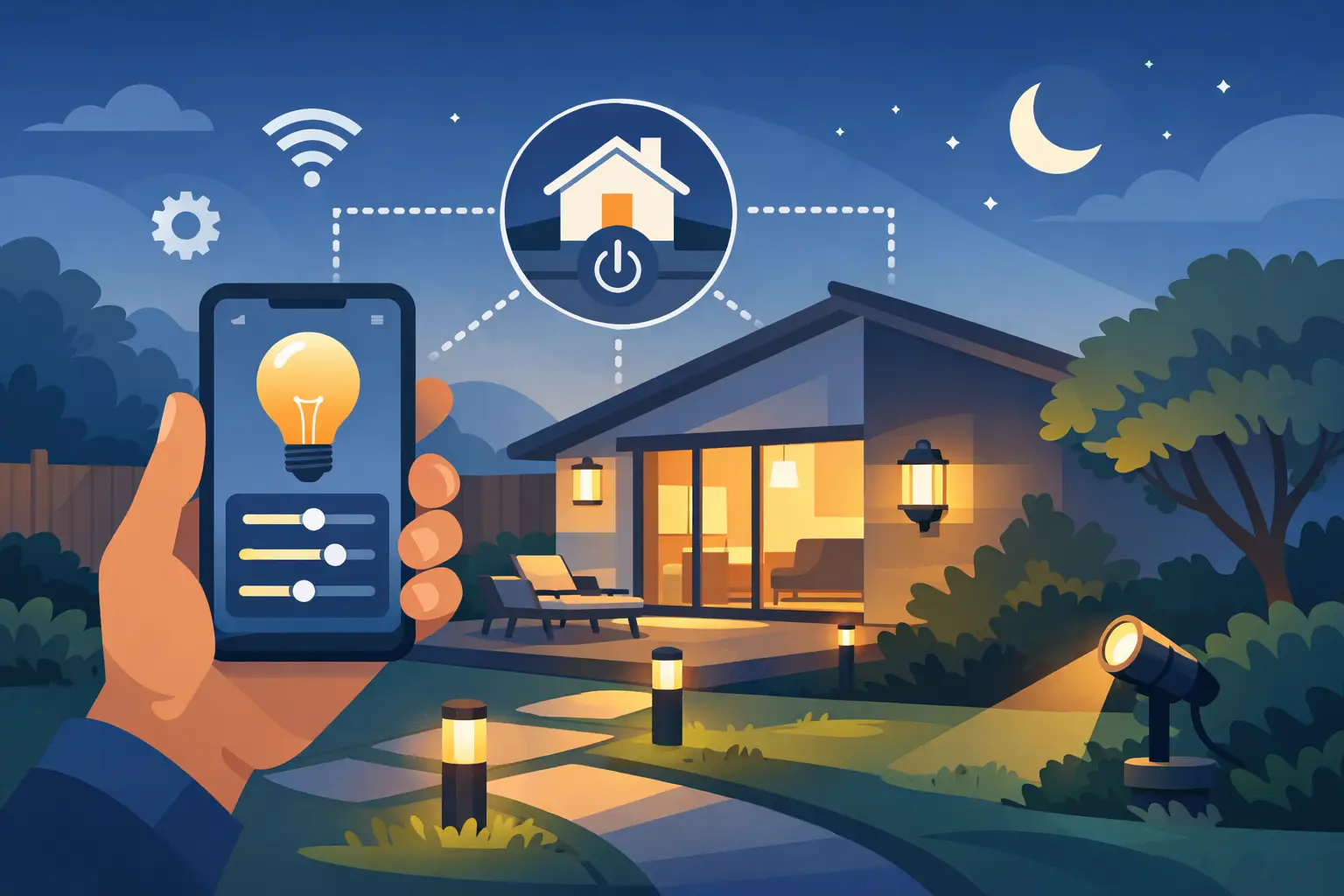
A well-lit driveway, patio, or front walk should feel welcoming without becoming another task on your evening checklist. Learning how to automate outdoor lighting lets the right areas come on when they are useful, turn off when they are not, and adjust to the way your household actually lives.
The best setup is rarely about adding one more app to your phone. It is about creating simple routines that work quietly in the background: pathway lights that follow sunset, patio lighting that stays on while you entertain, and landscape lighting that does not run all night when no one is outside.
How to automate outdoor lighting around your routine
Start by thinking about moments, not devices. When do you arrive home? Which outdoor spaces do you use after dark? Do you want the front of the home softly illuminated every evening, or only when the sun goes down early in winter?
A thoughtful lighting plan gives each area a job. Entry and pathway fixtures help people move comfortably from the driveway to the door. Patio and deck lights extend the time you can use outdoor living areas. Landscape fixtures add depth and curb appeal without flooding the property with glare.
Use sunset and sunrise schedules for a dependable baseline
Sunset-based scheduling is often the most practical starting point. Unlike a fixed 7:00 p.m. timer, a smart lighting system can adjust as daylight changes throughout the year. That matters in Northeast Ohio, where summer evenings stay bright much later than winter afternoons.
For many homes, a simple schedule works best: exterior accent and pathway lighting comes on around sunset, then turns off at a set bedtime. You can keep selected lights on longer when needed, but the default routine handles the everyday decision for you.
A sunrise schedule can be equally useful for lights that should switch off automatically in the morning. This avoids wasted energy and removes the need to remember whether the lights were left on after an early departure.
Add motion sensing where it serves a purpose
Motion sensing is helpful when a space is used occasionally rather than continuously. A side yard, rear gate area, garage approach, or trash-bin route may not need lighting all evening, but it should be visible when someone walks through it.
The key is placement and adjustment. A sensor aimed too broadly can react to passing cars, tree branches, or neighborhood activity. One aimed too narrowly may miss the approach it was meant to cover. A professional design considers fixture location, sensor range, timing, and brightness so the response feels natural rather than distracting.
Create scenes for the way you use outdoor spaces
Schedules manage the predictable parts of life. Scenes make it easy to handle the exceptions. A single “patio evening” command, for example, can bring deck, step, and perimeter lighting to comfortable levels without turning every fixture to full brightness.
Scenes are especially useful when your outdoor lighting includes dimmable fixtures or color-capable landscape elements. Brighter light may be appropriate for setting up dinner outside, while a softer setting is better once guests are seated. The goal is not to add complexity. It is to make a preferred setting available with one simple command.
Choose controls that fit the system you already have
Outdoor lighting automation can range from a straightforward smart timer to a fully integrated home control system. The right choice depends on the number of lighting zones, the type of fixtures, and how much coordination you want with indoor spaces.
For a small upgrade, a weather-rated smart switch, transformer timer, or plug-in controller may be enough. These options can work well for one circuit, string lights, or a basic low-voltage landscape lighting transformer.
A larger property often benefits from a more coordinated design. Separating the front approach, side paths, backyard, deck, and landscape areas into distinct zones gives you more useful control than placing every outdoor fixture on one schedule. You can illuminate the areas in use while keeping the rest of the home calm and energy-conscious.
When planning equipment, consider these four practical needs:
- Weather rating: Controls, enclosures, connectors, and fixtures must be suited to outdoor moisture, temperature changes, and exposure.
- Load capacity: The controller and transformer must support the total wattage of the fixtures, with room for future additions.
- Local control: A wall keypad, switch, or physical button is valuable when guests or family members do not want to reach for a phone.
- Manual override: You should always be able to turn lights on or off outside the usual routine.
Design lighting zones before choosing the app
Many frustrating smart-lighting installations start with the app instead of the layout. If every fixture is grouped together, the system may technically be automated but still fail to match how the home is used.
Walk the property after dark and identify where light is needed. Pay attention to steps, changes in elevation, address visibility, doors, seating areas, and transitions between the house and yard. Then decide which spaces should operate together and which should remain independent.
A front pathway and entry may belong on one zone because they serve the same arrival experience. Patio lighting may need its own zone because it is used later and at different brightness levels. Landscape uplighting may be separate again, allowing it to shut off earlier than the lights people need for walking.
This approach also improves the appearance of the home. Layered lighting creates a more comfortable result than one overly bright flood of light. It helps guide the eye and makes outdoor spaces feel intentional without adding visual clutter.
Plan for glare, neighbors, and changing seasons
More light is not always better. Poorly aimed fixtures can create harsh shadows, shine into windows, and make it harder to enjoy the view from inside. Choose shielded fixtures where possible and direct the light toward the surface that needs illumination, such as a walkway or stair tread.
Seasonal conditions deserve attention as well. Snow can reflect a surprising amount of light, while dense summer foliage can block fixtures that performed perfectly in spring. A good lighting plan leaves room for occasional adjustments as landscaping matures and outdoor spaces evolve.
If you use solar fixtures, treat them as a convenience solution rather than the foundation of a larger automation plan. Their performance depends on available sunlight, battery condition, and winter weather. Wired low-voltage fixtures generally offer more consistent output and better control options, particularly for permanent pathways and landscaped areas.
Make automation easy for everyone in the home
The most successful systems do not require each person to understand the technology behind them. They provide familiar controls, sensible defaults, and just enough flexibility for daily life.
Keep naming simple. “Front path,” “patio,” and “backyard” are easier to use than technical labels. Build schedules around household habits, then live with them for a few weeks before making major changes. You may find that the patio lights should stay on 30 minutes longer, or that front lighting can turn off earlier after bedtime.
It also helps to plan for power outages and internet interruptions. Certain products rely heavily on cloud services, while others can continue scheduled behavior locally. For homeowners who value long-term dependability, that distinction is worth discussing before equipment is selected.
When professional installation makes sense
A single smart plug can be a reasonable do-it-yourself project. But outdoor systems become more involved when they include multiple zones, buried cable, low-voltage transformers, dimming, integrated controls, or changes to existing electrical infrastructure.
Professional installation helps ensure the equipment is properly rated, wiring is cleanly routed, fixtures are positioned with purpose, and controls are configured around the home rather than left at factory settings. It also provides a clearer path when something needs adjustment later.
For new construction and major renovations, planning outdoor lighting early is especially valuable. Conduit paths, transformer locations, switch placement, and future expansion can be considered before hardscaping and landscaping make changes more difficult. Tri-County Technology can help homeowners and builders create a practical plan that feels polished from the first evening.
The right outdoor lighting automation should disappear into your routine: a warm path when you arrive, a comfortable patio when you gather, and less to remember when the night is over.


Comments are closed