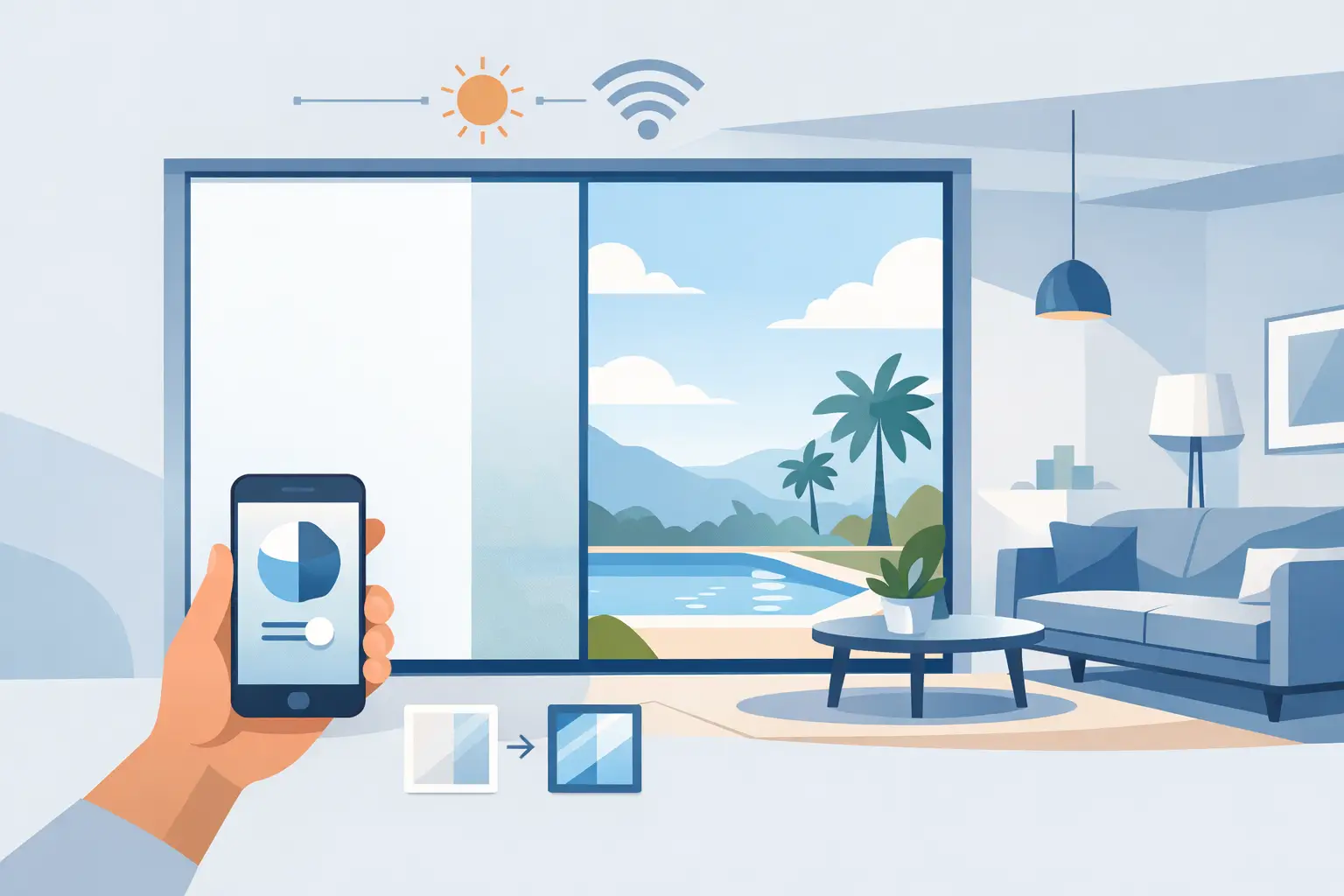
A bathroom window that turns private at the tap of a button. A glass-walled office that becomes a focused meeting room in seconds. A front-facing room that feels open during the day without leaving every interior detail on display after dark. This smart window film guide explains where that experience makes sense, what it requires, and when a different window treatment may serve your home better.
Smart window film can make glass more flexible without changing the architecture around it. But it is not a one-size-fits-all replacement for shades, drapery, or every type of window tint. The best result comes from matching the film to the room, the glass, and the way you want the space to feel every day.
What Smart Window Film Actually Does
Most residential smart window film is switchable privacy film. It uses a polymer dispersed liquid crystal layer, often called PDLC, placed between conductive layers. When power is off, the liquid crystals scatter light and the film appears frosted or opaque. When power is applied, the crystals align and the film becomes clear enough to see through.
The change is quick, quiet, and useful. It gives a room a visual boundary without a permanent curtain or blind covering the glass. In a home, that can be especially valuable for bathroom sidelights, interior glass doors, shower enclosures, home offices, and windows near closely spaced neighbors.
There are other products grouped under the smart glass umbrella. Electrochromic glass gradually tints to manage glare and daylight. Thermochromic films react to heat. Automated shades use fabric rather than changing the glass itself. Each has a place, but they solve different problems. If your main goal is instant privacy, switchable film is usually the relevant option.
Smart Window Film Guide: Start With the Room
The right question is not simply, “Can film go on this window?” It is, “What should this glass do for this room?” Privacy, glare control, heat reduction, and decorative finish are separate needs. One product rarely performs every job equally well.
Bathrooms and shower glass
Bathrooms are a natural fit because privacy is immediate and nonnegotiable. Switchable film can keep an exterior window bright while obscuring the view, or turn a clear shower partition private when the room is in use. It also eliminates cords, fabric, and hard-to-clean slats in humid areas.
The trade-off is that the frosted state still admits light. At night, a bright interior can create a visible glow from outdoors even though details remain obscured. For a window directly facing a neighboring home, the overall lighting plan and the window’s placement still matter.
Home offices and flexible rooms
Interior glass walls make an office feel open, but they can also make video calls, focused work, and private conversations uncomfortable. Smart film lets a room shift between connected and contained. It is a particularly clean solution in renovated homes where adding a solid wall would make the layout feel smaller.
For office spaces, consider how the film will be controlled. A wall keypad, a simple switch, or an app can all work. The most comfortable choice is often the one that fits an existing daily habit, such as turning the room private when a meeting begins.
Street-facing and close-neighbor windows
Smart film can improve daytime privacy, but it should not be mistaken for a complete nighttime privacy solution in every exterior application. When the film is clear, people can see through it. When it is frosted, it obscures details but does not act like a blackout shade.
A layered approach may be better for bedrooms, media rooms, or windows exposed to strong afternoon sun. Smart film can provide on-demand privacy, while motorized shades handle light blocking, glare, insulation, and nighttime coverage. The result feels intentional rather than asking one product to do too much.
Film, Tint, or Motorized Shades?
Traditional window tint is passive. Once installed, it stays tinted and may reduce glare, ultraviolet exposure, and solar heat gain depending on the product. It is a practical choice where privacy is not the priority and you want a consistent appearance without controls or power.
Switchable film is active. It needs low-voltage power to change states and delivers a dramatic privacy effect, but it does not typically provide the same level of solar heat management as specialized tint. Its clear state can also have a slight haze compared with untreated glass. On an interior partition, that is rarely a concern. On a picture window with a prized view, it deserves careful evaluation.
Motorized window treatments remain the strongest choice for broad light control and a softer finished look. They can lower for sleep, raise for a view, and respond to schedules. They also offer more fabric, color, and opacity options. Smart film is often better when you want the glass to remain visually uncluttered or when a shade would be awkward, such as on a shower enclosure or an interior glass wall.
Plan Power and Wiring Before Installation
The film itself is thin, but a successful installation is more than applying material to glass. It needs a power source, discreet wiring, a transformer or controller, and a thoughtful control plan. Those details determine whether the finished room feels polished or improvised.
New construction and major renovations offer the cleanest path because low-voltage wiring can be planned before drywall is complete. In a finished home, retrofit installation is still possible, but wire routes may shape the design. A professional should assess where power will originate, how wiring can be concealed, and whether the window frame or surrounding trim can accommodate it cleanly.
Film must also be measured and applied with precision. The edges, electrical bus bars, and connection points need to be protected and finished properly. Poor installation can leave visible wiring, uneven edges, bubbles, or premature performance issues. This is not a typical peel-and-stick project, especially on large panes, shower glass, or custom interior partitions.
Choose Controls That Feel Natural
A smart feature becomes useful when everyone in the home understands it without instruction. For many spaces, a basic wall switch is the best answer. It is immediate, familiar, and reliable.
For more connected homes, smart window film can be tied to a centralized control interface, a touchscreen, scheduled settings, or voice control. A “morning” setting might clear office glass and raise shades. An “evening” setting might frost selected windows and lower room-darkening treatments. The value is not in adding another app. It is in reducing small daily decisions.
Automation should stay practical. A bathroom window may only need one switch. A group of office partitions or several public-facing windows may benefit from grouped control. Tri-County Technology approaches these decisions around how a room is actually used, so the technology supports the routine instead of creating another one.
Cost, Care, and Long-Term Expectations
Smart window film is a premium finish, and pricing varies widely with glass size, film type, wiring complexity, controls, and site conditions. A small interior panel is very different from multiple oversized exterior windows. Installation access, custom trim work, and retrofit power routing can all affect the final investment.
The film is generally low maintenance. Clean it with a soft cloth and manufacturer-approved products, and avoid abrasive pads or harsh chemicals near the edges and electrical connections. Because the film depends on power to remain clear, it will return to its frosted state during a power outage. For many privacy-focused applications, that default is a benefit. For a window where an unobstructed view is essential at all times, it is a planning consideration.
Before selecting a product, request a real sample and view it in the actual lighting conditions of the room. Look at it from both sides, in daylight and after dark. Notice the clarity in its powered state, the level of privacy when frosted, and how it works with the room’s finishes. A sample answers questions that a product photo cannot.
Smart window film works best when it is treated as part of the room design, not an afterthought on a pane of glass. Used in the right place, it gives a home more privacy, more flexibility, and a calmer visual finish – all while letting the architecture remain the focus.


Comments are closed