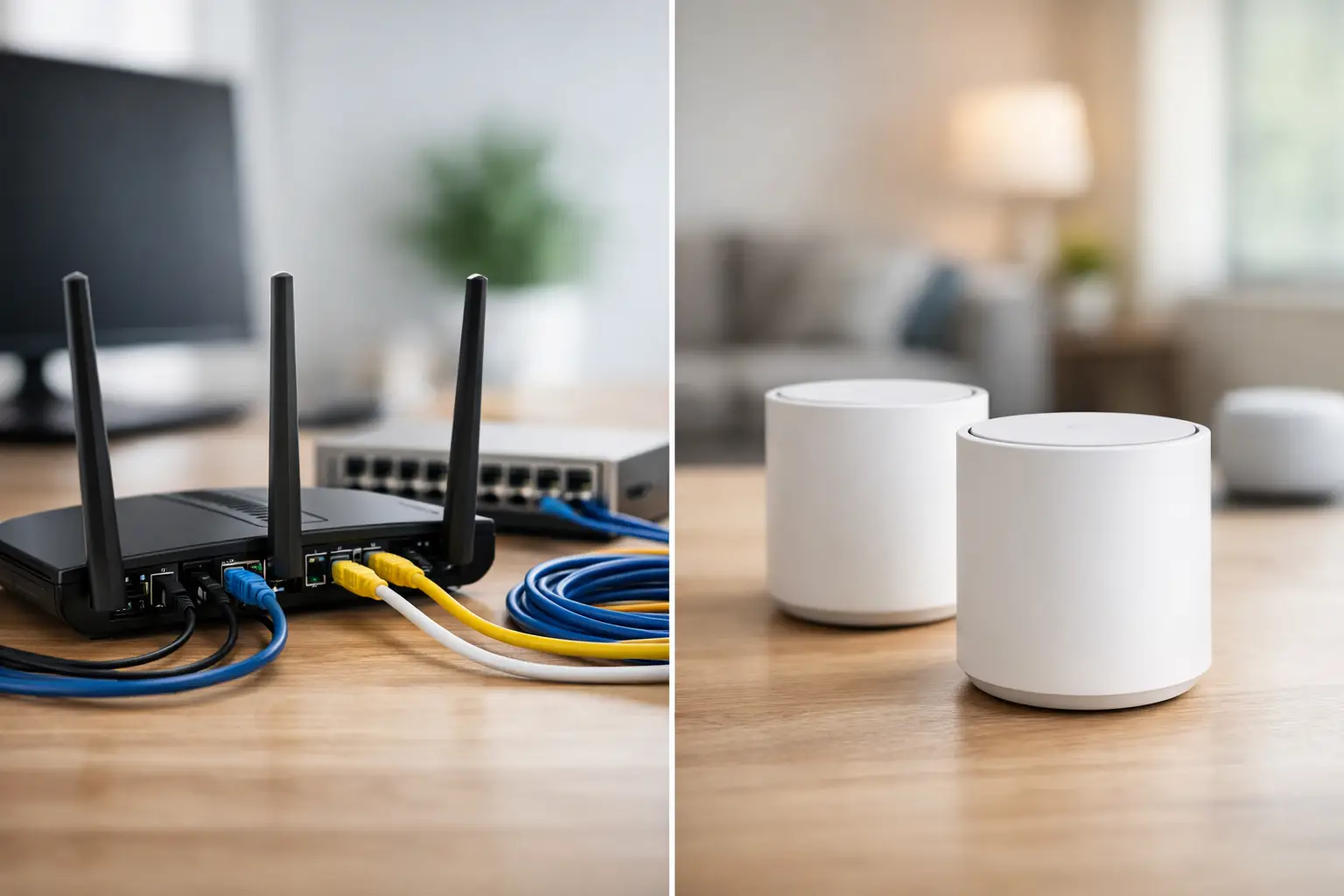
A fast internet plan does not fix a weak network. If your video calls freeze in the back office, the TV buffers at night, or smart devices randomly drop offline, the real question is often wired vs mesh wifi – and which setup actually fits the way your space is used.
For some homes and small businesses, the answer is simple: run cable wherever performance matters most. For others, mesh WiFi solves dead zones without opening walls or turning a renovation into a bigger project. The best choice depends on the building, the devices, and how much reliability you expect from the system every day.
Wired vs mesh WiFi: what is the difference?
A wired network uses Ethernet cabling to connect devices directly back to your router or network switch. That physical connection creates a stable, high-speed path for data. It is the standard choice for devices that need consistent performance, like desktop computers, gaming systems, streaming equipment, security cameras, and business workstations.
Mesh WiFi uses multiple wireless access points, often called nodes, to spread wireless coverage through a home or office. Instead of relying on one router in one room, mesh places several points throughout the property so devices can connect to the strongest nearby signal. It is designed to improve coverage and make WiFi feel more consistent across larger or more challenging spaces.
Both approaches solve real problems. They just solve different ones.
Where wired wins
If reliability is the priority, wired is hard to beat. A cable connection is not affected by the same interference that impacts wireless signals. Walls, appliances, distance, and neighboring networks have far less influence when data is moving over Ethernet.
That matters in everyday ways. TVs stream more reliably. Zoom calls stay cleaner. Smart home hubs respond faster. Security systems and cameras maintain more dependable connections. In a small business, wired connections can reduce frustrating slowdowns that interrupt work.
Speed is another advantage, but it helps to be precise here. Many people focus on internet speed from their provider, yet internal network performance matters too. A wired connection often delivers better consistency from room to room and device to device. Even if your internet package is fast, WiFi can still become the weak link.
There is also a long-term value argument. Structured wiring done well gives a property a stronger foundation for future upgrades. As more devices compete for bandwidth, a wired backbone keeps the network from feeling crowded. That is especially useful in larger homes, renovated homes with heavy AV use, and workspaces where downtime is more than a minor annoyance.
The trade-off is installation. Running cable is easiest during new construction or major remodeling. In finished spaces, it can still be done cleanly, but it requires planning and professional execution to avoid a messy result.
Where mesh WiFi makes sense
Mesh WiFi is often the practical answer when coverage is the main issue. If a single router leaves bedrooms, patios, upstairs offices, or back corners of the building with weak signal, mesh can fill those gaps without the disruption of opening walls.
For many households, that is enough. Phones, tablets, laptops, smart speakers, and general browsing all work well on a properly designed mesh system. Good mesh hardware can also make roaming easier, so devices move between coverage points more smoothly as you walk through the property.
Mesh is also attractive because it feels simpler on the surface. You are not plugging every device into a wall jack or planning cable runs to every room. That convenience matters, especially in existing homes where a full wiring upgrade may not be realistic right away.
Still, mesh is not magic. Each wireless node has to communicate with the rest of the system somehow. If that communication is happening wirelessly instead of through Ethernet, performance can drop compared with a wired backhaul. In other words, mesh can improve coverage, but it does not always match the stability or speed of a fully wired network.
Wired vs mesh WiFi for real-life use
This is where the decision becomes more practical than technical.
If you work from home and depend on stable calls, cloud access, and large file transfers, wired connections at the desk usually make more sense than trusting WiFi alone. If you have a media room, hardwiring the TV, streaming box, and game console can remove a lot of common frustrations.
If your main problem is that the guest room, upstairs hallway, or kitchen loses signal, mesh may be the smarter fix. It solves coverage problems without requiring a full network overhaul.
Many properties need both. That is often the most effective answer, even if it is not the most obvious one at first. Core devices and heavy-use areas benefit from wiring, while mesh or professionally placed wireless access points extend reliable coverage to phones, tablets, and mobile devices throughout the space.
The hidden issue: not all WiFi problems are coverage problems
People often assume weak performance means they need better WiFi. Sometimes that is true. Sometimes the issue is actually poor router placement, outdated hardware, overloaded equipment, cheap internet provider gear, or a network that was never designed for the number of devices now using it.
That is why buying a popular mesh kit online does not always solve the problem. If the internet service is underpowered, if the modem is failing, or if the building materials block signal more than expected, the result can still be disappointing.
A network should be designed around the property, not around the box it came in. Older homes, larger footprints, additions, finished basements, detached garages, and dense device loads all change what good performance looks like.
What about smart homes and connected devices?
As homes add more connected technology, the wired vs mesh wifi conversation becomes more important. Smart TVs, thermostats, cameras, audio systems, video doorbells, and voice assistants all share the same network. Even if each device uses only a small amount of bandwidth, together they create more demand and more opportunities for inconsistency.
A thoughtfully designed network keeps that complexity in the background where it belongs. Wired connections are especially helpful for fixed devices that stay in one place and need dependable uptime. Wireless still has an important role, but it performs best when it is supported by the right infrastructure.
That is one reason professionally installed systems tend to feel easier to live with. The goal is not to make the network more complicated. It is to make the technology less noticeable once it is in place.
Cost, convenience, and long-term value
Mesh usually costs less upfront than extensive wiring, especially in a finished home. It is quicker to deploy and can be a very good solution when expectations are realistic. For many families, that balance of improved coverage and lower disruption is exactly what they need.
Wired infrastructure often costs more initially, but it can prevent recurring frustration and reduce the need for piecemeal fixes later. If you are building a new home, finishing a basement, remodeling an office, or planning a media-heavy space, adding wiring early is usually the smarter investment.
For small businesses, the long-term value of wired connections is even easier to justify. A more dependable network supports employee productivity, video conferencing, point-of-use devices, and customer-facing systems with fewer interruptions.
So which one should you choose?
Choose wired if performance, stability, and future readiness matter most – especially for offices, entertainment areas, security equipment, and fixed devices. Choose mesh if your biggest issue is wireless coverage and you want a practical improvement without major construction.
If you want the most reliable result, think less in terms of either-or and more in terms of balance. A strong network often starts with a wired foundation and layers in wireless coverage where mobility matters. That approach gives you the benefits of both without asking WiFi to do every job on its own.
For homeowners and small businesses in Northeast Ohio, this is often the difference between a network that looks good on paper and one that actually works well every day. At Tri-County Technology, we see the best results when the system is built around how people live and work, not just around the latest hardware trend.
The right network should feel quiet, dependable, and easy to trust. If your connection has become one more thing to troubleshoot, that is usually a sign it is time to stop guessing and start with a design that fits the space.


Comments are closed