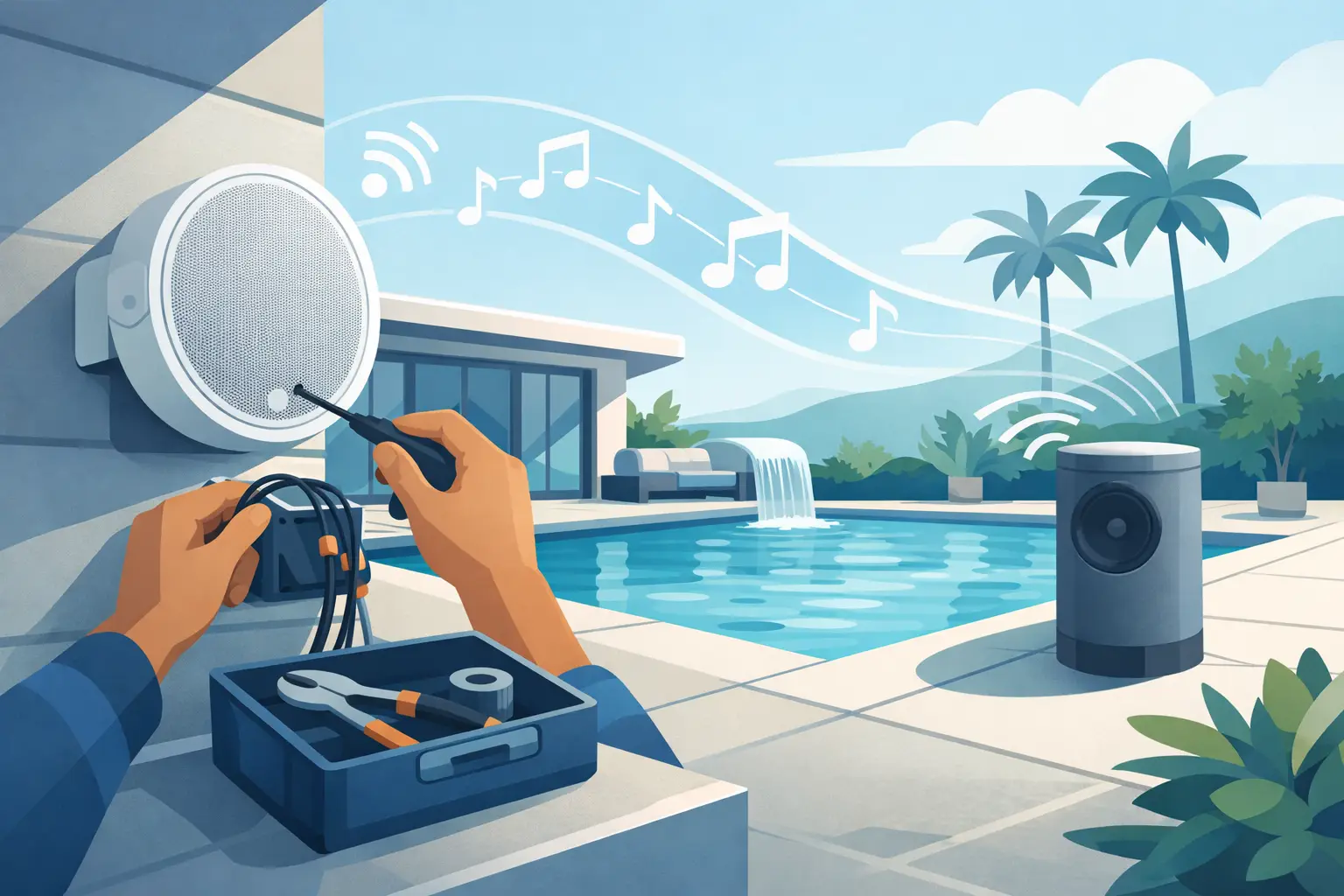
A great pool area has a rhythm of its own: conversation near the patio, kids moving through the water, a grill warming up, and music present without taking over. A thoughtful pool audio system installation makes that possible. The goal is not simply to make the backyard louder. It is to create clear, comfortable sound that reaches the places people actually gather while keeping the equipment protected, the controls simple, and the landscape looking clean.
For homeowners planning a new pool, a patio renovation, or a backyard upgrade in Northeast Ohio, audio is easiest to get right before concrete, decking, and landscaping are complete. It can also be added to an established outdoor space with careful planning. In either case, the best result comes from designing the system around how the space is used, not around a speaker count.
Start With the Listening Areas, Not the Equipment
The pool deck is rarely the only place where people listen. There may be a covered patio, dining area, outdoor kitchen, fire feature, lounge chairs, or a yard beyond the water. Each zone has different background noise and different expectations for volume.
A system designed for one pair of speakers near the house may sound fine on the patio but fade out at the far end of the pool. Turning up the volume to compensate usually creates a different problem: music becomes too loud near the home, while still sounding thin across the yard. Distributed audio solves this by placing more modest speakers around the space, allowing the system to play evenly at a lower and more pleasant level.
During planning, consider where people sit, where they walk, and where noise naturally rises. Water features, pool pumps, wind, and nearby traffic all affect what listeners hear. A professional design accounts for those conditions before speaker locations and amplifier power are selected.
Think About Everyday Use and Entertaining
A backyard system should work just as well for a quiet weekday evening as it does for a larger gathering. That often means separating areas into zones. The patio may play a relaxed playlist while the pool area has its own volume level, or the whole yard can play the same source when guests are over.
Zones are useful, but too many can complicate operation. For most homes, the right approach is a small number of meaningful areas controlled from a familiar app, a wall keypad, or a simple handheld remote. Technology should feel like part of the environment, not another task to manage.
Choose Speakers Built for the Pool Environment
Outdoor audio equipment faces much more than rain. It deals with humidity, heat, cold, direct sun, irrigation, chemicals carried in the air, and seasonal changes. Speakers intended for a covered porch may not be the right choice for an exposed pool deck.
Weather-rated landscape speakers are often an excellent fit because they can be positioned throughout planting beds and around hardscape edges. Their low-profile form helps preserve the look of the yard, and their placement can be adjusted to direct sound toward seating rather than toward neighboring homes. Surface-mount speakers under an eave can also work well for covered patios and pergolas.
The right speaker type depends on the layout. In-ground or landscape designs may blend beautifully into a finished yard, but they require a plan for cable routes and drainage. Mounted speakers can be easier to service, yet they are more visible. Neither option is automatically better. The best choice balances sound coverage, visual preferences, and the realities of the property.
Subwoofers deserve the same consideration. Outdoor subwoofers add warmth and depth that small speakers cannot produce on their own, especially in open spaces where bass dissipates quickly. One properly placed, buried or partially concealed subwoofer can often provide a fuller listening experience than adding more speakers and pushing them harder.
Plan Wiring Before the Hardscape Is Finished
Clean installation begins with the infrastructure behind the scenes. Speaker wire should be rated for outdoor use and routed in a way that protects it from moisture, landscaping work, and future repairs. The path should be documented so homeowners and contractors know where it runs long after the project is complete.
For new construction and pool projects, this is the moment to include conduit under decking, walkways, and drive areas. Conduit adds flexibility. If a cable ever needs replacement or the system is expanded later, installers have a protected path instead of needing to disturb finished surfaces.
Retrofit projects require more creativity, but they do not have to mean visible wire along the home or across the yard. Existing planting beds, attic paths, crawlspaces, and architectural details can sometimes provide discreet routes. A site visit is valuable because the most practical path is rarely obvious from a floor plan or a few photos.
Keep Electronics Sheltered and Serviceable
Speakers live outside, but source equipment and amplification are usually happiest indoors or in a properly designed, protected location. A utility room, finished basement, equipment closet, or conditioned garage can offer better protection and easier long-term service than a box exposed to temperature swings.
Wherever equipment is located, it should remain accessible. A polished installation is not only about hiding components. It is also about making future adjustments, maintenance, and upgrades straightforward. Clear labeling, organized connections, and ventilation support dependable operation over time.
Control Should Be Simple at the Water’s Edge
The best pool audio systems do not require guests to understand the equipment rack. Homeowners should be able to choose music, adjust volume, and select an area from the device they already use most often. That might be a phone or tablet, a dedicated keypad near the patio, or both.
Reliable Wi-Fi matters here. A strong indoor network does not automatically extend to a pool deck, especially through exterior walls, masonry, and landscaping. If streaming drops out when someone walks outside, the speakers are not the problem. Proper network coverage should be part of the audio plan so music remains stable where it is being enjoyed.
It is also wise to define control permissions. A simple guest-friendly control option can prevent an accidental full-volume adjustment or unwanted changes to the whole-home system. The experience should feel flexible for the homeowner and uncomplicated for everyone else.
Balance Great Sound With Neighborly Living
Outdoor sound travels farther than many homeowners expect, particularly at night or across open yards. Speaker placement is one of the most effective ways to control this. Aim speakers inward toward the pool and seating areas rather than outward toward property lines. More evenly distributed speakers allow lower volume settings, which improves clarity nearby while reducing sound beyond the yard.
Music choice and bass settings matter as well. Low frequencies can carry through structures and open spaces even when the overall volume seems modest. A well-tuned system gives the homeowner control without making every adjustment feel technical.
Local conditions also influence design. In Cleveland-area neighborhoods, lot sizes, mature trees, retaining walls, and close-set homes can all shape how sound behaves. An on-site evaluation helps identify the placement that will feel inviting within the property without becoming a distraction outside it.
Make Room for the Future
A pool project is a major investment, and the audio plan should leave room for changing habits. Perhaps the initial priority is music by the water, but an outdoor television, a covered lounge, or additional landscape speakers may come later. Running extra conduit or allowing amplifier capacity now can reduce cost and disruption down the road.
This does not mean buying more equipment than the space needs. It means making intentional decisions that protect flexibility. Tri-County Technology designs connected home systems with that long view in mind, pairing clean installation with controls that remain easy to use as a home evolves.
The right pool audio system installation should disappear into the experience: music clear enough to enjoy, controls close at hand, equipment out of sight, and a backyard that still feels like your backyard. Plan the sound around the moments you want to create, then let the technology do its work quietly in the background.


Comments are closed