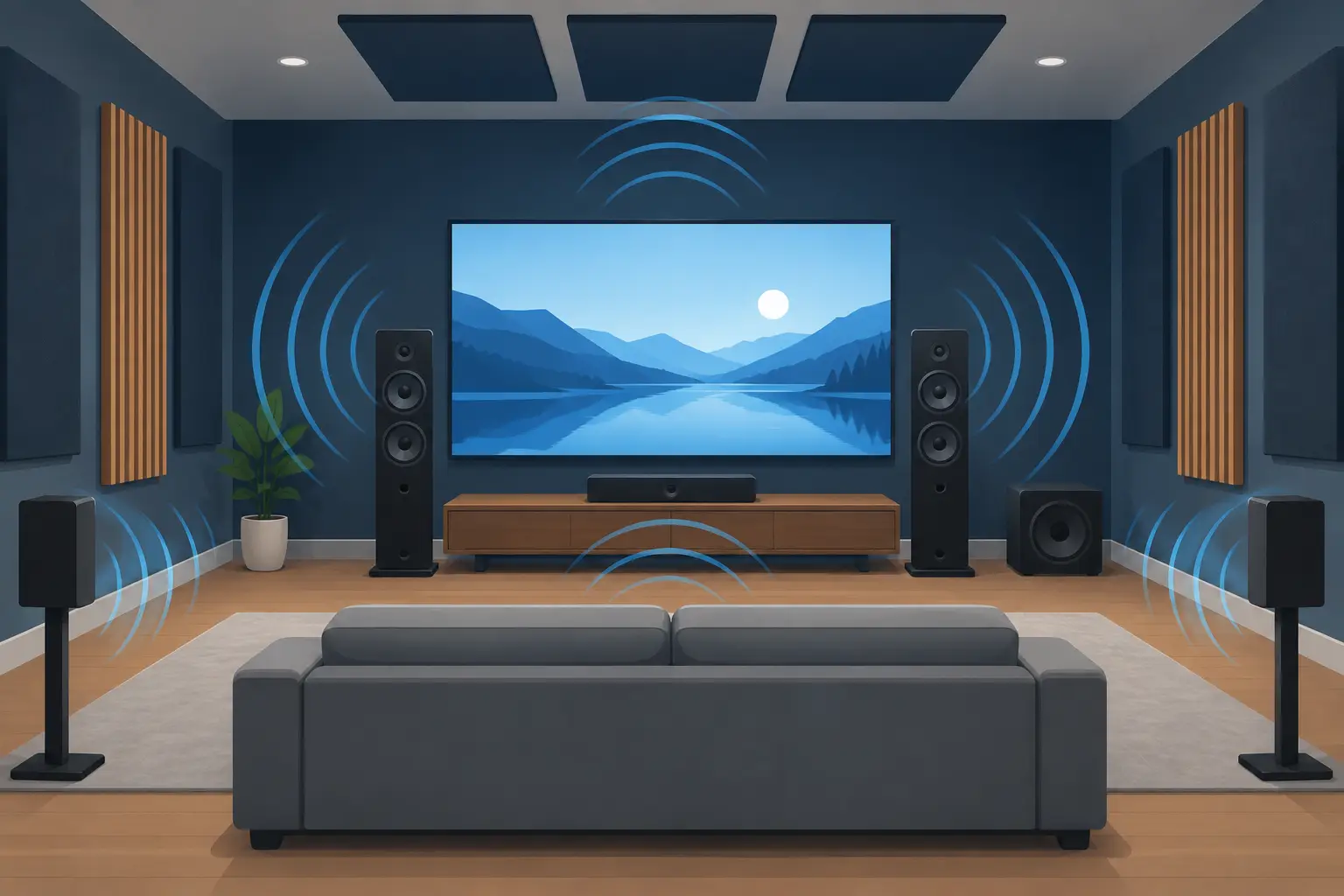
A large TV, projector, and premium speakers can still sound disappointing in the wrong room. If dialogue seems buried, bass shakes one seat but disappears in another, or movie scenes feel harsh at higher volume, the room is often the missing piece. This home theater acoustics guide explains how to create sound that is clear, balanced, and comfortable without turning your living space into a recording studio.
Good acoustics are not about making a room completely silent. They are about controlling how sound reflects, builds up, and travels through the space. When the room and equipment are planned together, a theater feels more natural: conversations are easy to follow, music has detail, and action scenes have impact without becoming tiring.
Why Home Theater Acoustics Matter
Speakers do not send sound only toward the listener. Their output also reaches walls, windows, ceilings, floors, furniture, and nearby openings. Those surfaces reflect, absorb, or scatter sound at different frequencies. The result can either support the movie experience or work against it.
Hard, bare surfaces tend to create strong reflections. In a room with hardwood floors, large windows, and minimal furnishings, those reflections can make voices sound bright or smeared. A room with heavy carpeting and oversized upholstered furniture may absorb too much high-frequency energy, leaving the presentation dull while low-frequency bass still lingers.
Bass is especially dependent on the room. Low frequencies collect in corners and interact with room dimensions, creating areas where bass is overly strong and others where it nearly disappears. Turning up the subwoofer usually does not solve this problem. It often makes the strongest areas worse.
The goal is not perfection on a graph. The goal is a theater that sounds consistent across the main seating area and remains enjoyable through a full movie, not just an impressive five-minute demo.
Start With the Room Before Choosing Treatments
Acoustic products can help, but they should follow a practical evaluation of the room. Size, shape, ceiling height, opening locations, and seating position all affect the result. This is particularly valuable during new construction or a renovation, when wiring, speaker locations, and finishes can be coordinated before walls are closed.
Choose the seating position carefully
Avoid placing the primary row directly against a rear wall whenever possible. That location commonly exaggerates bass and can make surround effects feel crowded. Moving seating even a couple of feet forward can improve balance significantly.
The center of a perfectly rectangular room can also be problematic because of bass cancellations. There is no single measurement that works in every room, but placing the main seats slightly forward or back from the exact center is a sensible starting point. A professional calibration can refine the final position once the system is installed.
Give speakers room to perform
Speaker placement should serve both the design and the listening experience. Front left and right speakers need reasonable separation from each other and from the center channel. The center channel should be aimed toward ear level at the main seats, rather than firing into knees or reflecting heavily off a cabinet surface.
Surround and height speakers also need intentional placement. Hiding every speaker in the nearest available ceiling location may keep a room visually clean, but it can weaken the sense of movement that makes immersive audio worthwhile. In-wall and in-ceiling speakers can deliver excellent results when they are selected and positioned for the room, not simply installed where it is easiest.
Subwoofer placement deserves special attention. A subwoofer placed in one corner may produce strong output, but strong is not always even. Depending on the room, a different wall location or a second subwoofer can create smoother bass across multiple seats. Two properly integrated subwoofers often provide better consistency than one larger unit.
Work with the room’s existing surfaces
Look at the surfaces around the viewing area. Glass, painted drywall, stone, and wood are common in beautiful homes, and none automatically prevents a great theater. They simply require thoughtful balance.
An area rug can reduce floor reflections in a room with hard flooring. Upholstered seating can soften some reflections near listeners. Drapery or motorized window treatments can help manage reflections from large windows while also making daytime viewing more comfortable. These choices should complement the room’s style rather than make it feel overly treated.
A Practical Home Theater Acoustics Guide to Treatment
Acoustic treatment is most effective when each product has a clear job. The three most useful categories are absorption, diffusion, and bass control. They are not interchangeable.
Absorption improves clarity
Absorptive panels reduce reflections that arrive shortly after the direct sound from the speakers. In a dedicated theater, common locations include the side walls near the first reflection points, the wall behind the screen, and portions of the rear wall. Ceiling treatment can also be helpful in rooms with hard floors and a low or reflective ceiling.
Panel thickness matters. Thin decorative foam may change the room slightly, but it does little for the lower midrange frequencies that affect vocal clarity. Purpose-built fabric panels with appropriate thickness and density are generally a more effective choice. They can be wrapped in colors and fabrics that coordinate with the theater rather than looking technical or out of place.
Not every wall needs absorption. Too much can make a theater feel lifeless. A balanced design preserves a sense of openness while reducing the reflections that interfere with clear sound.
Diffusion preserves energy without harsh echoes
Diffusers scatter sound in different directions rather than absorbing it. They are often useful on a rear wall or large back surface, particularly when seating is not very close to that wall. Their role is to break up distinct echoes while keeping the room from becoming overly dead.
Diffusion is not always necessary in a compact media room. If the listening seats are close to the rear wall, absorption may be the better choice. Room size and seating distance determine which approach makes sense.
Bass control requires patience
Bass traps are designed to manage low-frequency buildup, often in corners or along wall-ceiling intersections. They can improve the tightness of bass, but they work best as part of an overall plan that includes subwoofer placement and electronic calibration.
A receiver or processor’s room correction system can make meaningful improvements, especially after the physical layout is right. However, digital correction cannot fully fix a deep bass null caused by the room. It cannot replace proper speaker placement, suitable subwoofer locations, or thoughtful treatment.
Keep Equipment and Finishes Working Together
A polished theater should sound good without becoming difficult to use or visually cluttered. This is where system design matters as much as acoustics. Equipment can be placed in a ventilated rack or cabinet, speakers can be integrated into walls or ceilings where appropriate, and wiring can be planned so there are no exposed cables competing with the room’s finish.
For homeowners updating an existing room, improvements do not always require a complete rebuild. Repositioning a subwoofer, adjusting speaker angles, adding an area rug and window treatments, or installing a few well-placed acoustic panels may provide a noticeable change. The right scope depends on whether the room is a casual family space, a multipurpose media room, or a dedicated theater.
Builders and remodelers benefit from making these decisions early. Framing can accommodate speaker back boxes, wiring paths can remain accessible, and wall finishes can incorporate treatments cleanly. Planning also avoids the familiar problem of trying to fit high-performance equipment into spaces that were never designed for it.
When Professional Design Makes Sense
A simple soundbar setup may only need sensible placement and a few room adjustments. A theater with a projector, multiple subwoofers, immersive audio, concealed speakers, and several seating rows benefits from a coordinated design.
Professional integration brings the room, equipment, wiring, mounting, calibration, and everyday control into one plan. For Northeast Ohio homeowners and builders, Tri-County Technology can help translate the technical details into a theater that feels easy to enjoy from the first movie night. The result should be intuitive: select what you want to watch, settle into your seat, and let the system do its work quietly in the background.
The best theater rooms do not call attention to their acoustic treatment or technical complexity. They simply make every line easier to hear, every soundtrack more involving, and every gathering more comfortable.


No responses yet