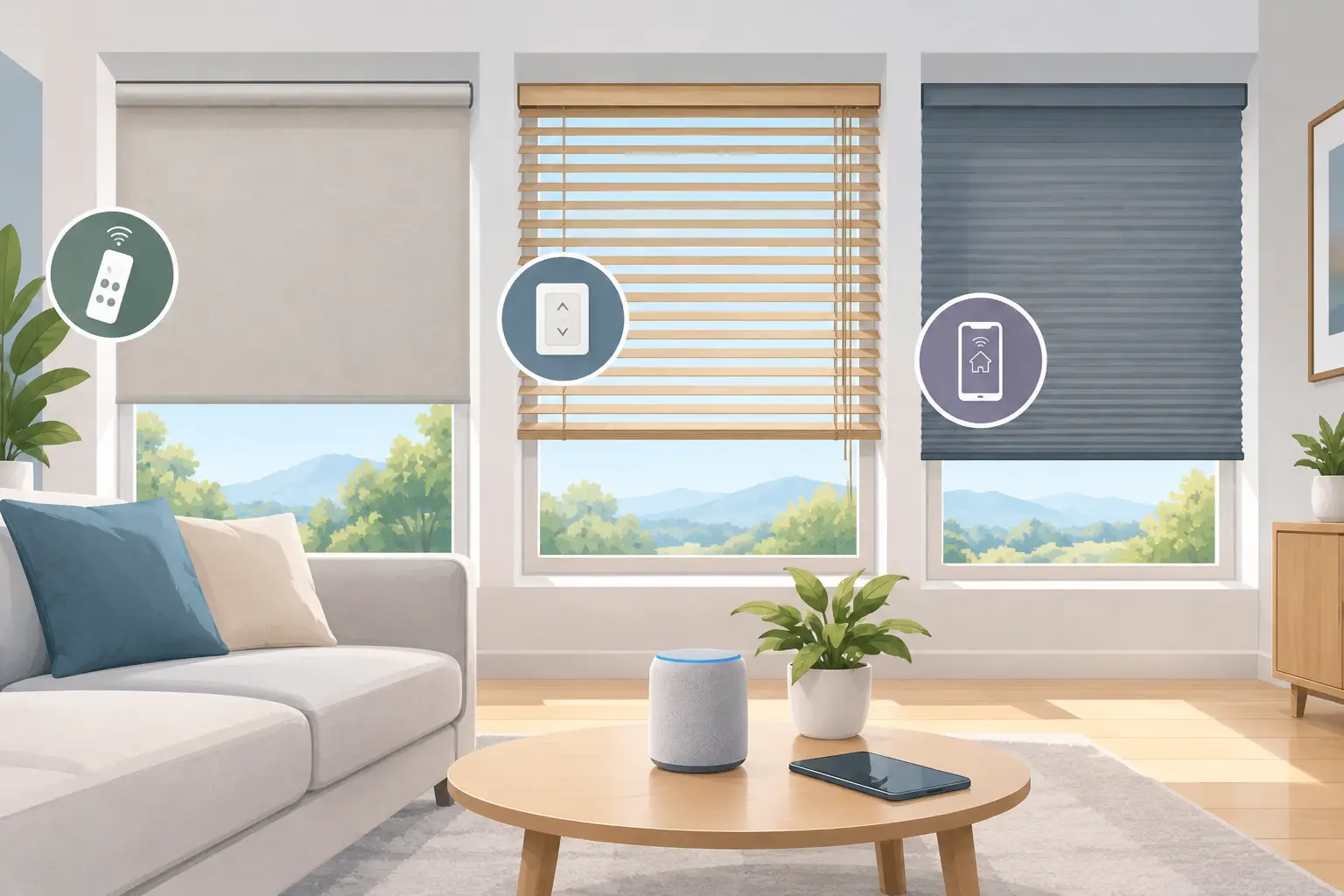
A smart blinds comparison should begin with the room, not the app. The right treatment can soften bright afternoon sun, protect a view from glare, add privacy at the right time, and make a home feel finished without asking anyone to adjust cords all day. The wrong choice can leave a beautiful room with uneven coverage, frequent charging, or controls that feel like one more thing to manage.
For homeowners, builders, and renovators, motorized window treatments work best when they are planned as part of the home rather than added as an afterthought. Here is how to compare the options that matter most in daily life.
Smart Blinds Comparison: Start With the Treatment Style
“Smart blinds” is often used to describe every automated window covering, but blinds, shades, and drapery each solve a different problem. The first decision is not motor type or voice control. It is the level of light control, privacy, insulation, and visual softness the room needs.
Roller shades for a clean, modern look
Roller shades are a natural fit for contemporary interiors, large windows, and rooms where you want the treatment to disappear when raised. They are available in sunscreen fabrics that preserve a view while reducing glare, as well as room-darkening fabrics that block more light.
A sunscreen fabric is useful in a kitchen, living area, or home office with strong sun exposure. It reduces harsh light without making the room feel closed off. Room-darkening roller shades are better suited to bedrooms, media spaces, and any room where early morning light is unwelcome. Keep in mind that a standard roller shade can have small light gaps at the sides, depending on the mounting method and window opening.
Cellular shades when comfort and efficiency matter
Cellular shades use a honeycomb-shaped fabric structure that creates an insulating air pocket at the window. For homes dealing with cold Ohio winters, sunny exposures, or rooms that are difficult to keep comfortable, that added insulation can be meaningful.
They also offer a softer look than many roller fabrics. The trade-off is that cellular shades have a more textured appearance and may not be the first choice for a minimal, architectural design. They are often an excellent fit for bedrooms, nurseries, and spaces where comfort is more important than maintaining an open view.
Venetian blinds for adjustable light direction
Wood, faux wood, and metal blinds use slats that tilt to direct daylight upward or downward. This makes them useful where occupants want to fine-tune brightness without fully raising the treatment. They can complement traditional homes, transitional interiors, and spaces where the detail of the slat is part of the design.
Their trade-off is maintenance. Slats collect dust more readily than a smooth shade, and a motorized tilt-and-lift system can be more complex than a single shade movement. For many homes, a motorized shade provides a simpler daily experience. But blinds remain a strong option when angled light control is the priority.
Drapery for scale, softness, and complete coverage
Motorized drapery brings warmth to tall windows, formal living spaces, primary bedrooms, and large openings. It can be decorative, functional, or both. A sheer drapery layer can diffuse daylight beautifully, while lined panels can provide substantial privacy and room darkening.
Drapery requires careful planning because track placement, stack-back space, fabric weight, and ceiling details all affect the final result. It is especially valuable to involve an integrator and designer early when the treatment will be recessed into a ceiling pocket.
Compare Fabric Before Comparing Features
The fabric choice has a bigger impact on the room than most control features. Consider what occupants should see and feel when the treatment is down: an open view, filtered daylight, softened shadows, or near-darkness.
Sunscreen fabric is rated by openness, which refers to how much light and view can pass through the weave. A lower openness factor generally gives more glare reduction and privacy during the day, while a higher openness factor preserves more of the outside view. Neither is universally better. A west-facing family room may benefit from a tighter weave, while a shaded breakfast nook may need a more open one.
Color matters, too. Dark fabrics can often preserve outward views well because they reduce reflected light on the interior side of the shade. Lighter fabrics can brighten the room and blend quietly into trim or wall color. Samples should be viewed at the actual window during different times of day. What looks refined under showroom lighting may feel very different in direct afternoon sun.
For bedrooms, look beyond the phrase “blackout.” A blackout fabric blocks light through the material, but light can still enter around the edges or above the shade. If a truly dark room is the goal, the system may need side channels, a carefully sized outside mount, or layered treatments.
Power Choices Affect Long-Term Convenience
Every smart blinds comparison should include power early, especially in new construction. There are three common approaches: battery power, plug-in power, and hardwired low-voltage power.
Battery-powered shades are popular for retrofit projects because they avoid opening walls. They can be a good choice for a limited number of windows, windows without nearby power, or a project where preserving finished surfaces matters. Battery life varies with shade size, fabric weight, use frequency, temperature, and motor type. Rechargeable options reduce replacement waste, but they still require a plan for charging.
Plug-in power is practical when an outlet is already located near the window and the cord can be concealed cleanly. It is less ideal when cords would be visible or when furniture placement could interfere with access to the outlet.
Hardwired low-voltage power is usually the strongest choice for whole-home projects, large shade groups, tall windows, and new builds. It removes charging from the homeowner’s routine and supports a cleaner installation. The planning must happen before drywall, which is why builders benefit from coordinating window treatment power with the broader low-voltage plan.
Controls Should Feel Natural, Not Performative
The most useful control method is the one people will actually use. A well-designed system gives occupants more than one simple way to operate the treatments: a wall keypad, a handheld remote, a phone app, scheduled operation, and integration with other home routines.
Wall controls are often the quickest option in daily life. A labeled button near the room entry can lower shades for an evening movie or raise them in the morning without finding a phone. Remotes work well at a bedside or favorite chair. Apps are helpful for checking the home while away or making adjustments, but they should not be the only practical control method.
Schedules are where motorization becomes especially useful. A morning schedule can raise bedroom shades gradually. A late-day schedule can reduce glare in rooms that face the setting sun. The goal is not to automate every movement. It is to remove repetitive tasks while keeping manual control easy for guests and family members.
Voice control can be convenient, particularly for difficult-to-reach windows, but it is best treated as an extra layer rather than the foundation of the system. Physical controls remain dependable when a phone is charging, a network setting changes, or someone simply prefers a button.
Installation Details Determine the Finished Look
Two projects can use the same shade fabric and motor yet look completely different after installation. The difference is often in the measurements, mounting choice, wiring plan, and trim coordination.
Inside mounting places the treatment within the window opening and creates a tidy, built-in appearance. It requires sufficient depth and an opening that is reasonably square. Outside mounting can cover more of the window perimeter, reduce edge light, and solve shallow-depth challenges. It may also make a small window feel larger when the shade is mounted higher and wider than the opening.
For new construction, recessed shade pockets can hide the roller or drapery track when the treatment is raised. This is a polished detail, but it needs coordination among the builder, electrician, drywall team, designer, and technology installer. Retrofitting can still look excellent with the right fascia, valance, or mounting approach. The best choice depends on the architecture and the homeowner’s expectations.
A Practical Way to Make the Right Choice
Start by grouping windows according to how people use the room. Bedrooms may need room darkening and quiet operation. Main living areas may need glare reduction without losing the view. A sunroom may need fabric that manages heat and brightness throughout the day. Tall or hard-to-reach windows may make motorization valuable even if other rooms remain manual.
Then decide where long-term convenience is worth investing in hardwired power. Finally, choose controls that match the household. A family that wants simple routines may prefer a few well-labeled buttons and automatic schedules. A homeowner who travels frequently may place more value on app-based control and remote adjustments.
Tri-County Technology helps bring these decisions together with clean installation and controls that fit naturally into everyday routines. The best smart window treatment is not the one with the longest feature list. It is the one that quietly makes each room more comfortable from morning through night.


No responses yet