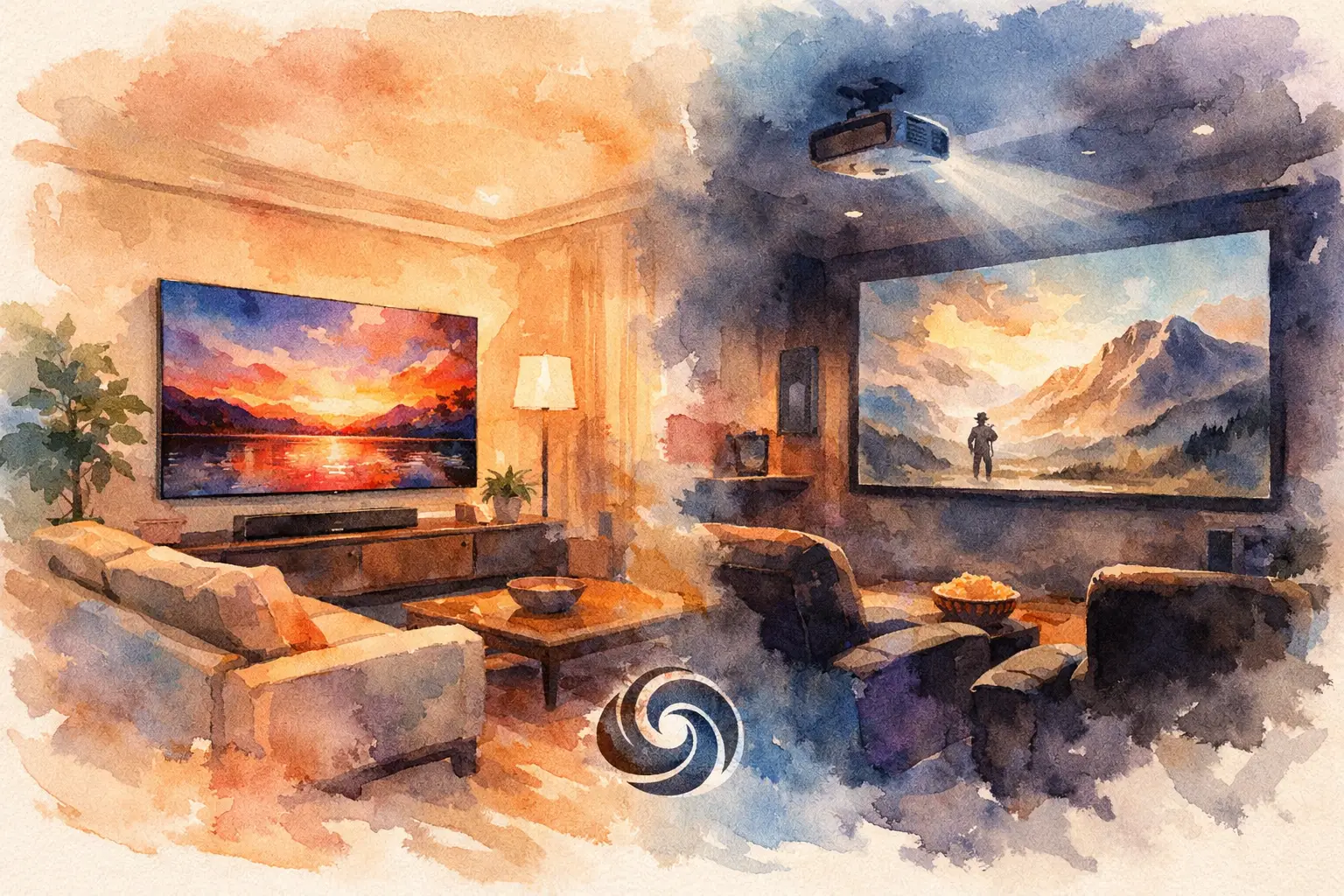
A movie night can feel completely different depending on one decision: the display. In an oled vs projector room comparison, the better choice is rarely about which technology has the best specifications on paper. It is about how you use the room at 2 p.m., at 8 p.m., and on a quiet Saturday when the whole family wants to watch the game.
An OLED TV delivers a bright, crisp picture with very little effort from the homeowner. A projector can create the scale and atmosphere of a true theater, but it asks more from the room around it. The right answer comes from balancing image quality, room conditions, viewing habits, and the level of integration you want behind the scenes.
OLED vs Projector Room: Start With How the Room Lives
A dedicated theater is different from a family room, a finished basement, or an open-concept great room. Before choosing a display, consider whether the space is designed primarily for movies or whether it needs to work for casual TV, kids’ shows, sports, entertaining, and everyday living.
An OLED TV is usually the easier fit in a multipurpose room. It turns on quickly, looks excellent from the moment it starts, and handles a wide range of content well. You can watch a morning news program with the shades open, then switch to a movie after dark without changing the room setup. For busy households, that consistency matters.
A projector is at its best when the room can support it. It rewards thoughtful planning with an image that feels expansive and immersive, especially at screen sizes that would be impractical or costly with a television. In a basement media room or a purpose-built theater, a projector often creates the more memorable experience.
The question is not whether a projector can work in a living room. It can. The question is whether the room will support the kind of picture you expect when sunlight, lamps, windows, and light-colored surfaces enter the equation.
Picture Quality: Bright Detail or Big-Screen Impact?
OLED technology is known for deep black levels, rich contrast, accurate color, and sharp detail. Because each pixel produces its own light, dark scenes remain dark instead of appearing gray or washed out. This is particularly noticeable in movies, prestige television, and games with high-contrast scenes.
OLED also performs well at off-center viewing angles. If a sectional sofa spreads across the room, people seated on either end can still enjoy a consistent image. That is a practical advantage in family rooms where every seat matters.
Projectors approach image quality differently. Their advantage is scale. A properly selected projector and screen can create a 100-inch, 120-inch, or larger image that changes the feeling of the room. Sports become more communal. Movies feel more cinematic. Even a simple streaming series can feel like an event.
That larger image comes with trade-offs. Projector contrast and black levels depend heavily on ambient light, screen material, and room finishes. A white ceiling, pale walls, and uncovered windows can reflect light back onto the screen and soften the picture. A projector may still look good in that setting, but it will not deliver the same dark-scene performance as an OLED.
For viewers who prioritize the most precise image in any lighting condition, OLED has the edge. For viewers who want theater-sized entertainment and are willing to shape the room around it, projection has a compelling advantage.
Light Control Often Decides the Projector Question
In Northeast Ohio, daylight can be surprisingly strong even on overcast days, particularly in rooms with large windows. This does not rule out a projector, but it makes window treatment planning part of the entertainment design.
Motorized shades can make a projector room much easier to live with. With one command, shades can lower, lights can dim, and the display can turn on. The technology should support the experience without making the room feel like a complicated production.
A projector paired with an ambient-light-rejecting screen can also improve daytime viewing. These screens are designed to reduce the effect of certain light sources, but they are not a substitute for good room planning. Bright windows directly opposite the screen, glossy surfaces, and strong overhead lighting still affect the result.
OLED TVs are more forgiving. They are bright enough for most daytime living spaces, and a simple glare check is usually the main concern. If the screen faces a large bank of windows, placement and shades remain worth considering, but the system does not depend on a darkened room in the same way.
Screen Size and Viewing Distance Matter More Than Bragging Rights
A larger screen is not automatically better. The goal is a comfortable, engaging image from the main seating position. A TV that is too small can make a spacious room feel underused. A screen that is too large for the viewing distance can feel tiring during long movies or games.
OLED sizes continue to grow, making them a strong option for many media spaces. A 77-inch or 83-inch OLED can be an excellent fit where viewers sit roughly eight to eleven feet away, depending on personal preference and content. It provides a substantial picture without requiring a dark theater environment.
Projection becomes especially attractive when the room supports seating farther back or when a 100-inch-plus image is part of the goal. For a family that hosts game days or wants a dedicated movie space, that scale is hard to duplicate.
Do not choose a display by diagonal measurement alone. Wall dimensions, furniture layout, speaker locations, ceiling height, and sightlines all deserve attention. A professional design process prevents the common problem of installing a large display first, then discovering it competes with windows, artwork, doorways, or the best seating location.
Installation Is Where the Experience Becomes Easy or Frustrating
An OLED installation is generally more straightforward, but the finished result still benefits from planning. Proper wall mounting, concealed wiring, correctly placed power, and a clean equipment location make the display feel intentional rather than added on. Sound also deserves consideration. Modern TVs are thin by design, which limits the depth and presence of their built-in speakers.
A projector requires more coordination. The projector location, screen location, ceiling structure, cable paths, ventilation, and equipment placement should be determined before drywall whenever possible. Retrofit installations are still very achievable, but early planning provides the cleanest options.
Projector noise is another small but real factor. Quality models are quiet, yet a ceiling-mounted projector sits closer to viewers than a TV does. Selecting the right model and mounting location helps keep fan noise from becoming noticeable during quieter scenes.
Both options benefit from a properly designed audio system and intuitive control. The best room is not one with a stack of remotes and visible cables. It is one where the family can select a source, adjust volume, and enjoy the show without troubleshooting before every movie.
When OLED Is the Better Choice
Choose OLED when the room has regular daytime use, windows you do not want to cover every time you watch TV, or seating spread across a wide area. It is also a strong fit for homeowners who want excellent picture quality with the simplest day-to-day operation.
OLED makes particular sense in primary living rooms, open family rooms, bedrooms, and flexible media spaces. It offers a refined, high-performance result without asking the architecture of the room to become a theater.
When a Projector Is Worth It
A projector is worth serious consideration when you have a basement, bonus room, dedicated media room, or new-build space where light control and screen placement can be planned from the start. It is the natural choice when screen size is central to the experience.
Projection is also well suited to households that value shared viewing. A large screen makes sports, movies, and gaming more social. With the right screen, shades, audio, and controls, the room can feel polished and relaxed rather than overly technical.
A Hybrid Setup Can Be the Smartest Answer
Some homes do not need to choose only one. A large OLED can handle everyday television in the main living area, while a projector serves a dedicated entertainment room. This approach keeps casual viewing simple while reserving the big-screen experience for the space where it will be appreciated most.
For new construction and major renovations, it can be wise to run wiring for future projection even if you begin with an OLED. Conduit, properly placed power, and structured cabling create options without forcing an immediate purchase. Planning ahead is often less expensive and less disruptive than opening finished walls later.
The best display is the one that fits your room and your routine. Whether the answer is OLED, projection, or a thoughtfully planned combination, Tri-County Technology can help turn the technical decisions into a comfortable entertainment space that feels easy to use from the first night.


Comments are closed