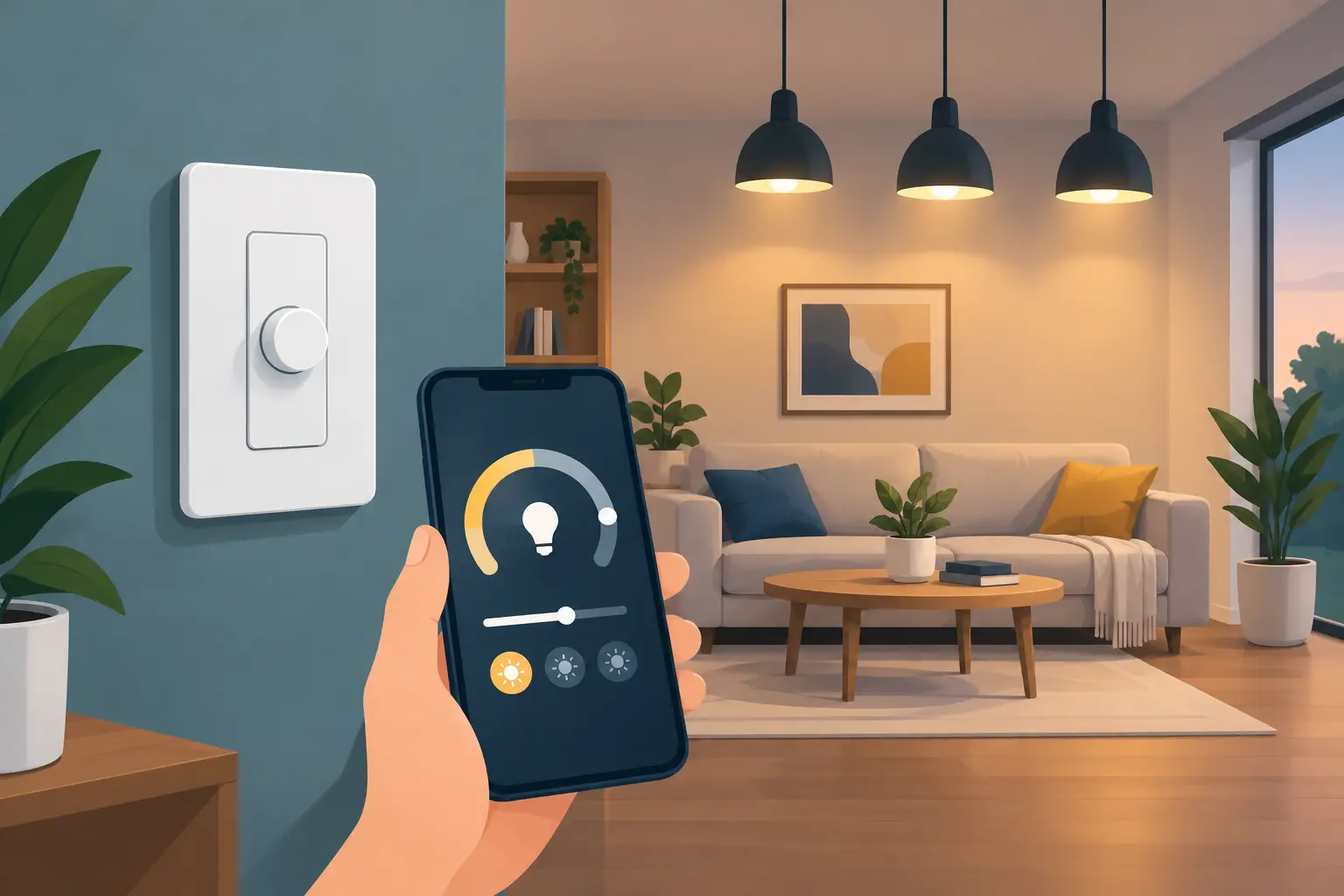
The right lighting does more than brighten a room. It changes how a kitchen feels at breakfast, makes a movie night more comfortable, and lets the house settle down at the end of a long day. So, are smart dimmers worth it? For many homeowners, yes – especially when lighting is part of a larger plan for a more comfortable, easier-to-manage home.
A smart dimmer replaces a standard wall dimmer and gives you more control over the lights already in the room. Depending on the system, you can adjust brightness from the wall, a phone, a handheld remote, or a voice assistant. You can also set schedules and scenes that bring multiple lights to the right level with one simple command.
The real value is not the novelty of controlling a light from the sofa. It is the way lighting begins to support the rhythm of everyday life without adding another complicated system to manage.
What a smart dimmer changes in daily life
A standard dimmer gives you manual control over brightness at one location. That is useful, but it depends on someone walking to the switch, adjusting it, and remembering the preferred setting. A smart dimmer keeps that familiar wall control while adding flexible ways to use it.
For example, a kitchen can be bright for meal prep, softened for dinner, and set low for an early-morning coffee without repeated trial and error. In a living room, one command can lower the overhead lights, turn on accent lighting, and create a more comfortable setting for watching television. A hallway can come on at a modest level overnight rather than flooding the house with bright light.
These small adjustments add up because they remove friction from routines. Good lighting control should feel natural. You should still be able to walk into a room and use a switch, while having the option to make the home respond more thoughtfully when it helps.
Are smart dimmers worth it for energy savings?
Smart dimmers can reduce energy use, but savings alone are rarely the best reason to install them. Dimming a compatible LED fixture uses less power than running it at full brightness, and schedules can prevent lights from being left on longer than necessary. The amount saved depends on how many lights are controlled, how often they are used, and how consistently they are dimmed.
The more meaningful benefit is intentional use. Many rooms do not need full brightness all day. A family room may need 100 percent light while cleaning, but only 30 to 50 percent for a relaxed evening. A smart dimmer makes those lower, more appropriate levels easy to repeat.
There may also be a longevity benefit for compatible bulbs and fixtures, since lights that are regularly operated at lower levels may experience less stress. Still, homeowners should view this as a possible added advantage, not a guarantee that every bulb will last dramatically longer.
The rooms where smart dimmers earn their keep
Smart dimmers tend to be most valuable in rooms with several uses, layered lighting, or frequent changes in mood and activity. Great rooms, kitchens, dining rooms, primary bedrooms, media spaces, and finished basements are common starting points.
They are also helpful in transition areas. A foyer, stairway, or hallway may only need a gentle level of light during the evening. Instead of making a late-night trip feel harsh and bright, the lighting can be set to a lower default level during selected hours.
In a new build or major renovation, smart dimmers are particularly practical because the lighting plan can be considered before walls are closed and fixtures are selected. That creates an opportunity to group lights logically, account for multi-location switching, and keep wall controls clean and consistent.
For existing homes, a retrofit can be just as worthwhile when it focuses on the rooms used most. Starting with a kitchen, main living area, or primary suite often provides more day-to-day value than trying to automate every switch in the house at once.
When smart dimmers may not be the right answer
Not every light needs smart control. A closet, utility room, or infrequently used storage area may be perfectly well served by a standard switch. Adding technology everywhere can increase cost without making the home appreciably easier to live in.
Compatibility is another important consideration. Not every LED bulb, decorative fixture, fan light kit, or low-voltage transformer dims well. Some combinations can flicker, buzz, drop out at low levels, or fail to turn on consistently. Older fixtures and certain specialty bulbs may need replacement before they can deliver a smooth dimming experience.
A smart dimmer also needs the right electrical setup. Many models require a neutral wire in the switch box, though options are available for some homes without one. Three-way and four-way circuits, where a light is controlled from multiple locations, need careful product selection and proper configuration. These details are manageable, but they are exactly why a quick online purchase is not always the whole solution.
Smart dimmers versus smart bulbs
Smart bulbs have a place, especially when color-changing light is a priority or when replacing a single lamp bulb. But for permanent room lighting, smart dimmers are often the more polished choice.
With a smart bulb, the wall switch generally needs to stay on for the bulb to remain connected. If someone turns the switch off out of habit, app and voice controls stop working until the switch is turned back on. That can be frustrating for guests, children, and anyone who simply expects a wall switch to work normally.
A smart dimmer keeps the control where people expect it: on the wall. It can manage multiple compatible bulbs or fixtures together, maintain a consistent appearance throughout the home, and avoid the need to replace several individual bulbs. For most white-light applications, that approach feels more dependable and intuitive.
The value of scenes and schedules
The strongest reason to choose smart dimmers is often the ability to create lighting that fits predictable moments. A scene is simply a saved combination of lighting levels. It can be as straightforward as “Morning,” with brighter kitchen and bathroom lights, or “Evening,” with warm, lower levels in the main living spaces.
Schedules make those settings available at the right time without requiring anyone to remember them. Exterior lights can follow sunset. Common areas can shift to a softer level later in the evening. A home can appear lived in while the owners are away by following a thoughtful lighting routine.
The key is restraint. A useful system does not require dozens of scenes or constant attention. It should provide a small number of settings that match how the household actually lives. When scenes are designed around real habits, they quickly become part of the home rather than another app to manage.
Professional installation brings the pieces together
Installing one compatible smart dimmer can be a reasonable do-it-yourself project for an experienced homeowner. A larger lighting upgrade is different. It involves confirming fixture compatibility, evaluating wiring, selecting controls that work together, programming scenes, and making sure the finished system remains easy for everyone to use.
Professional design is especially helpful for new construction, renovations, homes with multiple lighting zones, and projects that combine lighting with motorized window treatments, whole-home audio, or other connected systems. The goal is not to fill the home with technology. It is to make the pieces work together quietly and predictably.
At Tri-County Technology, the approach starts with how each room is used. That makes it easier to recommend control locations, brightness levels, and simple scenes that feel right from the first day, while leaving room for the home to evolve over time.
How to decide if the investment makes sense
Start with the moments that currently feel inconvenient. Do you regularly walk through the house turning off lights at night? Does the living room feel too bright for relaxing but too dim for reading? Are wall switches scattered in ways that make a room harder to use? Those are stronger reasons for smart dimmers than the desire to add another feature to a phone.
Then consider the scale. A few carefully chosen dimmers can offer a noticeable improvement, particularly in the rooms where your household spends the most time. A broader system may make sense when building or renovating, when consistency across the home matters, or when you want lighting to work alongside other connected features.
Smart dimmers are worth it when they make the home more comfortable with less effort. The best installation does not demand attention. It simply gives each room the right light when you need it, and lets the rest of the day move along more easily.


No responses yet