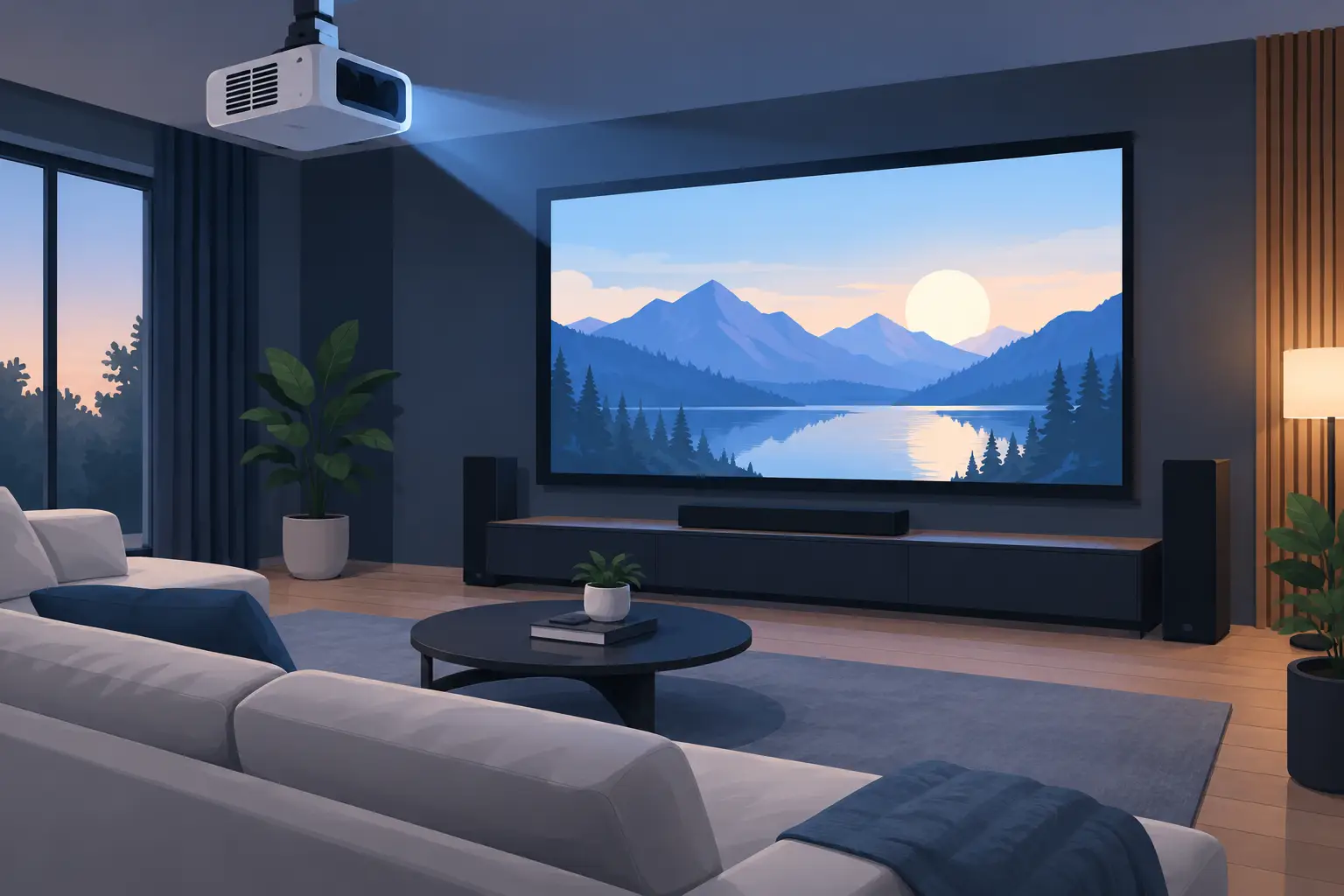
A projector can turn an unused basement wall or a carefully planned media room into the place everyone wants to gather. But the best home theater projectors are not simply the models with the biggest brightness number or the longest feature list. The right choice depends on the room, the screen, the viewing habits, and how easily the system works when it is time to watch something.
For a polished theater, picture quality is only part of the decision. Placement, light control, sound, wiring, and everyday operation all shape the experience. A thoughtfully designed system should make movie night feel effortless, not require a stack of remotes and a troubleshooting session before the opening scene.
What Makes a Projector Right for a Home Theater?
A television is generally easier to place, while a projector is more dependent on its environment. That is not a drawback. It is the reason projection can create a genuinely cinematic image at 100 inches or more. It simply means the room and equipment need to be considered together.
Start with the image size you actually want. For many dedicated theaters, a 100- to 120-inch screen is a comfortable range. A screen that is too large can make standard-definition programming look soft and may force viewers to sit farther back than the room allows. A screen that is too small can leave the projector’s potential on the table.
Then consider viewing distance. As a general starting point, seating around 1.2 to 1.6 times the screen’s diagonal measurement often feels comfortable for 4K content. Personal preference matters, though. Some homeowners want an immersive front-row feel, while others prefer a little more space around the image.
The projector also needs a suitable throw distance. This is the distance between the projector lens and the screen. A standard-throw model may fit neatly at the back of a room, while a short-throw or ultra-short-throw projector can work closer to the screen. Lens shift, zoom range, and ceiling height all affect what is possible without compromising the image.
Best Home Theater Projectors: Choose by Room Type
There is no universal winner because the best projector for a dark, dedicated theater may be the wrong choice for a family room with windows, lamps, and afternoon sports viewing.
Dedicated dark theater rooms
For a room where shades can block outside light and wall finishes are dark or neutral, prioritize black level, contrast, color accuracy, and native 4K detail. These qualities give films depth. Shadowy scenes retain their texture instead of turning into a flat gray field, and bright highlights stand out more naturally.
In this setting, a projector does not need extreme brightness. Too much light can reduce perceived black levels in a fully dark room. A high-quality laser or lamp-based cinema projector paired with a proper screen can produce a rich, balanced picture that feels far more engaging than its specification sheet suggests.
Multipurpose family rooms
A family room calls for a different balance. Ambient light is usually unavoidable, even with good window treatments. Here, higher brightness becomes more valuable, especially for daytime viewing, sports, gaming, and casual television.
Look for strong real-world light output, good color at brighter settings, and an image mode that remains watchable without making every scene look overly harsh. A screen designed to reject some overhead or side light can help, but it cannot fully replace thoughtful light management. The goal is a picture that looks good when the room is being lived in, not just after dark.
Spaces where ceiling mounting is not ideal
Ultra-short-throw projectors sit near the wall rather than across the room, making them appealing for renovations where a ceiling mount is not practical. They can reduce visible equipment overhead and eliminate a long projector run across the ceiling.
They do require precision. Even small changes in the cabinet, wall, or projector position can affect alignment. They also work best with a screen made specifically for ultra-short-throw optics. Using a basic wall or conventional screen may create uneven focus or visible image distortion.
Picture Specifications That Matter Most
Marketing language can make projector shopping feel unnecessarily complicated. A few specifications have a direct impact on what viewers see.
Resolution and processing
Native 4K projectors place all of the image detail on screen at once. Pixel-shifting 4K projectors use fast optical processing to create a 4K-addressable image from a lower-resolution imaging chip. Both can look excellent from normal seating distances when the optics and video processing are good.
For a larger screen and close seating, native 4K may justify the additional investment. For a more modest room, a well-calibrated pixel-shifting model can provide a remarkably detailed picture and leave room in the budget for a better screen, audio, or room treatment.
Brightness, measured in lumens
Lumens describe light output, but the number alone does not determine picture quality. A projector that produces very high brightness may still have weak contrast or limited color performance. Published ratings are often measured in modes that are not ideal for movies.
As a practical guide, a light-controlled theater often works well with roughly 1,500 to 2,500 real-world lumens, depending on screen size and gain. A brighter multipurpose space may benefit from 2,500 to 4,000 lumens. Screen size, screen material, and room light can shift those ranges considerably.
Contrast and black levels
Contrast is the difference between the darkest and brightest portions of an image. It matters most in film content, where dark scenes, night sequences, and letterbox bars reveal whether a projector has convincing depth.
Dynamic contrast figures can be useful, but they are not always comparable between brands. It is wiser to look at overall image performance, especially black level, shadow detail, and how the projector behaves in a room similar to yours. A controlled demonstration is often more revealing than a large number printed on a box.
Light source and long-term ownership
Laser projectors have become popular because they offer long light-source life, quick startup, and steady brightness over years of use. They are often a strong choice for homeowners who want a low-maintenance system.
Traditional lamp projectors can still deliver beautiful cinema images and may cost less at the outset. The trade-off is eventual lamp replacement and a gradual change in brightness. For a dedicated room used mainly on weekends, that can be perfectly reasonable. For frequent viewing in a busy household, laser convenience is often worth considering.
Do Not Treat the Screen as an Afterthought
A projector displays light. The screen determines how that light is reflected back to the viewers. An expensive projector on the wrong surface can look less impressive than a well-matched projector and screen combination.
A white screen with moderate gain is often a reliable choice for a dark theater. Gray or ambient-light-rejecting screens can improve perceived contrast in brighter rooms, but they may narrow viewing angles or alter image uniformity. Ultra-short-throw models need specially designed screens to preserve geometry and reject overhead light effectively.
Screen size should also fit the architecture. A fixed-frame screen gives the cleanest theater appearance and a consistently flat viewing surface. A recessed motorized screen is a smart option when the room serves more than one purpose and the screen should disappear between uses. Planning for power, control wiring, and framing before drywall makes this much easier.
Installation Details That Protect the Picture
Projectors are sensitive to alignment. Keystone correction can rescue a difficult installation, but it digitally alters the image and can reduce visible detail. Whenever possible, choose a location that allows the lens to sit square to the screen and use optical lens shift for fine adjustment.
Ceiling mounting keeps the projector out of the way, but the mount needs to be secure, accurately positioned, and accessible for service. Heat and ventilation also matter. A projector installed in a tight enclosure can run louder or shorten its useful life if airflow is restricted.
Wiring should be planned for the equipment you will own later, not only the source you have now. A quality in-wall HDMI path, conduit for future cable replacement, reliable network connectivity where needed, and clean power distribution prevent many avoidable headaches. In a new build or major renovation, these details are much simpler to address before finishes are complete.
Make Operation Feel Simple
The best picture loses some appeal if the system takes five steps to start. A well-designed theater should let a homeowner press one button and have the projector, screen, audio, source equipment, and lighting scenes respond in the right order.
This is where professional integration adds practical value. Equipment can be tucked away, cables can stay out of sight, and controls can be organized around activities rather than device names. Instead of asking which input is active, the family selects Movie Night, Game Night, or TV, and the room responds appropriately.
For Northeast Ohio homes, basement theaters are especially common, and they often offer excellent natural light control. They can also introduce planning concerns such as lower ceilings, bulkheads, mechanical equipment, and limited pathways for wiring. Addressing those conditions early allows the projector and screen to feel intentional rather than squeezed into the room.
A good projector system should disappear into the routine of the home. Choose the image size that invites people to stay for one more scene, protect that image with the right screen and room conditions, and build controls that feel natural from the first use.


No responses yet