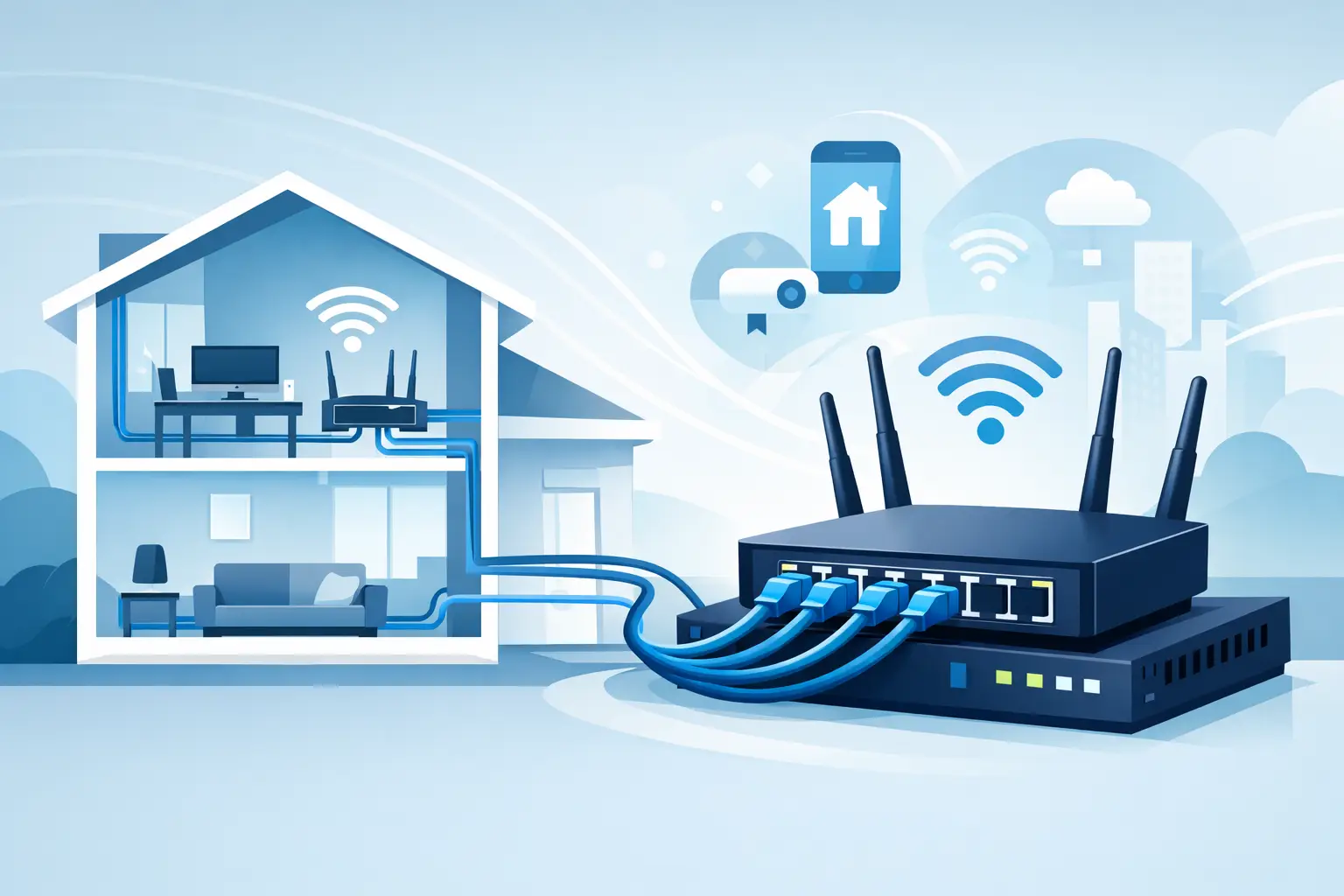
A video call drops when someone walks upstairs. The TV buffers just as the game starts. A smart thermostat responds slowly because the network is crowded. These frustrations are small on their own, but together they change how a home feels. The future of home wifi is not simply about buying a faster router. It is about building connectivity that works quietly, consistently, and wherever life happens.
For homeowners, builders, and renovators, that changes the conversation. Wi-Fi is becoming part of a home’s core infrastructure, much like electrical service, plumbing, and heating. A thoughtful network plan gives every connected device a better foundation while keeping equipment, wiring, and controls out of sight.
Why home Wi-Fi is changing
Homes now carry more connected devices than most networks were designed to support. Phones, laptops, streaming televisions, gaming systems, tablets, thermostats, speakers, appliances, cameras, and work equipment all share the same airspace. Even households that do not consider themselves especially technology-focused may have dozens of devices competing for a reliable connection.
The challenge is not only the number of devices. It is where and how they are used. A family may stream in the living room while a parent joins a video meeting from a home office and a student completes online coursework upstairs. Add a finished basement, patio, detached garage, or workshop, and a single router placed wherever the internet provider installed it is rarely enough.
New Wi-Fi standards will help networks handle more devices and reduce congestion. Faster internet service will also continue to become available in more areas. But neither improvement can overcome poor placement, weak coverage, unsuitable equipment, or a home built with materials that block wireless signals. The best results come from treating Wi-Fi as a complete system rather than one box on a shelf.
The future of home wifi is built around coverage
Speed gets the headlines, but coverage is what people notice every day. A fast connection in one room does little good if calls freeze in the office or streaming stalls in the bedroom. The homes that feel easiest to live in have dependable coverage where people actually spend time.
That often means using multiple professionally placed wireless access points instead of relying on one central router. Each access point serves a portion of the home, allowing phones and tablets to move between spaces without the sudden dead zones that frustrate everyday use. Placement matters as much as the equipment itself. An access point hidden in a mechanical room, tucked into a cabinet, or blocked by masonry will not deliver the same experience as one planned around the home’s layout and construction.
Mesh systems can be a practical option for some smaller homes or simple retrofit projects. They are convenient and can improve coverage quickly. However, mesh units that communicate wirelessly with one another may lose performance as the signal travels through walls and floors. For larger homes, new construction, or more demanding use, wired access points usually provide a stronger and more predictable result.
Wiring remains the long-term advantage
Wireless technology is improving, yet the best wireless networks still benefit from wires behind the walls. Structured wiring gives a home a dependable path for access points, streaming equipment, office connections, and future upgrades. It reduces the need to rely on a distant wireless signal for every device and gives an installer more options as a household’s needs change.
For builders, this is a valuable distinction. Running quality low-voltage cable during construction is far easier and more cost-effective than opening finished walls later. A well-planned wiring enclosure or equipment location also keeps network hardware organized rather than scattered across closets, counters, and entertainment furniture.
Homeowners planning a renovation can take advantage of the same opportunity. If ceilings or walls are already open, it is an ideal time to consider wiring for access points, televisions, workspaces, and other high-use areas. Not every room needs the same level of connection, but a plan should account for the way the household lives now and the rooms likely to matter later.
Faster Wi-Fi will not fix every problem
Newer equipment can offer real gains, especially in busy homes. Wi-Fi 6 and Wi-Fi 6E are designed to manage many connected devices more efficiently, while Wi-Fi 7 is beginning to arrive with the promise of higher capacity and lower latency for compatible devices. These developments are meaningful, but they are not automatic cures for an underperforming network.
A home may not see much improvement from the newest standard if the internet service itself is limited, the device is older, or the signal still has to pass through several dense walls. Compatibility matters, too. A new access point can support an advanced standard, but phones, laptops, and streaming devices must also support it to receive the full benefit.
This is why a practical recommendation starts with the home, not a product label. Some families will benefit most from better placement and wired access points. Others may need upgraded equipment because their device count, work demands, or media use has grown. The right answer depends on the home’s size, building materials, internet service, and daily routines.
More connected rooms call for better planning
The next generation of home Wi-Fi will reach beyond the main living areas. Reliable coverage on a patio makes outdoor entertaining easier. A stable connection in a garage or workshop supports flexible work and hobbies. Strong service in a basement can turn a frustrating dead zone into a comfortable media room, fitness space, or guest area.
This broader reach needs careful design. Extending Wi-Fi everywhere without a plan can create overlapping signals, inconsistent performance, and more devices competing for limited capacity. A professional assessment considers floor plans, wall materials, equipment locations, existing cabling, and the places where performance matters most.
It also considers appearance. Technology should not take over the room. Cleanly installed access points, properly managed wiring, and a designated equipment location help a home stay polished while making support and future changes easier. The goal is not to fill a house with visible gadgets. It is to create a connection that feels natural to use.
A network should be easy to live with
The most successful home technology is rarely the most noticeable. It works in the background, supports daily routines, and does not require constant attention. Wi-Fi should follow that same standard.
That means choosing equipment that fits the household rather than chasing features that will never be used. It means giving the network room to grow, without overspending on capacity a small home does not need. It also means having a clear plan for support when internet providers change equipment, a renovation affects wiring, or a new work-from-home setup creates new demands.
For a custom home, planning should begin before drywall. For an existing home, a walkthrough can reveal practical upgrades without turning the project into a major disruption. Tri-County Technology approaches connectivity as part of the home experience: designed around how people work, relax, entertain, and move through their spaces.
What to consider before your next Wi-Fi upgrade
Before replacing equipment, look at the pattern behind the problem. Does performance drop in one area or throughout the house? Is the issue coverage, internet speed, device congestion, or an aging router? Is the home being remodeled, expanded, or prepared for a new home office? These answers shape the right investment.
It is also worth thinking several years ahead. A network designed only for today’s device count can feel outdated quickly. Leaving room for additional wired connections, future access points, and equipment changes helps protect the investment without making the system unnecessarily complicated.
The future of home WiFi will be less about visible technology and more about dependable experiences: a call that stays clear, a movie that starts without waiting, and a home office that works as well as the room looks. A well-planned network gives a home the quiet confidence to keep up with whatever comes next.


Comments are closed