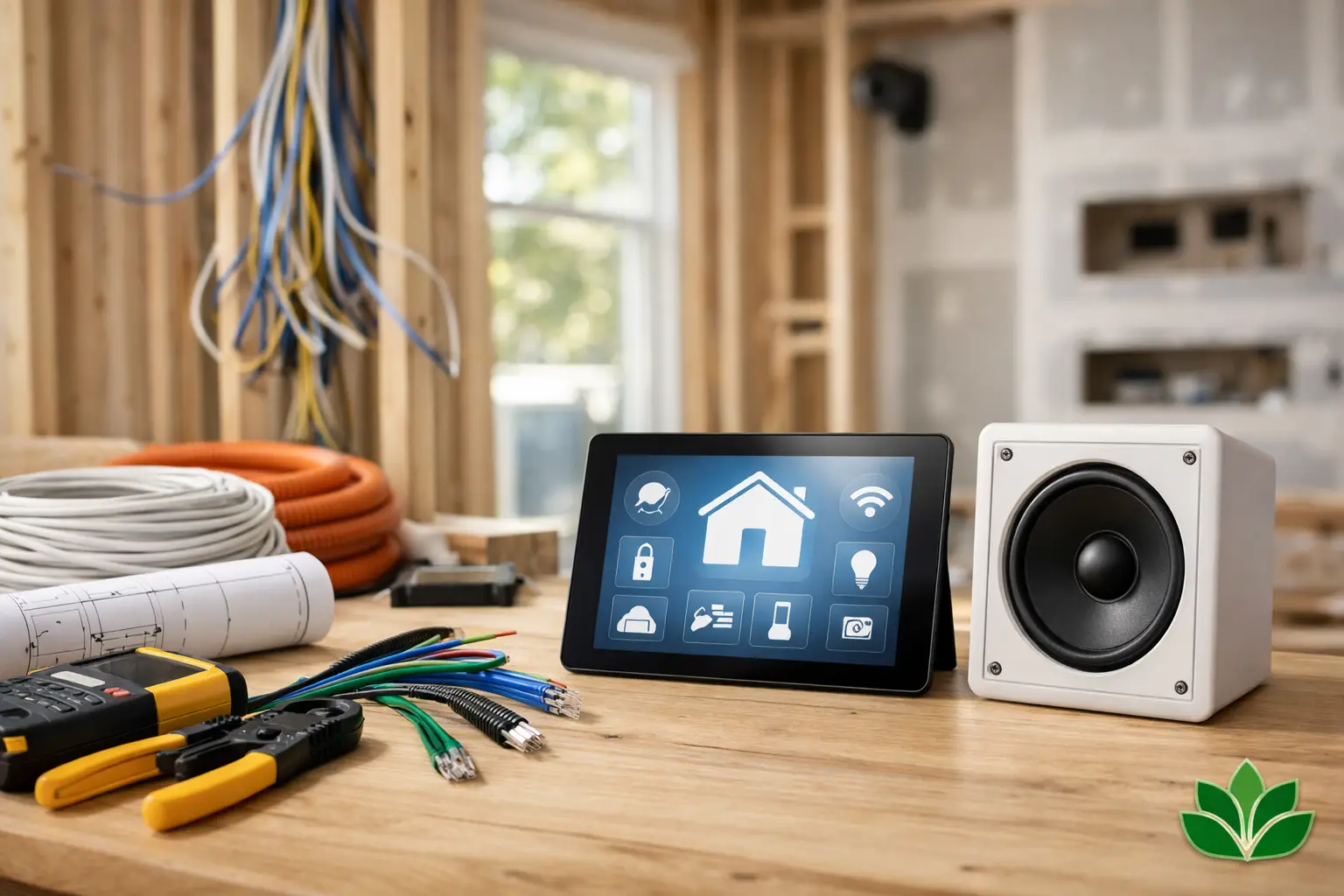
A few extra cable runs before drywall can save you from years of workarounds, weak signals, and visible add-ons. That is the real value of a smart home prewire planning guide – making decisions early so your home feels clean, reliable, and ready for the way you actually live.
Prewiring is not about filling walls with every cable you have heard of. Good planning is more selective than that. The goal is to put the right low-voltage infrastructure in the right places, so your future security, entertainment, networking, and control systems work the first time and still make sense five or ten years from now.
What a smart home prewire planning guide should solve
Most homeowners do not regret wiring too little because they wanted fewer options. They regret it because nobody translated the plan into everyday use. A prewire plan should answer simple questions. Where will Wi-Fi be strongest? Where will TVs sit without exposed wires? Which rooms may want audio later? Where should cameras go for useful coverage instead of just checking a box?
That is why prewire planning works best when it starts with lifestyle, not products. A family room used every evening may deserve stronger network support and clean media wiring. A home office may need hardwired data for dependable video calls. A front entry, driveway, and back patio may need camera locations that balance visibility, privacy, and practical installation.
The best plans also account for the fact that priorities change. You may not install motorized shades, distributed audio, or outdoor entertainment right away. But if the home is wired with those possibilities in mind, future upgrades become much simpler and far less disruptive.
Start with the rooms you use most
A strong prewire plan usually begins room by room. Not every space needs the same level of infrastructure. Primary living spaces, offices, media rooms, and outdoor gathering areas tend to benefit most from thoughtful wiring, while guest rooms or secondary spaces may only need a lighter touch.
In a great room, for example, it often makes sense to plan for a TV location, power coordination, data, and speaker wiring if surround sound or distributed audio is even a remote possibility. In a home office, wired network connections matter more than people expect, especially in households where several devices are competing for bandwidth all day.
Bedrooms can be simpler, but they still deserve some foresight. Even if a television is not in the plans today, wiring pathways and data access can preserve options later. The same goes for patios and outdoor living areas. If people gather there, technology tends to follow.
Network wiring comes first
If there is one part of this smart home prewire planning guide that affects nearly everything else, it is the network. Smart devices, streaming, remote access, video doorbells, surveillance, and app-based control all depend on a stable connection. Wi-Fi matters, but Wi-Fi works best when it is supported by good wiring behind the scenes.
That usually means running data cable to wireless access point locations, key TV areas, offices, and any devices that benefit from a hardwired connection. It also means choosing a central location for your structured wiring hub or network enclosure. That space should be accessible, ventilated, and practical for service, not hidden in the least convenient corner of the house.
This is one area where underplanning creates ongoing frustration. A beautiful new home can still have dead zones, overloaded wireless devices, and unreliable streaming if the network backbone was treated as an afterthought. Prewiring gives you the chance to build that backbone correctly from the start.
Security and surveillance need placement, not just wiring
Security wiring should never be approached as a generic package. Camera locations, door contacts, motion coverage, video doorbell placement, and alarm devices all work better when they are chosen for the property itself.
A camera at the front door may seem obvious, but the better question is what view actually helps. Do you want faces at the entry, activity at the porch, packages at the doorstep, or a wider angle that shows the driveway approach? The right answer depends on the layout of the home and what gives you real peace of mind.
The same principle applies indoors. Not every opening needs the same level of protection, and not every room benefits from the same device type. A good plan balances security goals with appearance and ease of use. You want coverage that feels thoughtful, not excessive.
Audio, video, and comfort features are easier to plan now
Many homeowners focus first on security and internet, then realize later they also want music in the kitchen, better TV sound in the living room, or a clean outdoor entertainment setup. Those upgrades are far easier when the wiring is already in place.
Speaker wire, subwoofer locations, television backing, conduit, and control cable paths are all worth considering before walls are finished. Even if you install only part of the system now, the home remains ready for future phases without opening ceilings or fishing wires through insulation.
Window treatments and lighting control can also benefit from early coordination. The specifics depend on the products you choose, but planning for power and low-voltage pathways ahead of time gives you more flexibility and cleaner results.
Conduit is one of the smartest low-cost decisions
When homeowners ask how to future-proof a house without overspending, conduit is often part of the answer. It is not necessary everywhere, but in the right spots it creates breathing room for later changes.
Conduit can be especially useful between a central wiring location and major television areas, office spaces, or places where technology tends to evolve quickly. It gives you a path for future cable upgrades without opening finished walls. That matters more than ever because equipment changes faster than the structure around it.
There is a trade-off, of course. Adding conduit everywhere can become expensive and unnecessary. The better approach is targeted flexibility in the spaces most likely to change.
Plan for serviceability, not just installation day
A neat smart home installation is not only about what disappears into the walls. It is also about what happens later when equipment needs to be upgraded, restarted, or serviced. That is why good prewire planning includes access, labeling, rack or enclosure space, and enough room for the system to grow.
This is where professional design brings real value. It is easy to focus on what will be visible in the room and ignore the supporting infrastructure behind it. But dependable systems rely on organized terminations, logical cable runs, and hardware locations that technicians can reach without turning a simple service call into a bigger project.
For homeowners in Northeast Ohio building a new home or renovating an existing one, that kind of planning can be especially helpful during busy construction schedules. It keeps the technology portion aligned with the builder, electrician, and other trades before small oversights become expensive corrections.
Common prewire mistakes to avoid
The most common mistake is waiting too long. Once framing is complete and decisions are rushed, people tend to wire only for immediate needs. That usually leaves out the spaces and features that matter six months after move-in.
Another mistake is assuming wireless will handle everything. Wireless devices are useful, but they are not a substitute for a well-planned low-voltage foundation. The stronger the wired infrastructure, the better the overall experience tends to be.
It is also common to overfocus on hardware brands too early. During prewire, placement and infrastructure matter more than the exact device model. Good wiring keeps your options open. Bad wiring limits them from day one.
A practical way to think about your prewire plan
If you are building or remodeling, think in layers. First, support the network. Then cover safety and surveillance. After that, plan for entertainment, comfort, and convenience in the rooms where they will make the biggest difference. Finally, add selective flexibility for future upgrades.
That approach keeps the budget grounded while still protecting the home from costly missed opportunities. It also helps you avoid the all-or-nothing mindset. You do not need every feature installed on day one to make smart decisions now.
A well-planned home should feel easy to live in, not filled with technology for its own sake. The right prewire strategy gives you cleaner walls, stronger performance, and fewer compromises later. If you are making decisions while the walls are still open, this is the moment to plan for the home you want to enjoy, not just the one you can finish this month.


Comments are closed