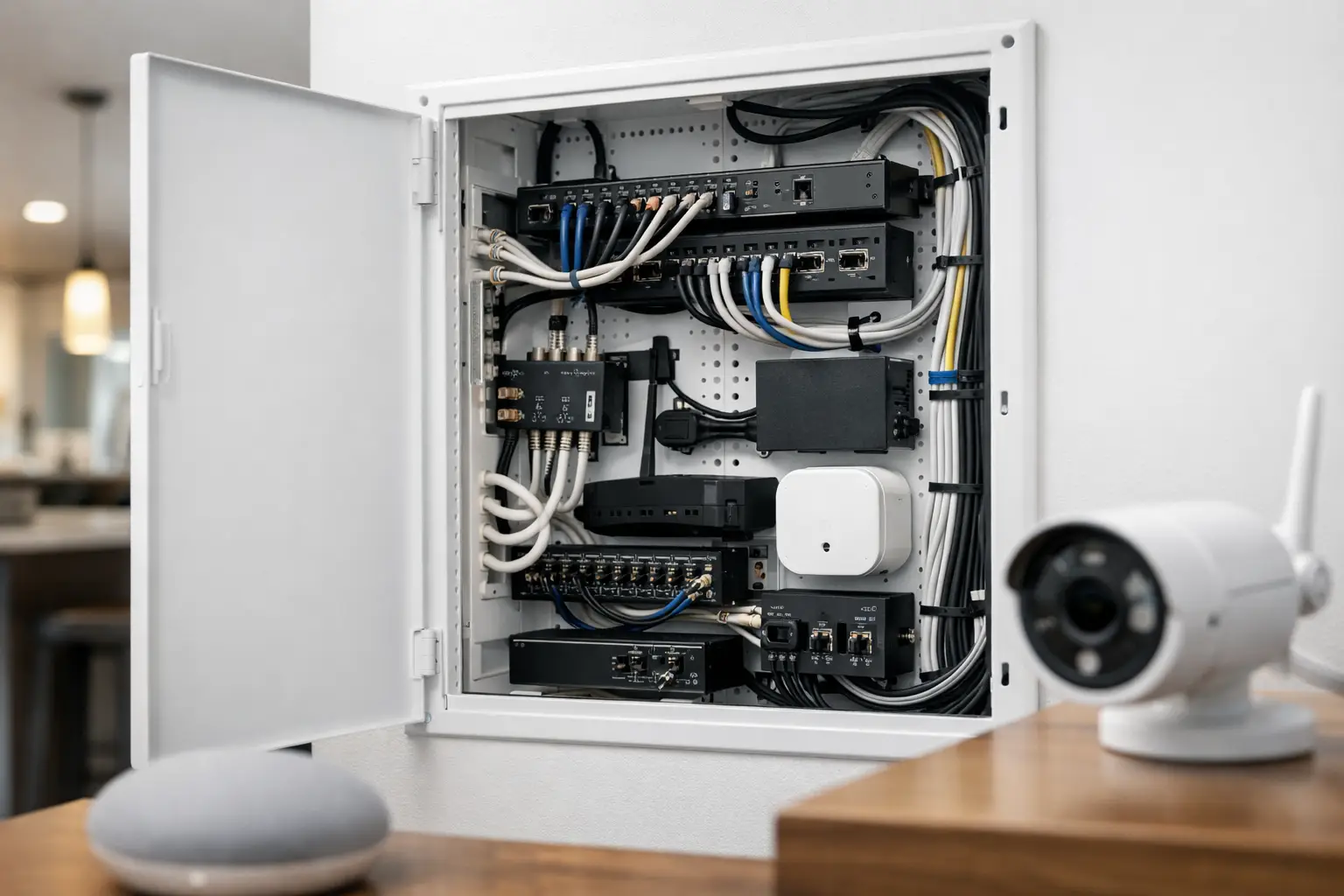
You usually notice a technology problem only after it starts getting in the way. The Wi-Fi drops in the office, a TV location never gets a clean signal, or a security upgrade turns into a tangle of cables and patchwork fixes. A home structured wiring panel helps prevent that kind of frustration by giving your low-voltage systems one organized, central place to live.
For homeowners, builders, and renovators, that matters more than it might seem at first. The panel is not the flashy part of a smart home or connected home. It sits quietly behind the scenes. But when it is planned well, it supports stronger connectivity, cleaner installations, easier service, and more reliable performance across the spaces you use every day.
What is a home structured wiring panel?
A home structured wiring panel is a central enclosure where low-voltage cabling and related components are terminated, organized, and distributed. Think of it as the home base for communication lines inside the house. Ethernet runs, coax cables, phone lines in older systems, and wiring for certain smart home or audio applications often route back to this location.
In many homes, the panel is installed in a utility room, basement, mechanical area, closet, or garage. The exact spot depends on the layout of the home, how accessible the space is, and how the rest of the system is designed. The goal is not just to hide wires. The goal is to create a clean and serviceable foundation for the technology that supports daily life.
A well-designed panel often includes patch modules, splitters, network switches, cable management, and power where needed. In some projects, it also serves as the logical hub for internet distribution, surveillance support equipment, and hardwired connections to key rooms. What goes inside depends on the house and on how the owner wants to use it.
Why the panel matters more than people expect
A lot of technology headaches start with poor infrastructure, not bad devices. If the wiring is scattered, unlabeled, or crammed into random wall cavities, every future upgrade becomes harder. The home may still function, but it will not be easy to expand, troubleshoot, or keep looking clean.
That is where a home structured wiring panel earns its value. It creates order. Instead of one cable going to a modem in a corner, another disappearing behind drywall, and another feeding a room with no clear label, everything comes back to a central point. That makes the system more predictable.
Predictability is what supports reliability. If you want stable data connections for work-from-home needs, better streaming performance, properly placed wireless access points, or a cleaner path for adding smart security and whole-home audio, centralized wiring gives those systems a better foundation.
There is also a practical service benefit. When a future issue comes up, a professional can test, identify, and adjust the system far more efficiently if the cabling is organized and terminated correctly. That saves time, reduces guesswork, and often avoids the need for intrusive rework.
What belongs inside a home structured wiring panel
Not every panel looks the same, and that is a good thing. The right setup should reflect the home, not force the home into a generic package.
Most often, the panel is home to the low-voltage terminations that feed rooms throughout the house. Ethernet runs may connect through patch modules or directly to a network switch. Coax lines may be split and distributed from the same enclosure if the home uses them for internet, television, or other signal distribution. Some systems also include surge protection, power modules, or compact support hardware to keep related components together.
This is one of those areas where balance matters. A panel should be organized and expandable, but it should not be stuffed with equipment that runs hot, requires frequent hands-on access, or would perform better in a dedicated rack or adjacent location. In smaller homes, one enclosure may be enough. In larger or more advanced homes, the structured wiring panel may work alongside a separate equipment area for networking, audio, and other connected systems.
That distinction matters because neatness alone is not the goal. Performance, ventilation, accessibility, and long-term serviceability all need to be considered.
Structured wiring panel vs. electrical panel
This is a common point of confusion. A structured wiring panel is not the same as your electrical breaker panel.
The electrical panel handles high-voltage power distribution for the home. The structured wiring panel handles low-voltage cabling and communication pathways. They may be located near each other in some homes, but they serve very different purposes.
Keeping that separation clear is important for safety, code considerations, and system performance. It also helps homeowners understand why a low-voltage specialist is often the right professional for planning and installing this type of infrastructure.
When it makes sense to install one
New construction is the easiest time to add a structured wiring panel because the walls are open and cable paths can be planned from the start. This gives you more flexibility to route wiring to office spaces, TV locations, access points, audio zones, and exterior device locations before drywall goes up.
But retrofit projects can benefit too. If you are renovating, finishing a basement, upgrading an older home, or dealing with unreliable connectivity, adding or reorganizing a panel can make a real difference. It may not be possible to hardwire every room in an existing house without major disruption, but even partial improvements can create a cleaner and more dependable system.
This is especially useful in homes where technology needs have changed. A floor plan that once needed a single cable modem and one television may now need strong Wi-Fi coverage, remote work support, outdoor cameras, smart device integration, and better network distribution across multiple levels.
Planning for today without boxing out tomorrow
One of the biggest mistakes in low-voltage planning is building only for current needs. Technology changes, families change, and the way people use their homes changes too.
A smart panel design leaves room for growth. That might mean extra cable runs, spare capacity in the enclosure, or a layout that makes future upgrades simpler. Even if you are not ready for every feature now, prewiring and organized termination points can save money and disruption later.
There is a trade-off, of course. Overbuilding can add cost to a project, especially if the home will never use that capacity. Underbuilding can create limitations that are frustrating and expensive to correct. The right approach is usually a practical middle ground – enough infrastructure to support likely future needs without turning the project into a technology wish list.
For many homeowners, that means prioritizing reliable network cabling to offices, media areas, wireless access point locations, and a few flexible extra drops in places where needs may evolve.
What professional installation changes
A structured wiring panel can look simple from the outside, but the difference between a basic enclosure and a well-executed system is significant. Cable routing, bend radius, labeling, termination quality, enclosure sizing, grounding considerations, and equipment placement all affect the final result.
Professional installation is not just about making it neat. It is about making it work well over time. Clean labeling helps with future service. Proper terminations support signal integrity. Thoughtful layout reduces clutter and avoids a panel that becomes unusable the moment one more device needs to be added.
For homeowners in Northeast Ohio, this matters even more during remodels and older-home upgrades where existing construction can limit options. An experienced integrator can help determine what is realistic, what is worth hardwiring, and what should be left flexible.
That is the kind of planning Tri-County Technology focuses on – systems that feel simple in daily use because the infrastructure behind them was handled correctly from the beginning.
How to tell if your current setup needs attention
You do not need to open a wall to know something is off. A few signs usually show up first. Internet equipment ends up scattered across multiple rooms. Cables are unlabeled and impossible to trace. A service call turns into a hunt for where wires actually go. Adding a new TV, camera, or network line feels harder than it should.
None of those issues automatically mean you need a full rebuild. Sometimes a panel can be reorganized, relabeled, or modestly expanded. In other cases, an older setup may need a more thoughtful redesign to support the way the home is used now.
The right answer depends on the age of the home, the condition of the wiring, and what you want the system to do next. A small fix can be enough. Sometimes it is smarter to create a proper foundation instead of continuing to patch around one weak point after another.
A home structured wiring panel is easy to overlook because it does its best work quietly. That is exactly why it matters. When the infrastructure is clean, central, and planned for real life, the technology in your home has a much better chance of feeling dependable, comfortable, and easy to live with for years to come.


Comments are closed