A light switch seems like a small decision until it becomes part of every morning, movie night, bedtime routine, and trip away from home. The real question behind Lutron versus smart switches is not which device has the most features. It is which lighting control will feel dependable, intuitive, and appropriate for the way your household actually lives.
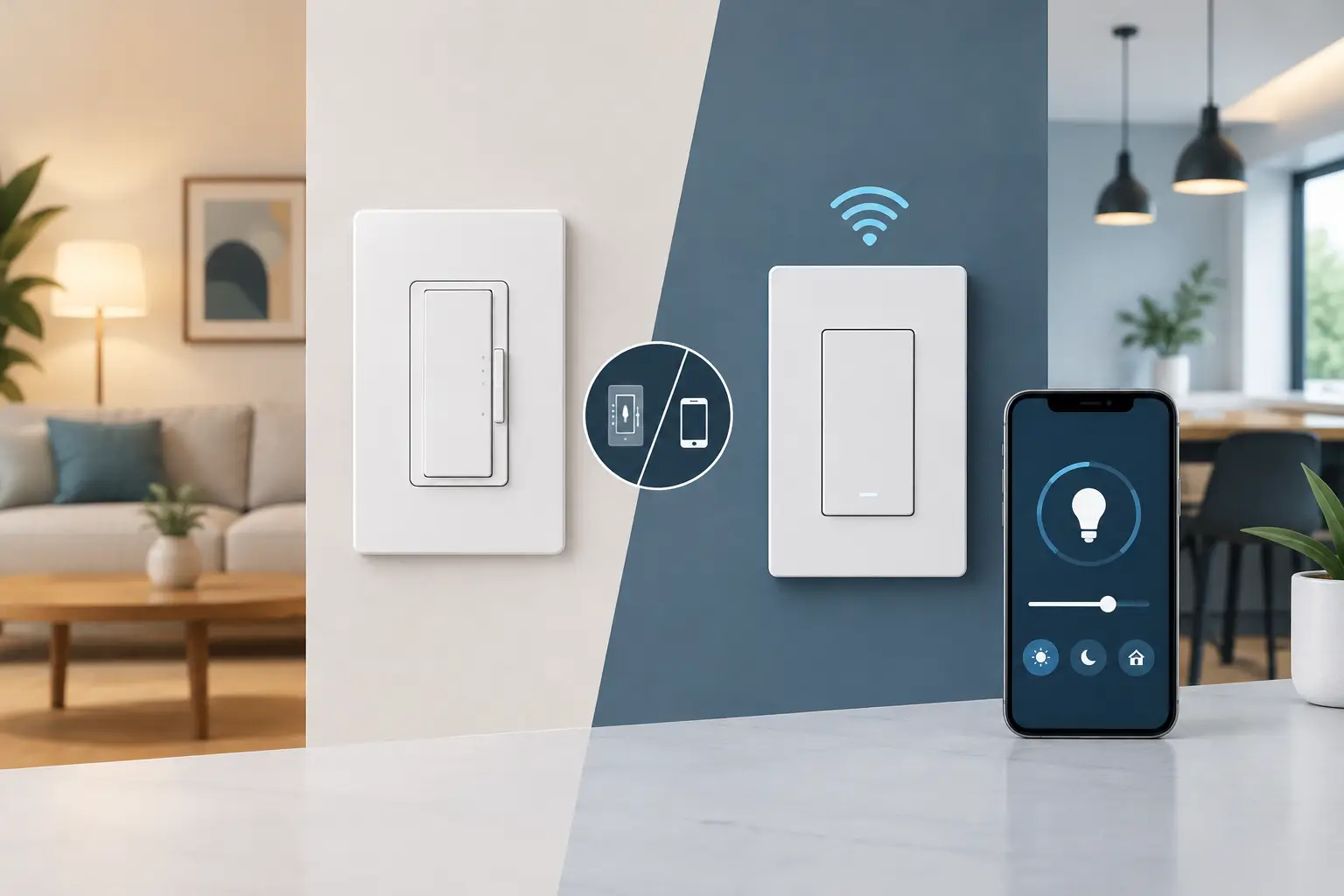
Lutron is often discussed as though it sits outside the smart-switch category. In reality, Lutron offers smart lighting controls. The more useful comparison is between Lutron’s established lighting systems and the many Wi-Fi, Bluetooth, Zigbee, Z-Wave, and Matter-compatible switches sold as general-purpose smart devices. Both can bring useful automation to a home, but their approach to reliability, design, and expansion is very different.
Lutron Versus Smart Switches: The Core Difference
Many consumer smart switches are designed as standalone products. Replace a switch, connect it to an app, join it to the home’s wireless network, and begin setting schedules or voice commands. For a single closet, laundry room, or guest room, that can be a sensible and affordable approach.
Lutron systems are designed around lighting control as a complete experience. Depending on the product family, controls communicate through a dedicated wireless signal rather than relying on the same Wi-Fi network used by phones, televisions, and laptops. That distinction matters in larger homes, homes with dense construction materials, and households that expect the lights to respond immediately every time.
The difference is not simply technical. A standalone smart switch can be a convenient gadget. A thoughtfully designed Lutron system can make a room or an entire home feel calmer because everyday lighting behaves consistently without requiring anyone to think about an app.
Reliability Is Usually the Deciding Factor
Wi-Fi smart switches have improved considerably, and many work well when the network is healthy and the installation is simple. Still, each added Wi-Fi device becomes another client competing for wireless capacity. A home with dozens of switches, speakers, cameras, thermostats, and streaming devices can place real demands on an average wireless network.
This does not mean Wi-Fi switches are inherently poor choices. They can be a practical fit for a limited retrofit, a rental property, or a homeowner who wants basic control in one or two spaces. The trade-off is that performance depends heavily on the quality of the network, the manufacturer’s app support, and continued firmware compatibility.
Lutron’s dedicated lighting communication is one reason builders and homeowners frequently choose it for broader projects. Commands tend to feel immediate. Physical controls continue to work normally even when an internet connection is unavailable. The system also reduces the temptation to fill a home with unrelated apps, each with its own account, updates, and notifications.
For homeowners in Northeast Ohio, dependable operation can be especially valuable during the seasons when a darker afternoon makes lighting more central to daily comfort. A scheduled entry light or a one-button evening scene should feel ordinary, not experimental.
Better Dimming Starts With the Right Hardware
Dimming is where the difference between products often becomes visible. LED bulbs use very little energy, but not every bulb and dimmer pair behaves well together. Common problems include flickering, popping on at a low level, limited dimming range, or lights that fail to turn fully off.
Lutron has spent decades developing dimming controls and testing bulb compatibility. That experience does not guarantee that every bulb will perform identically, but it gives installers and homeowners a much clearer path to a stable result. Selecting compatible lamps, choosing the correct dimmer type, and setting the low-end trim can make a meaningful difference in how a room feels at night.
Generic smart dimmers vary widely. Some offer good performance, while others provide limited adjustment and little guidance when a particular LED fixture misbehaves. If a home has decorative fixtures, recessed lighting, under-cabinet lighting, or large groups of LEDs, the dimming experience deserves more attention than a product comparison chart can provide.
Physical Controls Still Matter
A smart home should never force guests, children, or visiting family members to use a phone to turn on a light. It also should not create confusion at the wall. The best lighting controls preserve the familiar action people expect while adding useful options in the background.
Lutron keypads, dimmers, and companion controls are known for a consistent appearance and a straightforward feel. A properly labeled button can set a dining room for dinner, lower shades of light for a movie, or turn selected areas off before bed. The point is not to create more buttons. It is to replace a series of small, repetitive actions with one understandable choice.
Many smart-switch brands offer attractive controls too, particularly for a single room. The challenge comes when a home grows over time. Different brands may use different apps, LED indicators, button layouts, and control logic. What begins as a quick upgrade can become a collection of mismatched interfaces.
Installation Details Can Change the Recommendation
Before choosing any smart switch, review the wiring in the box. Older homes may not have a neutral wire available at every location. Some smart switches require one, while certain Lutron controls can work in situations where other products cannot. Load type, fixture wattage, multi-location wiring, and box capacity all affect the right choice.
Three-way and four-way lighting circuits deserve particular care. These are common in hallways, stairways, kitchens, and larger rooms, yet they are often where do-it-yourself installations become frustrating. A system that uses compatible companion controls can keep operation simple at every switch location without forcing a mix of devices or unusual wiring work.
Professional installation is also useful when lighting is part of a broader renovation or new build. It allows controls to be planned around furniture placement, traffic patterns, fixture groups, and daily routines. The result is cleaner than adding devices room by room after walls are finished.
Cost: Purchase Price Versus Long-Term Value
At the device level, basic smart switches are often less expensive than Lutron controls. For one switch in one room, that price difference may be enough to make the decision easy.
For a larger project, compare more than the initial hardware cost. Consider whether the system will need frequent network troubleshooting, whether it will support additional rooms gracefully, and whether matching controls will still be available when the next phase begins. Also consider the value of lighting that works consistently for everyone in the house, without regular app maintenance.
Lutron can cost more upfront, especially when a home needs multiple dimmers, scene controls, and coordinated programming. That investment often makes sense for homeowners who want a polished result across several rooms or who are building a home they intend to enjoy for years. It may be more than necessary for a small, isolated upgrade.
When a General Smart Switch Makes Sense
A conventional smart switch is worth considering when the scope is modest and expectations are clear. It can be a good option for a utility room, a single lamp circuit, or a space where simple scheduling is the main goal. It may also fit a homeowner who is already committed to one smart-home platform and has a strong, well-managed Wi-Fi network.
Choose carefully, however. Look for a manufacturer with a history of software support, confirm compatibility with the existing wiring and bulbs, and avoid mixing too many brands without a plan. Lower upfront cost is helpful only if the control remains easy to use a few years later.
When Lutron Is the Better Fit
Lutron is often the stronger choice when lighting needs to feel coordinated rather than pieced together. It is well suited to new construction, major renovations, open-concept living areas, homes with many dimmed fixtures, and households that want scene control without a learning curve.
It is also a strong fit when reliability is the priority. A homeowner should be able to tap a wall control and trust that the room responds. They should be able to leave for a weekend, use scheduled lighting, and return without wondering whether a router update disrupted the system.
The best choice begins with the desired experience, not a product box. Think about which lights should operate together, where lighting routines would remove friction, and how the controls should feel to someone who has never used the home before. With a clear plan and the right equipment, lighting control becomes one of those quiet improvements that makes a home more comfortable every day.


No responses yet